The Great Stupa of Sanchi Myth Meaning & Symbolism
A silent monument becomes a cosmic teacher, mapping the path from earthly suffering to enlightened liberation through its sacred geometry and silent presence.
The Tale of The Great Stupa of Sanchi
Listen. In the heart of Jambudvipa, where the earth breathes with the memory of a prince who became a light for the world, there stands a hill. It is not the highest hill, nor the most rugged. But upon its crown rests a silence so deep, it speaks in the language of mountains and stars.
Long ago, after the Tathagata had passed into Parinirvana, his wisdom scattered like seeds upon the wind. Kings and commoners alike wept, for the physical guide was gone. Then arose a king, Ashoka, whose heart, once a vessel of war, was shattered and remade into a vessel of peace. Tormented by the echoes of his past, he sought a way to make the Buddha’s presence tangible, to build a bridge between the seen and the unseen.
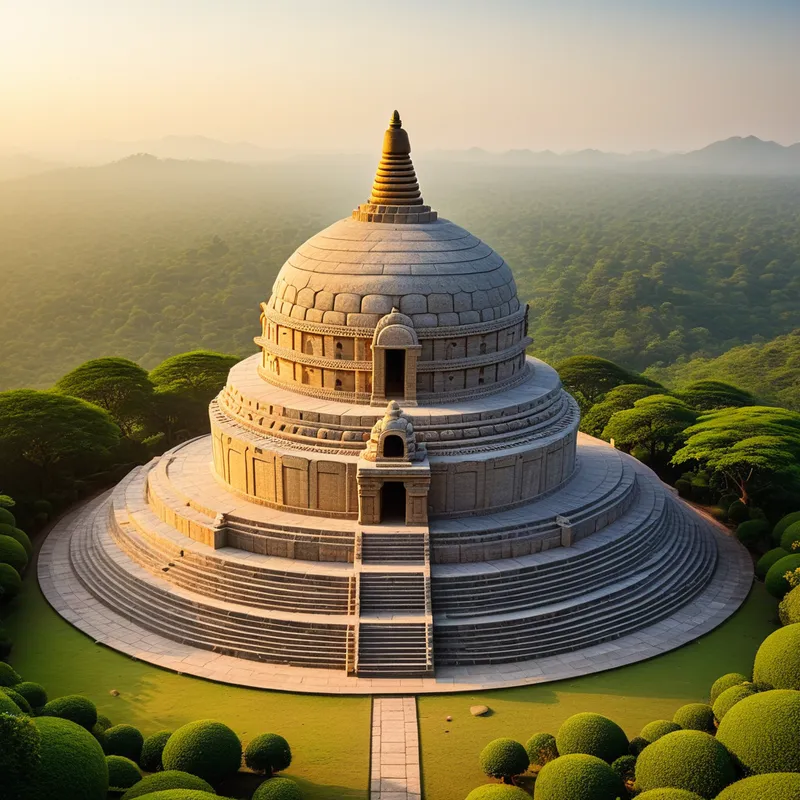
He commanded a monument. Not a palace, not a fortress, but a vessel for the ineffable. On the quiet hill of Sanchi, artisans began to shape the earth itself. They piled stone and packed clay, forming a perfect hemisphere, solid, vast, and immovable as the full moon resting upon the world. This was the Anda, the egg of the cosmos. Upon its summit, they set a square railing, the Harmika, and from its center, a stone shaft rose, piercing the heavens, crowned by a triple-tiered parasol, the Chatravali.
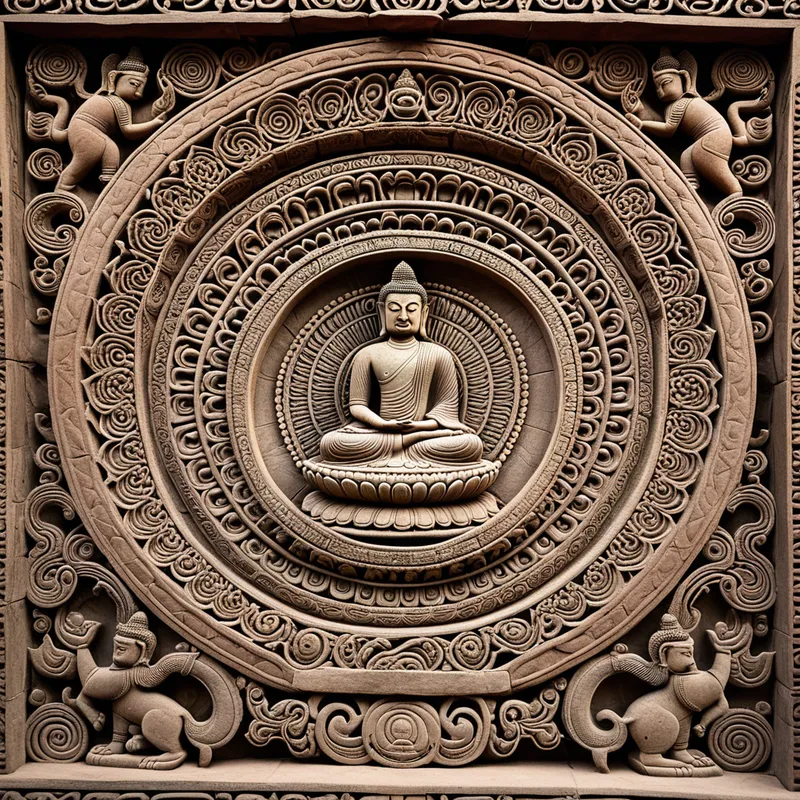
But the story was not in the form alone. It was in the gates. Four massive Toranas arose, facing the four quarters of the world. And upon these gates, the stone came alive. Here was not the image of the Master, for he was beyond form. Instead, the carvers told his story through the world he left behind: a lotus bloomed where he was born, a horse with empty saddle marked his great departure, a tree with a vacant seat whispered of his enlightenment, a wheel of law proclaimed his first teaching, and a silent, empty mound hinted at his final freedom.
Yakshas and Devas crowded the pillars, not as idols, but as witnesses. Elephants, lions, and mythical makaras bore the weight of the lintels, showing that all of nature upheld this truth. For decades, the work continued, a silent symphony of chisel and devotion. The monument was completed, yet it was never finished. For its purpose was not to be seen, but to be circumambulated. Pilgrims would come, their feet wearing a path in the earth, walking the Pradakshina Patha in a sunwise circle. With each step, the great silent form would reveal a new angle, a new carving, a new facet of the endless story. The stupa did not speak. It listened. And in its listening, it taught.
Cultural Origins & Context
The Great Stupa of Sanchi is not the product of a single mythic event, but the architectural crystallization of an entire philosophical and cosmological system. Its origins lie in the 3rd century BCE under Emperor Ashoka, who is said to have redistributed the relics of the Buddha across his empire, enshrining them in thousands of stupas. Sanchi became one of the most significant of these sites.
The “myth” of Sanchi is not a narrative of gods battling monsters, but a living, spatial story told through form and ritual. It was passed down not by bards, but by monks, artisans, and the pilgrims themselves. The societal function was multifaceted: it was a reliquary, making the Buddha’s presence geographically accessible; a cosmic diagram (mandala) instructing devotees on the structure of reality; and a communal focal point for the Sangha and laity. Its evolution over centuries—with additions from the later Satavahana period—shows it as a living text in stone, continuously annotated by generations who found in its silent geometry a perfect expression of the Dharma.
Symbolic Architecture
The stupa is a profound psycho-cosmogram. Every element is a deliberate symbol mapping the journey from ignorance to enlightenment.
The solid, earthen Anda (dome) represents the Samsaric world—apparently solid, heavy with attachment and form. Yet, within it are enshrined the relics, the indestructible essence of awakening, implying that enlightenment is not outside the world, but hidden within its very substance.
The path to the summit begins by honoring the base; enlightenment is not an escape from the world, but a profound penetration of its true nature.
The Harmika (square railing) signifies the world mountain, Mount Meru, the axis mundi. It is the stable, squared reality of the moral and mindful life. The Yasti (spire) ascending from it is the spiritual axis, the path of ascent. The concentric Chatras (parasols) mark the stages of that ascent, culminating in the pinnacle, the void beyond all form—Nirvana.
The four Toranas (gates) are the portals of perception, inviting entry from any direction of life. Their carvings—depicting the life of the Buddha only through symbols—teach the doctrine of Anatta. The Buddha is absent in form, present in essence. The pilgrim, by walking the circular path, internalizes this map. The outer circumambulation becomes an inner revolution, turning the wheel of the Dharma within one’s own consciousness.
The Dreamer’s Resonance
When the Great Stupa appears in a modern dream, it rarely arrives with fanfare. It manifests as a profound, silent structure in the psyche’s landscape. To dream of it is to encounter the Self’s own blueprint for integration.
One might dream of walking the Pradakshina Patha in a state of quiet urgency, feeling the weight of the dome beside them—a somatic representation of one’s own accumulated history, karma, and psychological complexes. The solidity feels both burdensome and protective. The dreamer may struggle to find the gate, or find it locked, reflecting a feeling of being outside one’s own center, unable to access inner peace. Alternatively, finding oneself atop the Harmika, looking out from a great height, signals a moment of achieved perspective, a temporary transcendence of worldly confusion.
The stupa in dreams often appears whole, luminous, and intact, even if the dreamer’s waking life feels fragmented. This is the psyche asserting the innate, archetypal pattern of wholeness (individuation) beneath the chaos. It is a call from the deep Self to begin the conscious, circular process of self-examination—to walk around one’s own nature, observing it from all sides without immediate judgment or entry.

Alchemical Translation
The myth of Sanchi models the alchemical Opus Magnum—the great work of psychic transmutation—for the modern individual. It outlines the stages of turning the lead of unconscious existence into the gold of conscious being.
First, the Nigredo: acknowledging the Anda, the dark, heavy mass of one’s personal and collective shadow, one’s inherited traumas and ingrained patterns. This is the base material. The alchemist must not reject it, but enshrine the divine spark (the relic) within it—the recognition that one’s potential for awakening is buried in one’s very wounds.
Next, the Albedo: the purification represented by the white-washed dome and the clear geometry of the Harmika. This is the stage of mindful discipline, of squaring one’s life with ethical conduct and clear introspection, creating a stable “vessel” for transformation.
The spiral path does not aim for escape, but for a return to the center with transformed vision.
Then, the Citrinitas: the dawning of inner light, symbolized by the ascending Yasti and the golden Chatras. Insights arise, perspectives shift. One begins to see the interconnected symbolism of one’s life (the carvings on the Toranas).
Finally, the Rubedo: the culmination at the pinnacle, beyond the triple parasol. This is not an acquisition, but a dissolution into the ultimate red—the warmth of complete integration. The separate self, having fully circumambulated its own nature, realizes its identity with the center that was never left. The pilgrim and the path, the seeker and the stupa, are one.
The modern individual’s journey is this same circumambulation. We are called to walk patiently around the mysteries of our own psyche, observing its stories and struggles from all angles (therapy, reflection, art, relationship), without always trying to “break in” and fix things prematurely. The myth teaches that wholeness is achieved not by a violent ascent, but by a devoted, repetitive, and respectful circling of the truth until it reveals itself, silent and complete, from within.
Associated Symbols
Explore related symbols from the CaleaDream lexicon: