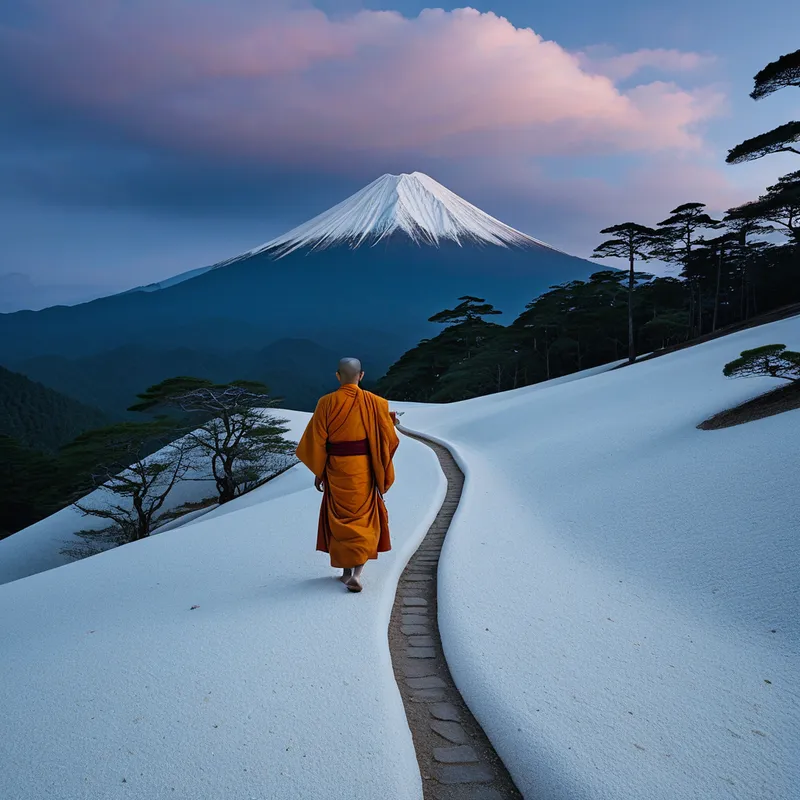
The Gravel Road to Mount Koya Myth Meaning & Symbolism
A monk walks a path of self-annihilation, crushing his own shadow into gravel to pave a sacred road to the mountain of awakening.
The Tale of The Gravel Road to Mount Koya
Listen, and let [the wind](/myths/the-wind “Myth from Various culture.”/) carry you back to a time when the mountains were not just stone and forest, but the very bones of [the world](/myths/the-world “Myth from Tarot culture.”/), and the path to wisdom was paved with [the self](/myths/the-self “Myth from Jungian culture.”/).
In the deep, green heart of Kii, where mist clings to ancient cedars like a ghostly shroud, there was a monk. He was not a great master, nor a famed scholar, but a man of simple, burning devotion. His name is lost to the pines, but his purpose echoes still. He dreamed of Kōya-san, the mountain realm founded by the great saint Kōbō Daishi. He dreamed of walking its hallowed ground, of breathing the air where enlightenment had taken root. But between him and the sacred peak lay an impenetrable wilderness—a tangled, shadowed forest where the path was not merely overgrown, but non-existent.
The monk stood at the forest’s edge, his begging bowl empty of all but resolve. He knew the journey was impossible by conventional means. The deities of the mountain, the kami of rock and root, would not permit a casual passage. The mountain demanded a toll not of coin, but of essence. And so, the monk made a vow that would shake the very substance of his being. He would not cut a path through the living forest. He would not ask the mountain to accommodate him. Instead, he would create the road from himself.
He knelt on the hard earth and began to pray, not for strength, but for dissolution. He called upon Fudō Myōō, whose fiery sword cuts through delusion. And as he prayed, a terrible, beautiful alchemy began. From [the shadow](/myths/the-shadow “Myth from Jungian culture.”/) he cast upon the ground—the shadow of his ego, his attachments, his fears and hidden angers—a dark, coarse gravel began to form. It was the literalized sediment of his own unconscious, the unrefined matter of his lesser self.
With each step forward, the monk had to consciously tread upon this emerging gravel of his own shadow. The act was excruciating, a somatic prayer of self-annihilation. The sharp stones bit into his bare feet. The path did not lead around his inner darkness; it was constructed from it. For every mile of wilderness, he had to generate a mile of his own crushed and transformed substance. The forest watched, silent and immense. Sometimes, the shadow-gravel would writhe, forming shapes of remembered temptations or whispered doubts, and he would have to steady his heart, recite a [sutra](/myths/sutra “Myth from Hindu culture.”/), and take another crushing step forward.
The journey took years. Seasons cycled over the monk’s bowed back. He became a moving sculpture of endurance, his robe fading to the color of dust and dusk, his body worn to its sinewy core. But the road grew behind him—a stark, winding ribbon of pure white gravel, glowing faintly with a moonlit luminescence. The crushing had become a purification; the shadow-stuff, through the relentless pressure of his devotion, was transmuted into a sacred material. Finally, as the last of his personal shadow was laid down and trodden upon, he emerged from the tree line. Before him lay the serene slopes of Mount Koya, its temples like [lotus](/myths/lotus “Myth from Hindu culture.”/) flowers upon the [water](/myths/water “Myth from Chinese culture.”/) of the morning mist. He had not found the road. He had become it.

Cultural Origins & Context
This myth, while not a canonical scripture, lives in the oral and folk traditions surrounding the Kumano Kodō and the cult of Kōbō Daishi. It is a setsuwa, a moral and instructional tale passed down by itinerant monks, storytellers, and pilgrims themselves. Its function was multifaceted: to explain the origin of the difficult pilgrimage paths, to underscore the severe asceticism of Shingon practice, and to provide a potent metaphor for [the pilgrim](/myths/the-pilgrim “Myth from Christian culture.”/)’s own inner journey.
In a culture where nature is deeply sacralized, the act of violently cutting a road would be a violation. The myth resolves this by making the road a product of self-sacrifice, not environmental conquest. It reflects the Buddhist ideal of <abbr title=""Self-power,” the practitioner’s own effort, as opposed to reliance on an external power like Amida Buddha”>jiriki, and the Shingon concept that enlightenment is found within the very stuff of our existence—our “body, speech, and mind”—when properly transformed. The gravel road is a permanent, physical testament to the idea that the path to the sacred is paved with the conscious, painful, and deliberate work of confronting and transmuting the self.
Symbolic Architecture
The myth’s power lies in its stark, almost brutal, symbolic [logic](/symbols/logic “Symbol: The principle of reasoning and rational thought, often representing order, structure, and intellectual clarity in dreams.”/). The [Gravel](/symbols/gravel “Symbol: Gravel in dreams can represent a rough path, ground that is unstable, or obstacles that need to be navigated carefully.”/) Road is the central [symbol](/symbols/symbol “Symbol: A symbol can represent an idea, concept, or belief, serving as a powerful tool for communication and understanding.”/)—it is not a pre-existing way, but the very record of a psychological process made manifest. It is the individuated [life](/symbols/life “Symbol: The symbol of ‘Life’ represents a journey of growth, interconnectedness, and existential meaning, encompassing both the joys and challenges that define human experience.”/) [path](/symbols/path “Symbol: The ‘path’ symbolizes a journey, choices, and the direction one’s life is taking, often representing individual growth and exploration.”/), created step-by-step through engagement with the unconscious.
The Monk’s [Shadow](/symbols/shadow “Symbol: The ‘shadow’ embodies the unconscious, repressed aspects of the self and often represents fears or hidden emotions.”/) is not a passive [absence](/symbols/absence “Symbol: The state of something missing, void, or not present. Often signifies loss, potential, or existential questioning.”/) of light, but an active, generative substance. It represents the totality of [the personal unconscious](/myths/the-personal-unconscious “Myth from Jungian Psychology culture.”/)—repressed desires, unresolved [trauma](/symbols/trauma “Symbol: A deeply distressing or disturbing experience that overwhelms the psyche, often manifesting in dreams as unresolved emotional wounds or psychological injury.”/), arrogance, and fear. In Jungian terms, it is the part of ourselves we refuse to acknowledge, which then dictates our lives autonomously.
The path to the mountain does not bypass the shadow; it is manufactured from its raw, unworked material. Enlightenment is not an escape from the self, but its total and willing reconstruction.
The act of Treading Upon the Gravel is the core psychodrama. It symbolizes the conscious [integration](/symbols/integration “Symbol: The process of unifying disparate parts of the self or experience into a cohesive whole, often representing psychological wholeness or resolution of internal conflict.”/) of the shadow. Each painful step is an acknowledgment: “This too is me.” The transformation from dark, writhing gravel to luminous white [stone](/symbols/stone “Symbol: In dreams, a stone often symbolizes strength, stability, and permanence, but it may also represent emotional burdens or obstacles that need to be acknowledged and processed.”/) signifies the [alchemical process](/symbols/alchemical-process “Symbol: A symbolic transformation of base materials into spiritual gold, representing inner purification, integration, and the journey toward wholeness.”/) where base lead (the ignored shadow) is turned into spiritual gold (integrated wisdom) through the [opus](/symbols/opus “Symbol: A spiritual or alchemical term for a great work of creation, often representing the culmination of a life’s purpose or a transformative process.”/) of conscious suffering and discipline.
Mount Koya itself symbolizes the Bodhicitta, the fully realized Self. It is not a place one simply visits, but a state of being one becomes by constructing the road that leads to it.

The Dreamer’s Resonance
When this myth stirs in the modern dreamer, it often manifests not as a literal monk, but as the core pattern: creating a necessary path through an obstacle by using the substance of the obstacle itself.
You may dream of trying to reach an important meeting or a loved one, but the streets are chaotic or collapsed. In the dream, you realize you must build the bridge or road yourself from the debris around you—broken concrete that represents your failed projects, or twisted metal that symbolizes your own rigid defenses. The somatic feeling is one of immense, weary effort, coupled with a profound, quiet certainty. The dream ego is engaged in what psychologist James Hillman called “soul-making”—the often painful, meticulous work of giving form to your own destiny from the very materials of your wounds and limitations.
Such a dream signals a critical phase of shadow-work. The [psyche](/myths/psyche “Myth from Greek culture.”/) is indicating that [the way](/myths/the-way “Myth from Taoist culture.”/) forward is blocked because you have not yet claimed and utilized the energy locked in your own rejected parts. The path will only appear as you consent to walk on, and thereby transform, the uncomfortable truths about yourself.

Alchemical Translation
The myth of the Gravel Road is a perfect map for the Jungian process of individuation—the journey toward psychological wholeness. For the modern individual, the “wilderness” is the complex, uncharted territory of one’s own life purpose and inner conflict. We wait for a path to appear, for a guide, for a map. The myth’s alchemical instruction is devastatingly clear: You are the mapmaker, and the ink is your shadow.
[The first stage](/myths/the-first-stage “Myth from Alchemical culture.”/), [nigredo](/myths/nigredo “Myth from Alchemical culture.”/) (the blackening), is the monk’s confrontation with the impossible forest and the emergence of the dark shadow-gravel. It is the depression, confusion, or crisis that forces a reckoning with what has been ignored.
The second stage, albedo (the whitening), is the long, arduous walk. This is the conscious, daily work of therapy, reflection, journaling, or spiritual practice—the repetitive, often painful act of facing one’s patterns, treading on one’s pride, and grinding down defenses.
The gravel turns white not by being washed clean from the outside, but by the internal pressure and friction of the walk itself. The Self is forged in the crucible of the journey.
The final stage, [rubedo](/myths/rubedo “Myth from Alchemical culture.”/) (the reddening), is the arrival at Mount Koya—not as a tourist, but as its architect. This is the realization of the integrated Self. The pilgrim and the path, the seeker and the sanctuary, are understood to have never been separate. The struggle was the substance of the arrival. The modern individual completes this alchemy when they can look back on their life’s difficulties and see not a series of random misfortunes blocking their way, but the very gravel—now polished and luminous—that forms the unique and sacred road only they could have built, leading to the mountain that was, all along, their own true nature.
Associated Symbols
Explore related symbols from the CaleaDream lexicon: