The Grail Table Myth Meaning & Symbolism
The myth of the Grail Table, a sacred artifact of unity and divine presence, whose loss mirrors the fragmentation of the self and the kingdom.
The Tale of The Grail Table
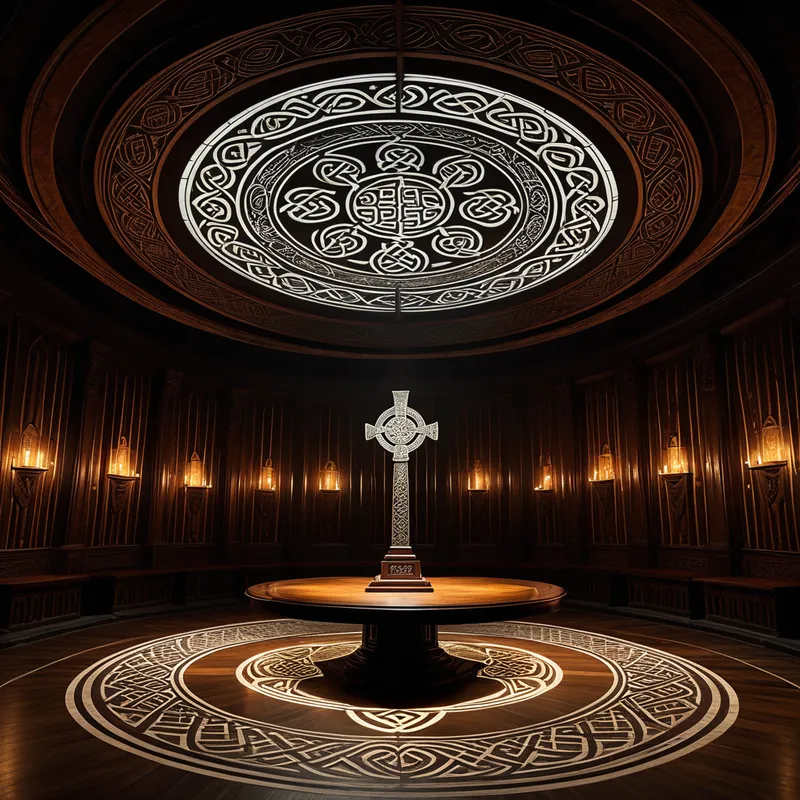
Listen, and hear the tale not of the quest, but of the hearth from which all quests are born. Before the Sword in the Stone, before the Round Table’s fellowship, there stood in the heart of Camelot a hall of silence and awe. It was not a hall for feasting or council, but for presence. At its center rested the Grail Table.
Forged not by mortal smith, but shaped from the living heartwood of an ancient, sacred oak—one that had witnessed the dawn of Britain—its surface was a sea of dark, polished grain, swirling like memory itself. Into this wood were set veins of silver, tracing the paths of the stars as they wheeled on the night Arthur was conceived. The table was round, yet not empty. At its precise center, a shallow depression, a cup-shaped hollow, awaited that which it was made to hold.
It was said that on the night of Camelot’s founding, when the stars aligned in the sign of the Dragon, a light descended. Not a beam, but a gentle emanation, like the first breath of dawn. And within that light, the Holy Grail itself manifested, settling into the waiting hollow of the Table. A hum, deeper than sound, filled the hall. The silver inlay glowed with a cool fire. The Table was no longer wood and metal; it was a living conduit, a still point where the divine touched the earthly realm.
Twelve chairs of carved yew stood around it, not for knights of war, but for guardians of this mystery. They were the Keepers of the Table, chosen not for bloodline or battle-prowess, but for the quality of their souls—their capacity for awe, for silence, for bearing witness to the unbearable light of grace. Their duty was not to speak, but to sit in vigil, to let the harmony emanating from the Grail and Table resonate through their beings and, by extension, through the very stones of Camelot. So long as the vigil was kept, the kingdom was whole. Justice flowed like water, courage was tempered with compassion, and the land itself bore fruit without fail.
But the human heart is a fragile vessel for eternity. A whisper began, born of pride and forgetfulness. “Why do we merely sit?” asked one Keeper. “Should we not use this power? Should we not take the Grail and wield its light as a sword against our enemies?” The sacred charge was slowly corrupted into a fantasy of possession. One by one, the Keepers abandoned their silent vigil, drawn away by the clamor of the outer world—by politics, by ambition, by the growing fame of the Round Table.
On the night the last Keeper rose from his seat, turning his back to the soft, persistent light, the connection severed. The hum ceased. The silver inlay turned dull. And the Holy Grail, with a sigh that was felt rather than heard, vanished from its place. The hollow at the center of the Table was empty, a wound in the wood. The great oak from which it was carved, miles away in a hidden grove, split asunder with a crack that echoed like thunder in a clear sky.
Camelot did not fall that day. It began a long, slow fading. The harmony was broken. The center did not hold. The knights would later ride out on their desperate, fractured quests for the lost Grail, never knowing they were searching for that which had once resided in the very heart of their home, sustained by a quietness they had collectively forsaken.
Cultural Origins & Context
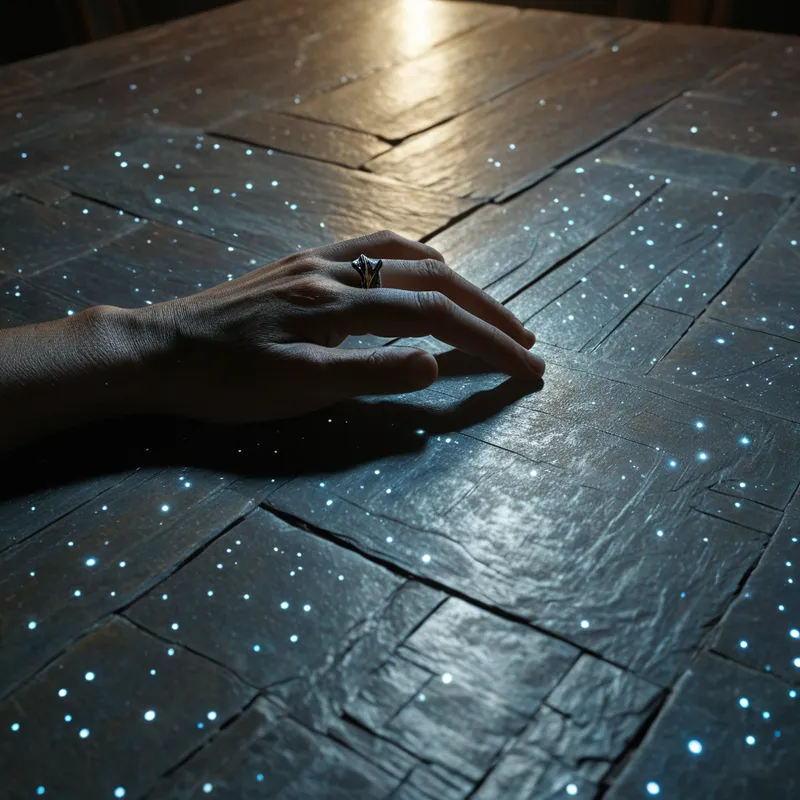
The myth of the Grail Table exists in the shadow of the more famous Grail Quest narratives, such as those by Chrétien de Troyes and the Vulgate Cycle. It is less a single, codified story and more a thematic undercurrent, a piece of deep Brittonic lore absorbed into the Arthurian tapestry. Scholars point to its resonance with Celtic concepts of sacred kingship, where the health of the sovereign and the fertility of the land are intrinsically linked to a divine covenant or talisman.
This myth was likely not told in grand epics, but in fragments—by bards as a prelude to the greater quest, by monks in mystical treatises linking it to the Table of the Last Supper, or whispered as a cautionary tale within the tradition itself. Its societal function was profound: it established the spiritual precondition for the Arthurian golden age and provided the foundational tragedy that explained its eventual ruin. It speaks to a culture deeply aware that societal order and justice (Cyfraith) are not human inventions, but gifts sustained by sacred attention and ritual integrity. The loss of the Grail Table is the mythic moment where sacred duty is abandoned for worldly enterprise, setting the stage for all the later chivalric striving, which is, in this light, a frantic attempt to recover a lost state of grace.
Symbolic Architecture
The Grail Table is the archetype of the temenos—the sacred, protected precinct at the center of the world, or the self. It is not the dynamic, questing spirit (that is the Grail itself), but the container that makes the sacred manifest and sustainable. The Round Table is for human fellowship and governance; the Grail Table is for divine communion.
The Table represents the psyche in a state of integrated wholeness, where the transcendent function (the Grail) is not sought externally, but hosted internally.
The twelve Keepers symbolize the complete constellation of psychic faculties—not just the conscious ego, but all aspects of the self, aligned in service to the central mystery. Their abandonment is the fragmentation of the psyche, where complexes (the political ambitions, the personal pride) break away from the unifying center. The hollow left in the Table is the modern sense of existential lack, the “God-shaped hole” or the core wound that drives endless, often misguided, seeking. The myth tells us that the sacred is not lost in some distant castle, but recedes when the inner altar is deserted.
The Dreamer’s Resonance
When this myth stirs in the modern unconscious, it rarely appears as a medieval tableau. The dreamer may find themselves in a familiar room—a conference room, a dining room—where a central object (a vase, a lamp, a simple bowl) holds an inexplicable, captivating importance. The dreamer feels a solemn duty to simply be with it, to guard it. Anxiety enters when other dream figures (colleagues, family members) demand they leave their post for urgent, mundane tasks. To abandon the object causes it to vanish, leaving the dreamer with a profound, inarticulate grief.
Somatically, this dream pattern correlates with a crisis of attention and center. The psyche is signaling that a vital, integrative process—perhaps related to healing, creativity, or a spiritual insight—is being neglected for the pressures of the “outer kingdom” (work, social obligations, daily drama). The dream is a call to re-establish the inner vigil, to protect the fragile, nascent wholeness from the fragmenting forces of the persona and the demands of collective life.

Alchemical Translation
The alchemical process mirrored here is not the fiery solve (dissolution) of the quest, but the crucial, prior stage of coagulatio—the creation of the sacred vessel, the vas hermeticum. Individuation is not merely a heroic journey outward; it first requires building the inner Grail Table—a stable, receptive consciousness capable of containing the transformative, often overwhelming, experience of the Self (symbolized by the Grail).
The myth’s tragedy is the attempt to possess the transformative substance (the Grail’s power) without having first perfected the vessel (the steadfast Table and its Keepers).
The modern individual’s “alchemical translation” begins with the recognition of their own fragmented inner council. Which parts of the self have abandoned the center? The ambitious achiever? The needy child? The cynical critic? The work is to recall these exiled “Keepers” not to battle, but to silent vigil. It is to cultivate the discipline of inward attention, creating an inner space—through meditation, reflection, or creative practice—holy enough to host moments of grace and insight. The Grail may come and go, as transcendent experiences do, but the Table remains. To rebuild it within is to restore the lost center of Camelot in the soul, making the individual a vessel not for personal glory, but for the harmony that flows, inevitably, from a restored connection to the deep, abiding source.
Associated Symbols
Explore related symbols from the CaleaDream lexicon: