The Golden Touch of Midas Myth Meaning & Symbolism
A king's wish to turn all he touches to gold becomes a curse, teaching a timeless lesson about the true nature of wealth and the cost of unchecked desire.
The Tale of The Golden Touch of Midas
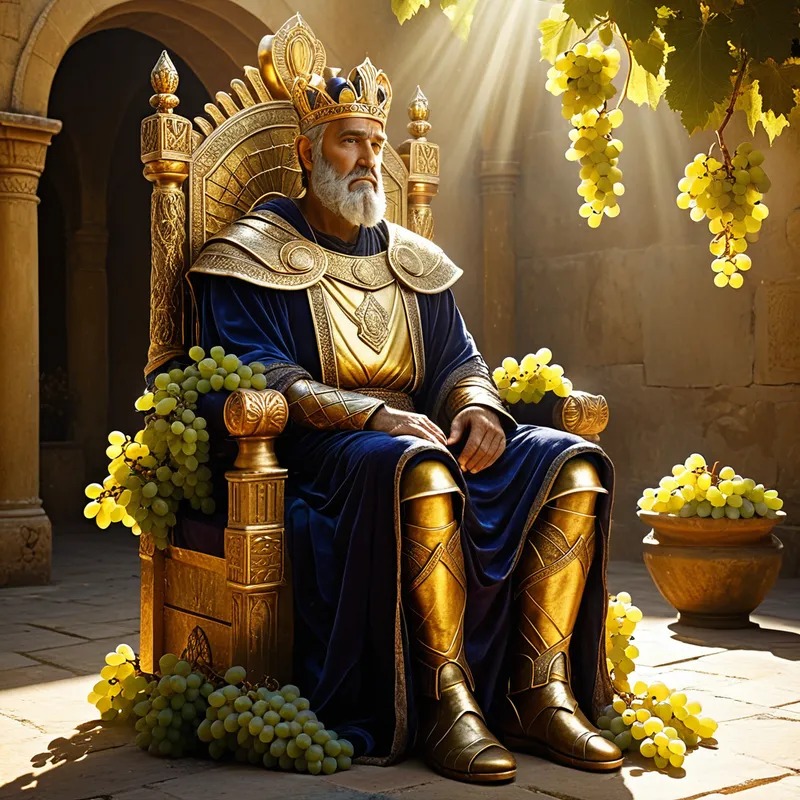
Listen, and hear a tale spun from sunlight and sorrow. In the ancient, rugged land of Phrygia, there ruled a king named [Midas](/myths/midas “Myth from Global/Universal culture.”/). His coffers groaned with treasure, his halls echoed with feasts, yet a hollow wind whistled through the chambers of his heart. He was a man who measured [the world](/myths/the-world “Myth from Tarot culture.”/) by its weight in gold, believing that to possess more was to be more.
One day, fate, in the form of a drunken old satyr named [Silenus](/myths/silenus “Myth from Greek culture.”/), stumbled into Midas’s royal gardens. The king, recognizing the creature as a companion of the great god Dionysus, treated him with lavish hospitality for ten days and nights. When Dionysus came to reclaim his beloved teacher, his joy was boundless. “Ask of me any boon, [King Midas](/myths/king-midas “Myth from Greek culture.”/),” the god declared, his voice rich with the promise of vineyards. “Name your heart’s desire, and it shall be granted.”
Midas did not pause. He did not look to the laughter of his daughter in the courtyard, or the warmth of the sun on his skin. His mind was a vault, and within it, only one thought echoed. “Grant that everything I touch,” he said, his voice trembling with avarice, “be turned to gold.”
Dionysus, his smile fading into a look of profound pity, assented. “So be it.”
The king’s [triumph](/myths/triumph “Myth from Roman culture.”/) was immediate, and deafening. He reached for a stone—it chimed like a bell, cold and yellow. An oak branch became a rigid, gleaming sceptre. He ran to his palace, giddy, touching column and couch, platter and pedestal. All transformed at his fingertips into perfect, immutable, lifeless gold. His servants gaped in terror and awe. Midas laughed, the sound ringing in his golden hall. He was the master of alchemy, a god of wealth!
But then, the pangs of hunger stirred. He called for a feast. He reached for a loaf of bread—it hardened into a metallic lump. He raised a cup of wine to his lips—the liquid thickened into a sluggish stream of gold, sealing his throat. Panic, cold and sharp, pierced his euphoria. It was then his daughter, hearing his cries of distress, rushed into the hall. Without thinking, he pushed her away—and watched in mute horror as the warmth fled her cheeks, her tears solidified on her face, and she stood before him, a beautiful, silent, golden statue.
The laughter was gone. The gold was everywhere, a glittering tomb. The touch he had coveted had become a curse of absolute isolation. The king who could create wealth from nothing was now the poorest man alive, starving in a desert of his own making, his love frozen forever in a precious metal.
Cultural Origins & Context
The myth of Midas is a cornerstone of Greek mythology, primarily preserved through the works of the Roman poet Ovid in his [Metamorphoses](/myths/metamorphoses “Myth from Greek culture.”/), and referenced earlier by historians like Herodotus. While set in Phrygia, a real Anatolian kingdom, the tale functions as a universal parable, told and retold as a cautionary fable. It was not a religious text but a narrative tool, performed by bards and written by poets to explore profound human follies. Its societal function was multifaceted: a warning to the powerful about the limits of wealth and the dangers of hubris, a lesson in moderation for the burgeoning merchant classes, and a philosophical exploration of value. It asks the audience, then as now, to define what constitutes true “wealth”—is it possession, or is it connection, sustenance, and life itself?
Symbolic Architecture
At its core, the myth is a masterclass in symbolic [paradox](/symbols/paradox “Symbol: A contradictory yet true concept that challenges logic and perception, often representing unresolved tensions or profound truths.”/). The golden touch represents the ultimate fantasy of [the ego](/myths/the-ego “Myth from Jungian culture.”/)‘s desire for control and permanence. Gold is stable, incorruptible, and universally valued—it is the ego’s attempt to freeze the fluid, messy, and perishable processes of [life](/symbols/life “Symbol: The symbol of ‘Life’ represents a journey of growth, interconnectedness, and existential meaning, encompassing both the joys and challenges that define human experience.”/) into a single, admired form.
The wish for the Golden Touch is the psyche’s tragic confusion: it mistakes the symbol of value for the source of value itself.
Midas is the [archetype](/symbols/archetype “Symbol: A universal, primordial pattern or prototype in the collective unconscious that shapes human experience, behavior, and creative expression.”/) of the uninitiated ruler, one who governs the external world but is a slave to his own inner [poverty](/symbols/poverty “Symbol: A state of lacking material resources or essential needs, often symbolizing feelings of inadequacy, vulnerability, or spiritual emptiness in dreams.”/). His “touch” is his mode of engagement with the world—a mode that seeks only to convert, to own, to transform the Other into a [reflection](/symbols/reflection “Symbol: Reflection signifies self-examination, awareness, and the search for truth within oneself.”/) of his own desire. The tragedy unfolds because this mode is indiscriminate. It cannot differentiate between a [stone](/symbols/stone “Symbol: In dreams, a stone often symbolizes strength, stability, and permanence, but it may also represent emotional burdens or obstacles that need to be acknowledged and processed.”/) and a [daughter](/symbols/daughter “Symbol: In dreams, a daughter symbolizes innocence, potential, and the nurturing aspects of oneself or one’s relationships.”/), between [food](/symbols/food “Symbol: Food in dreams often symbolizes nourishment, both physical and emotional, representing the fulfillment of basic needs as well as deeper desires for connection or growth.”/) and [furniture](/symbols/furniture “Symbol: Furniture in dreams often symbolizes comfort and the state of one’s identity and personal space.”/). This is the [shadow](/symbols/shadow “Symbol: The ‘shadow’ embodies the unconscious, repressed aspects of the self and often represents fears or hidden emotions.”/) of the individuation drive when it is commandeered by the ego: a forced, sterile uniformity that kills [relationship](/symbols/relationship “Symbol: A representation of connections we have with others in our lives, often reflecting our emotional state.”/) and process.
The daughter symbolizes all that is vulnerable, alive, and relational—the [soul](/symbols/soul “Symbol: The soul represents the essence of a person, encompassing their spirit, identity, and connection to the universe.”/)‘s [connection](/symbols/connection “Symbol: Connection symbolizes relationships, communication, and bonds among individuals.”/) to the soft, animate world. Her transformation into a [statue](/symbols/statue “Symbol: A statue typically represents permanence, ideals, or entities that are revered.”/) is the ultimate psychic cost: the [petrification](/symbols/petrification “Symbol: A state of being turned to stone, representing paralysis, permanence, or transformation in the face of overwhelming fear, trauma, or awe.”/) of eros, of love and spontaneous feeling, in service of the ego’s glittering ideal. The [resolution](/symbols/resolution “Symbol: In arts and music, resolution refers to the movement from dissonance to consonance, creating a sense of completion, release, or finality in a composition.”/), where Midas begs for release and washes away his [curse](/symbols/curse “Symbol: A supernatural invocation of harm or misfortune, often representing deep-seated fears, guilt, or perceived external malevolence.”/) in the [river](/symbols/river “Symbol: A river often symbolizes the flow of emotions, the passage of time, and life’s journey, reflecting transitions and movement in one’s life.”/) Pactolus, signifies the necessary [dissolution](/symbols/dissolution “Symbol: The process of breaking down, dispersing, or losing form, often representing transformation, release, or the end of a state of being.”/) of the ego’s rigid fantasy. True transformation (the “[alchemy](/symbols/alchemy “Symbol: A transformative process of purification and creation, often symbolizing personal or spiritual evolution through difficult stages.”/)”) begins not with a wish for gold, but with a plea for [water](/symbols/water “Symbol: Water symbolizes the subconscious mind, emotions, and the flow of life, representing both cleansing and creation.”/)—the element of flow, [emotion](/symbols/emotion “Symbol: Emotion symbolizes our inner feelings and responses to experiences, often guiding our actions and choices.”/), and life.

The Dreamer’s Resonance
When this myth stirs in the modern dreamscape, it often signals a critical juncture in the dreamer’s relationship to their own “[Midas touch](/myths/midas-touch “Myth from Greek culture.”/)“—their driving ambition or defining skill that risks becoming a curse. To dream of turning objects to gold may reflect a somatic experience of emotional hardening, a sense that one’s professional or personal endeavors are yielding cold, impressive results at the expense of warmth and nourishment.
Dreaming of touching a loved one and seeing them stiffen or turn cold is a profound alarm from the unconscious. It indicates that the dreamer’s mode of engagement—perhaps their workaholism, critical nature, or need for control—is damaging vital relationships, turning living connections into static, “perfect” arrangements that lack breath. The dream may present a golden meal, beautiful but inedible, pointing to a deep hunger that cannot be satisfied by external achievements or material gain. The [psyche](/myths/psyche “Myth from Greek culture.”/) is dramatizing the isolation that comes when our primary touch upon the world is one of conversion rather than communion.

Alchemical Translation
The path of Midas is a stark roadmap for a necessary psychic failure, a [nigredo](/myths/nigredo “Myth from Alchemical culture.”/) that precedes any genuine transformation. The initial “boon” from Dionysus is crucial—it represents a genuine encounter with the divine, with the irrational, creative, and transformative power of the unconscious (Dionysus). But the ego, represented by Midas, immediately misinterprets this energy. It tries to harness the god’s power for its own narrow, material ends.
The alchemical work begins not with the wish granted, but with the despair that follows. The curse is the first true gift.
The golden statue of the daughter is the central symbol of this arrested development. In alchemical terms, it is the [prima materia](/myths/prima-materia “Myth from Alchemical culture.”/) frozen in its most base, metallic state. For modern individuation, this represents a life structure, a relationship, or a talent that has been idealized and “set in gold”—perfect in appearance but utterly devoid of life-giving spirit. The work is to weep for this loss, to feel the full horror of the isolation, and then to seek the cleansing waters.
[The river](/myths/the-river “Myth from Buddhist culture.”/) Pactolus represents the therapeutic, dissolving power of humility, tears, and surrender. It is the conscious admission that one’s prized mode of operation is a curse. Washing in it is the act of letting go of the ego’s grandiose project. The myth tells us that after this dissolution, Midas lived out his days in the woods, a devotee of Pan. This is the alchemical albedo—a return to a simpler, more instinctual, and relational existence. He trades the sterile gold of the palace for the living green of the forest. The transmutation is complete: the ruler who sought to convert the world to his substance learns instead to participate in the world’s own, living substance. The gold he once craved now flows harmlessly in the riverbed, a reminder that true value is not held, but shared.
Associated Symbols
Explore related symbols from the CaleaDream lexicon: