The Golden Island Swarnadvipa Myth Meaning & Symbolism
A myth of a radiant, hidden island of gold, representing the ultimate spiritual treasure and the perilous inner journey required to find it.
The Tale of The Golden Island Swarnadvipa
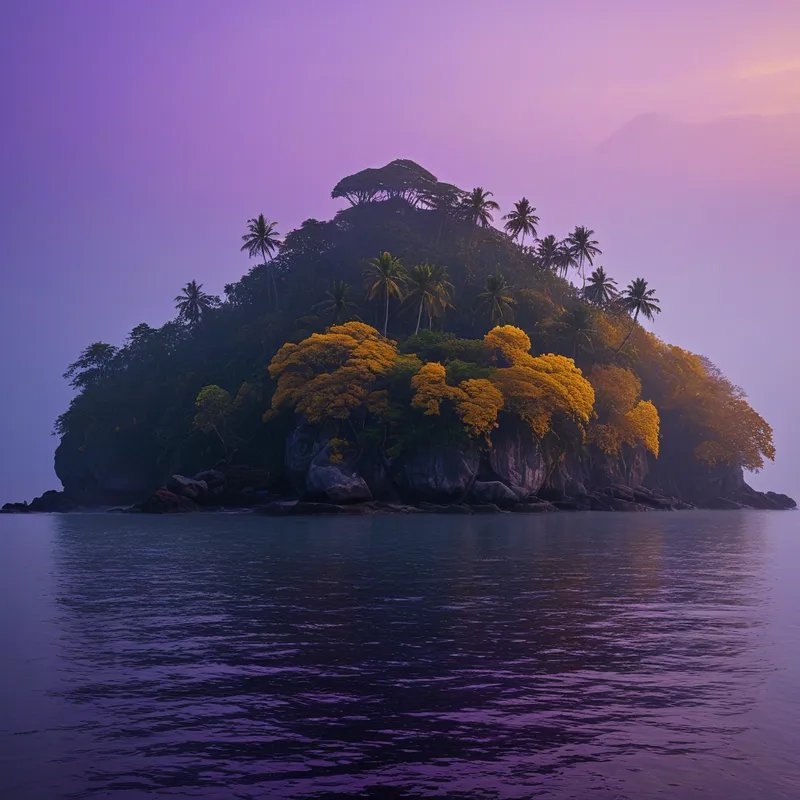
Listen. Beyond the last known wave, past the charts drawn by the bravest captains, there lies a breath held by the ocean. It is a place whispered of by the salt-wind and denied by the sun-bleached maps. They call it Swarnadvipa.
In the age when gods walked closer to the world, the island was not hidden. It was the jewel of the sea, a land where the very soil was powdered sunlight, where rivers ran not with water but with liquid amber, and the trees bore leaves of beaten gold that chimed like bells in the celestial breeze. It was the treasure-house of Dewa and the resting place of Widyadari. But mortal greed is a fire that even gold cannot withstand. Men came with ships of iron will, their eyes reflecting not wonder, but calculation. They sought not to behold, but to possess; not to honor, but to harvest.
And so, the island wept. The guardian spirits of the land and sea, the unseen Hyang, drew a veil of mist and mystery around their sacred home. The seas around it grew treacherous, swirling with sudden tempests conjured from calm. Navigational stars would wink out above its waters. The island did not vanish; it receded. It folded itself into the seam between the visible world and the realm of pure potential. It became a destination not for the body, but for the soul—a prize not for the hand, but for the spirit.
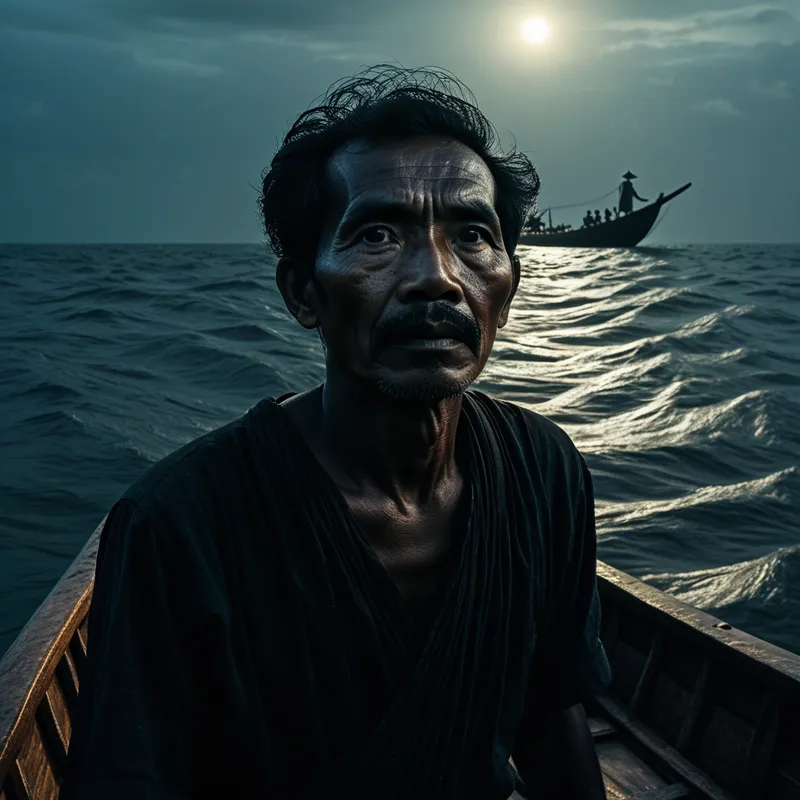
Yet, the call never ceased. In every generation, a few hear it: a haunting melody on the wind, a golden glint in a dream, a profound longing that pulls their gaze ever westward. These are the seekers. They build their perahu not just from timber and palm fiber, but from purified intention. They sail not by the North Star alone, but by an inner compass calibrated to humility. The journey is the first test. The ocean mirrors the mind: its storms are their doubts, its doldrums their despair, its siren songs their temptations.
To find Swarnadvipa, the legends say, one must first be lost to the world. Only when the seeker releases the very desire to find it, when they navigate by faith in the unseen rather than sight of the shore, does the mist part. Not as a reward, but as a revelation. The Golden Island appears not on the horizon, but within the heart. The seeker steps onto sands of gold and understands—the treasure was never the metal. It is the unshakable peace, the direct knowing of the divine woven into creation, the realization that the true Self is the golden land they sought across impossible seas. And in that moment of arrival, they also understand the final secret: they cannot stay, and they cannot take. They must return, carrying not gold, but the indelible light of the island within them, to guide others in the dark.
Cultural Origins & Context
The myth of Swarnadvipa is deeply woven into the archipelagic soul of Indonesia, particularly within the Hindu-Buddhist cultural strata of early kingdoms like Srivijaya and Majapahit. The name itself is Sanskrit: Swarna meaning “gold” and Dwipa meaning “island.” This points to its origins not as mere folklore, but as a sophisticated theological and cosmological concept imported and adapted from Indian traditions, which then took root in the local genius of Nusantara.
It functioned on multiple levels. Historically, it may have reflected vague knowledge of gold-rich lands within the archipelago, like Sumatra, fueling trade and exploration. Esoterically, within Buddhist and Hindu tantric traditions practiced in ancient Java and Sumatra, Swarnadvipa was often identified as a pure land, a Buddhakṣetra, or a mystical center of spiritual power (shakti pitha). It was passed down through dalang (shadow puppet masters) in the wayang tradition, through court poets (pujangga), and in the cryptic teachings of spiritual masters.
Its societal function was profound. For a culture defined by the sea, it mythologized the ultimate maritime quest. It taught that the greatest treasures are not material but spiritual, and that they are protected by cosmic law from the unworthy. It served as a narrative container for values of humility, perseverance, and the purification of desire—a necessary counterbalance to the very real and potent mercantile drives of these thalassocratic empires.
Symbolic Architecture
Swarnadvipa is the ultimate [symbol](/symbols/symbol “Symbol: A symbol can represent an idea, concept, or belief, serving as a powerful tool for communication and understanding.”/) of the Self, the central, golden core of the psyche that exists in a state of primordial completeness and value.
The Island is not found; it is recognized. It is the lost homeland of the soul, remembered only as a haunting beauty in dreams and an inconsolable longing in waking life.
The [Ocean](/symbols/ocean “Symbol: The ocean symbolizes the vastness of the unconscious mind, representing deeper emotions, intuition, and the mysteries of life.”/) represents the vast, unknown unconscious. The [Journey](/symbols/journey “Symbol: A journey in dreams typically signifies adventure, growth, or a significant life transition.”/) across it is the process of individuation—the perilous [navigation](/symbols/navigation “Symbol: The act of finding one’s way or directing a course, symbolizing life direction, decision-making, and the journey toward goals.”/) through the contents of one’s own psyche (storms of [emotion](/symbols/emotion “Symbol: Emotion symbolizes our inner feelings and responses to experiences, often guiding our actions and choices.”/), doldrums of depression, monsters of complex and [trauma](/symbols/trauma “Symbol: A deeply distressing or disturbing experience that overwhelms the psyche, often manifesting in dreams as unresolved emotional wounds or psychological injury.”/)). The Golden substance of the [island](/symbols/island “Symbol: An island represents isolation, self-reflection, and the need for separation from the external world.”/) symbolizes the incorruptible, eternal value of the authentic Self, once the dross of the ego’s ambitions and fears has been alchemically burned away. The island’s hidden [nature](/symbols/nature “Symbol: Nature symbolizes growth, connectivity, and the primal forces of existence.”/) speaks to the Self’s inaccessibility to the conscious, grasping ego. It only reveals itself when the ego surrenders its agenda.
The [seeker](/symbols/seeker “Symbol: A person actively searching for meaning, truth, or a higher purpose, often representing the dreamer’s own quest for identity or fulfillment.”/) who succeeds is not the strongest, but the one who has undergone the most complete [Death](/symbols/death “Symbol: Symbolizes transformation, endings, and new beginnings; often associated with fear of the unknown.”/) of the old, worldly [identity](/symbols/identity “Symbol: Identity represents the sense of self, encompassing personal beliefs, cultural background, and social roles.”/). The final requirement—to leave the island and return—is crucial. It signifies that the goal of individuation is not permanent escape into unconscious [bliss](/symbols/bliss “Symbol: A state of profound happiness and spiritual contentment, often representing fulfillment of desires or alignment with one’s true self.”/) (a spiritual bypass), but the return of the integrated Self to engage with the world, now acting as a conscious [vessel](/symbols/vessel “Symbol: A container or structure that holds, transports, or protects something essential, representing the self, emotions, or life journey.”/) of that golden light.
The Dreamer’s Resonance
When Swarnadvipa appears in the modern dreamscape, it rarely manifests as a literal golden island. Its presence is more subtle, more resonant. A dreamer may find themselves on a Boat on a perfectly still, endless sea, filled with a sense of immense, quiet anticipation. They may discover a Door in their home that opens not to another room, but to a breathtaking, sun-drenched coastline of impossible beauty, which vanishes when they try to show others. They may be diving in deep water and see a Light emanating from a submerged, city-like structure.
Somatically, these dreams are often accompanied by a feeling of profound peace, awe, or heartbreaking longing upon waking. Psychologically, they signal that the deep unconscious is activating the archetype of the Self. The dreamer is being presented with an image of their own wholeness and potential. The process at work is one of numinous invitation. The golden image acts as a psychopomp, guiding the dreamer’s attention away from the superficial conflicts of the ego and toward the deeper, healing center. The frustration of not being able to “stay” or “grasp” the image in the dream mirrors the ego’s inability to possess the Self. The dream is teaching the dreamer to relate to this inner treasure through reverence and connection, not ownership.

Alchemical Translation
The myth of Swarnadvipa is a perfect map for the alchemical Opus, the great work of psychic transmutation. The initial longing for the island is the nigredo—the darkening, the sense of lack and yearning that initiates the journey. The building of the perahu and the act of sailing is the albedo—the purification, the hard, conscious work of preparing the vessel of the personality (ego) to be a fit instrument for the journey.
The tempests and trials at sea are the necessary separatio and mortificatio—the breaking down of the old, rigid structures of the personality so that a new, more fluid consciousness can emerge.
The moment the island appears, when the seeker is truly “lost,” is the solutio—the dissolution of ego-boundaries in a transcendent experience. Setting foot on the golden shore is the coniunctio, the sacred marriage of the conscious mind with the unconscious Self, resulting in the creation of the “gold.” This is the rubedo or citrinitas, the reddening or yellowing, the illumination.
But the final, crucial step is the return. This is the multiplicatio and proiectio. The alchemical gold, now embodied as the integrated personality, must be “multiplied” by being brought back into the world and “projected” onto life’s base metals—transforming ordinary existence through its touch. The seeker becomes a philosopher’s stone, not by staying on the island, but by carrying its essence within. The myth thus models a complete cycle of individuation: descent, ordeal, illumination, and return—the hero’s journey internalized as the soul’s journey home to itself.
Associated Symbols
Explore related symbols from the CaleaDream lexicon:
- Island — The isolated, whole Self, a contained paradise of psychic completeness emerging from the sea of the unconscious.
- Gold — The incorruptible value of the authentic Self, the ultimate spiritual treasure that is refined through the fires of experience.
- Ocean — The vast, unknown, and potentially treacherous realm of the personal and collective unconscious that must be traversed.
- Journey — The core process of individuation, the lifelong pilgrimage toward self-discovery and integration.
- Boat — The vessel of the conscious ego or the prepared personality, which must be sturdy yet adaptable to navigate the inner seas.
- Light — The illuminating revelation of the Self, the divine awareness that guides the seeker and emanates from the island itself.
- Death — The necessary symbolic death of the old, grasping ego-identity, a prerequisite for being reborn at the shores of the golden Self.
- Door — The threshold between ordinary consciousness and the numinous realm of the Self, which opens only under specific, non-egoic conditions.
- Sun — The cosmic, life-giving force that the golden island reflects; the central, guiding consciousness of the psyche.
- Heart — The inner seat of true longing and knowing, the true compass that guides the seeker when all external maps fail.
- Dream — The primary medium through which the call of Swarnadvipa is heard in the modern age, a direct message from the unconscious Self.
- Rebirth — The ultimate outcome of the successful journey; the emergence of a new, integrated identity forged in the golden light of the Self.