The Golden Age Myth Meaning & Symbolism
A lost era of primordial peace under Cronus, where humans lived like gods, ended by a divine succession that created our world of toil and strife.
The Tale of The Golden Age
Listen. Before the ache in your bones, before the sweat on your brow, before the word “strife” was even whispered, there was a different world.
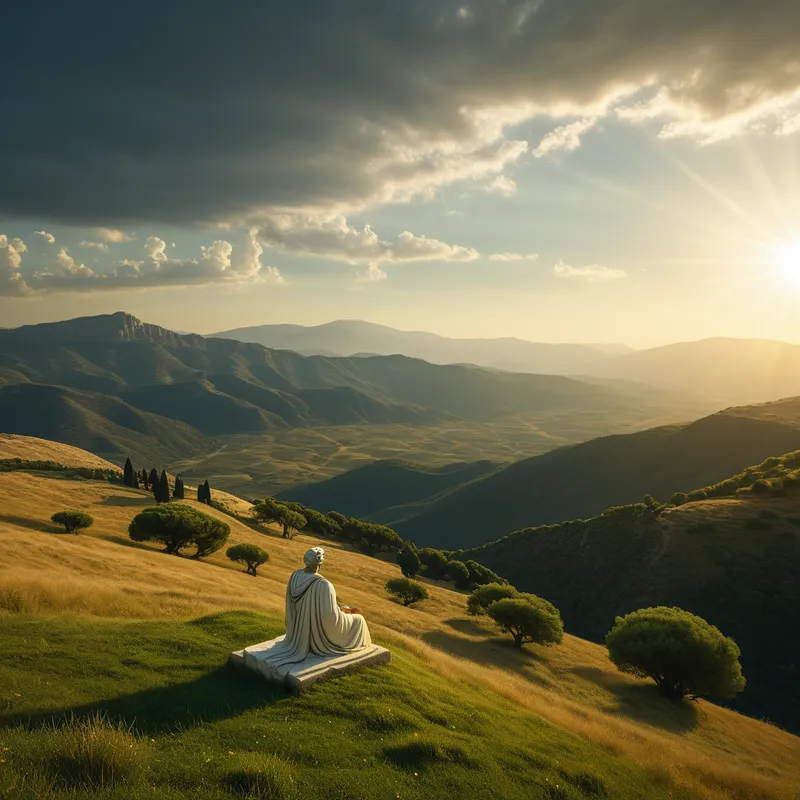
It was the First Age, the Age of Gold, and the sky was held by a different king. Not the distant, thunder-wielding Zeus, but his father, the great Cronus. In that time, the earth was not a mother to be wrestled with, but a lover who gave freely. The soil was rich and dark, and it needed no sharpened plough. The wheat sprang forth, tall and golden, of its own accord. The oak trees dripped with honey, and the rivers ran not with water, but with milk and sweet nectar.
The people of this age were not as you are. They were fashioned by the Ouranos and Gaia, or by the Prometheus himself from pure earth and water. Their limbs did not know weakness, their hearts did not know malice. They lived as companions to the immortal gods, feasting with them, sharing in their leisure. Old age did not creep upon them with trembling and grey; when their time was full, they simply sank into a deep, gentle sleep, as if stepping behind a veil of peace. Death was a soft shadow, not a terror.
There was no need for ships, for no one sought what was not already before them. There were no cities with high walls, for there was nothing to fear from neighbor or beast. There was no law, for the very concept of crime was unborn. The seasons were unchanging, an eternal, gentle spring where Zephyrus breathed softly across meadows forever in bloom. They labored not, and yet they lacked nothing. Their souls, when finally they departed, became benevolent daimones, watching over the later ages of mortals.
This was the world under the scythe of Cronus, a time of perfect circularity, where beginning and end were one, where want and war were impossible. It was not a kingdom ruled, but a state of being that simply was—a harmony so complete it needed no name.
Cultural Origins & Context
This vision of primordial perfection comes to us primarily from the poet Hesiod, in his epic Works and Days. It forms the opening movement of his Myth of the Five Ages, a somber, descending scale of human history from Gold to Silver, to Bronze, to the Age of Heroes, and finally to our own miserable Age of Iron. Hesiod, a bitter farmer wrestling with a difficult land and a corrupt brother, uses this myth as both a theodicy and a social critique. It explains why life is now hard and unjust: we live in a fallen time, far removed from divine grace.
The myth served a crucial societal function. It was not mere nostalgia; it was a foundational narrative that established a moral and temporal order. It explained the human condition as one of decline, setting a sacred benchmark against which all current suffering was measured. This story was recited not just as entertainment, but as a religious and pedagogical tool, reminding listeners of a lost cosmic order. It framed the relationship between gods and humans as one of increasing distance, justifying ritual and piety as necessary, if feeble, bridges back to a forgotten harmony. The Golden Age was the original contract, now broken, against which all subsequent history—and human effort—was defined.
Symbolic Architecture
The Golden Age is the ultimate symbol of the primal unity. It represents a psychic condition prior to the birth of the ego, of duality, of consciousness itself.
The Golden Age is the soul’s memory of a time before the fall into awareness, before the “I” was separated from the world.
Cronus, as Time (Chronos in later philosophical conflation), represents a cyclical, unchanging eternity. His reign is a closed circle, perfect and static. The effortless abundance symbolizes a state of unconscious identification with the nourishing Great Mother. There is no differentiation: human from god, nature from culture, desire from fulfillment. The absence of agriculture, sailing, and law signifies a pre-cultural, pre-technological existence where the human psyche is entirely contained within the instinctual and archetypal world.
The end of this age, precipitated by the rise of Zeus, symbolizes the inevitable emergence of consciousness. Differentiation, conflict, law, and labor are the costs of awareness. The myth tells us that consciousness is born from a rupture in paradise. The golden people becoming daimones signifies that this state of unity does not vanish; it recedes into the unconscious, becoming the inner guardians, the latent psychic potential, and the deep, often painful, longing for wholeness that drives the human journey.

The Dreamer’s Resonance
When the Golden Age echoes in modern dreams, it rarely appears as a classical idyll. More often, it manifests as a profound, melancholic sense of loss or an impossible longing. One might dream of a childhood home transformed into a boundless garden, only to find the doors locked as one approaches. Or of a reunion with a loved one where perfect understanding flows without words, yet upon waking, a deep sorrow remains for a connection that feels more real than waking life.
Somatically, these dreams can be accompanied by a feeling of weightless peace or, conversely, a crushing heaviness of nostalgia upon awakening. Psychologically, they point to a process of confronting the Self—not as an achievement, but as a remembered state. The dreamer is touching the deepest layer of the personal and collective unconscious, where the illusion of separation dissolves. This can occur during periods of burnout, where the demands of the conscious, striving ego (the Age of Iron) have become unbearable, and the psyche retreats to its most fundamental image of rest and integration. It is a call to acknowledge what has been sacrificed at the altar of becoming an individual.
Alchemical Translation
The alchemical journey, or individuation, is not about returning to the Golden Age. That is the fantasy of the Innocent. The work is to perform the opus in full awareness of the loss.
The goal is not to regain the unconscious paradise, but to consciously remember it, and in that remembering, forge a new wholeness that includes the reality of time, labor, and conflict.
The first step, nigredo, is the full confrontation with our Iron Age existence: the toil, the ambiguity, the suffering. We must fully inhabit our fallen state. The myth teaches that this state itself is sacred, for it is the necessary condition for consciousness. The longing for the Golden Age becomes the prima materia, the raw stuff of our transformation.
The subsequent stages involve a symbolic retrieval. We cannot have the effortless harvest, but we can learn to sow and reap with reverence, transforming labor into sacred work (citrinitas). We cannot live without law, but we can internalize moral order, moving from external constraint to inner integrity. We cannot feast with the gods, but we can seek moments of anima—of beauty, connection, and creative flow—that provide glimpses of the divine.
The final stage, rubedo, is not a return to gold, but the creation of the Philosopher’s Stone in its place. It is the realization that the Golden Age was not a historical place, but an eternal, inner archetype. The paradise of undifferentiated unity is transmuted into the conscious integration of opposites. The cyclical time of Cronus is integrated with the progressive, purposeful time of our lived experience. We become, in a sense, the guardians—the daimones—of our own lost paradise, not by dwelling in it, but by carrying its memory as a guiding light through the necessary struggles of our Iron Age world. The myth ends, but the alchemy begins where the story leaves off: in the hard, fertile soil of the present.
Associated Symbols
Explore related symbols from the CaleaDream lexicon: