The Goddess Kali Myth Meaning & Symbolism
The terrifying, loving goddess Kali emerges from fury to slay a demon, then dances on her consort, Shiva, in a moment of ultimate, world-saving realization.
The Tale of The Goddess Kali
Listen. The air was thick with the iron scent of blood and the ozone crackle of divine rage. The battlefield, a scar upon the earth, trembled under the feet of gods and demons. From the collective fury of the gods, the goddess Durga had been born, riding her lion into war against the buffalo-demon Mahishasura. She was victory incarnate, beautiful and terrible. But from the ranks of the defeated arose a greater horror: the demon Raktabija.
This demon possessed a dreadful boon. Should a single drop of his blood fall upon the ground, it would instantly give rise to a perfect, fully-formed clone of him. Durga’s warriors struck him with arrows, spears, and thunderbolts. Each wound bled. Each drop of blood that touched the soil sprouted into another Raktabija, who in turn bled and multiplied. The battlefield became a nightmare of exponential horror, a sea of identical demons swelling from a crimson tide. For every one slain, a hundred more sprang forth. The gods despaired. Durga’s brow furrowed in cosmic concentration.
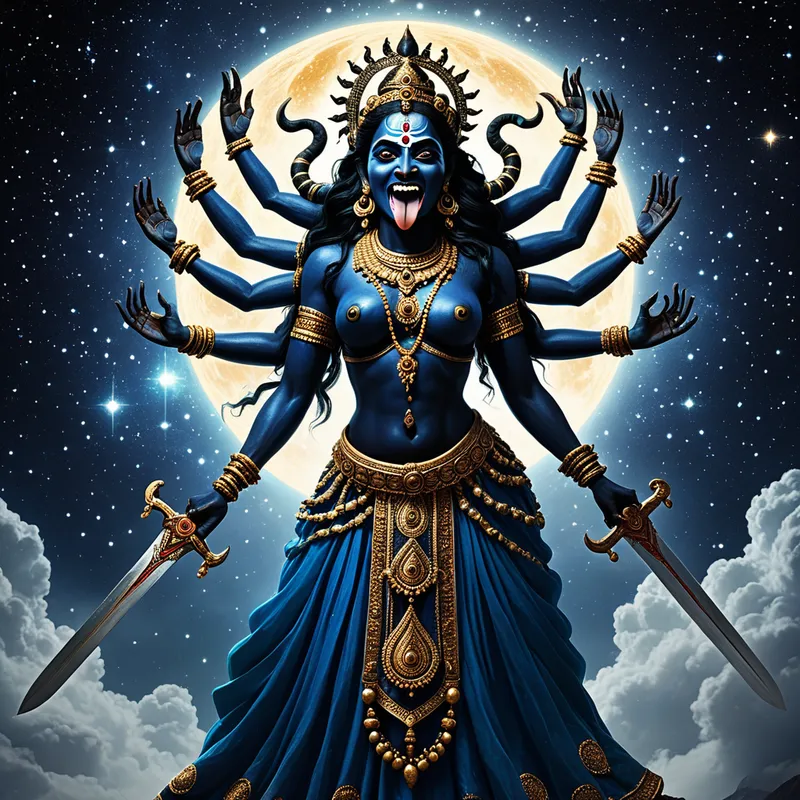
Then, from the center of her divine forehead, a deeper darkness coalesced. It was not an absence of light, but a presence so potent it consumed illumination. This darkness took form, erupting into the world with a roar that silenced the clashing armies. She was Kali. Her skin was the blue-black of a midnight sky, her hair a wild tempest. She was naked but for a girdle of severed arms and a garland of fifty-one skulls. Her eyes blazed with a red fire, and her tongue lolled out, thirsty. In her four hands she held a sword, a noose, and a severed head; her fourth hand was raised in a gesture of fearlessness.
She did not walk; she danced onto the battlefield, a whirlwind of annihilation. She saw Raktabija and understood the calculus of his curse. With a shriek that split reality, she leaped upon him, pinning him down. She did not merely wound him. She pierced his flesh with her trident, lifted him high, and with her gaping mouth, she drank. She drank every drop of his blood before it could touch the earth, swallowing his terrible power, consuming his very essence. Then, with her sword, she severed his head. The clones, bereft of their source, withered into dust.
But the dance did not stop. The ecstasy of destruction, the primal fury of liberation, had been unleashed. Kali’s dance became a frenzy. She whirled across the plains of existence, destroying any remnant of the demonic army, then any remnant of form itself. The world shook on the brink of dissolution. The gods, who had summoned her, now cowered in terror. Their savior had become the ultimate threat.
In desperation, they turned to her consort, the great ascetic god Shiva. He saw the cosmic imbalance. Kali, lost in her sacred rage, could not perceive the boundary between destroying evil and destroying creation. Shiva lay down on the battlefield, in the path of her catastrophic dance. And Kali, in her ecstatic, world-obliterating stomp, planted her foot upon his chest—and stopped.
The moment her foot touched his body, the body of pure consciousness, she froze. She looked down. She saw her lord, her beloved, beneath her feet. A shock of recognition coursed through her. Her lolling tongue snapped back into her mouth in a gesture of sudden, profound shame and realization. The fury drained from her eyes, replaced by a stunned, tender awareness. The dance of destruction ceased. The universe, held in a breath, exhaled. Balance was restored, not by force, but by the shocking, intimate confrontation with the ground of all being.
Cultural Origins & Context
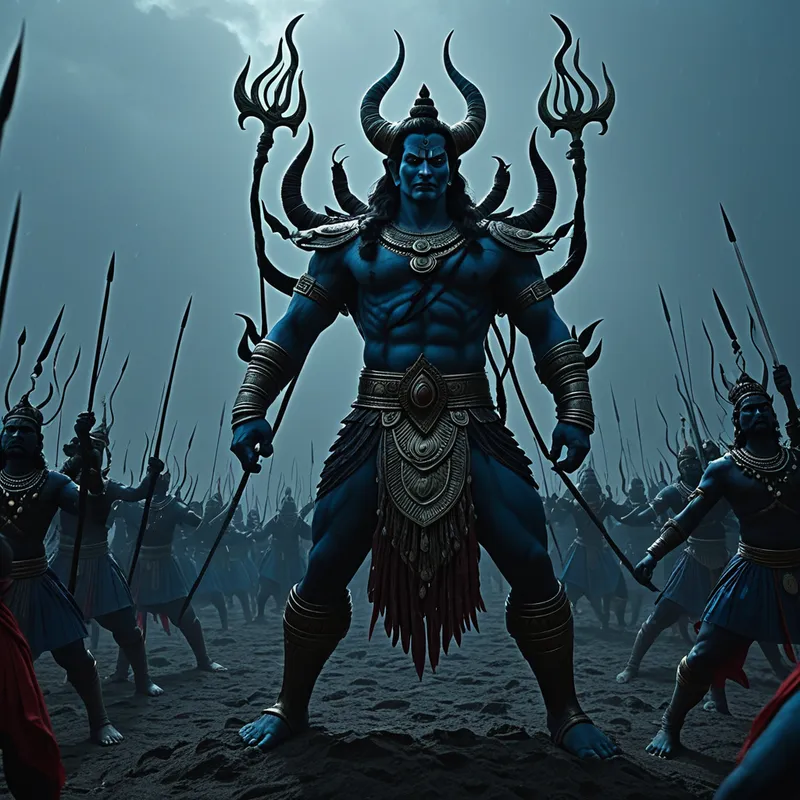
The myth of Kali finds its roots in the Puranas, particularly the Devi Mahatmya (circa 5th-6th century CE), which is a core text of Shaktism. Here, she is not a standalone goddess but the most fierce and transformative emanation of the supreme Goddess, Durga. The myth was passed down through oral recitation by priests and storytellers, often during festivals like Navaratri.
Societally, Kali served multiple functions. She was a protector of the cosmic order (dharma), a destroyer of egotistical, demonic forces that threaten stability. For tantric practitioners, she represented the ultimate reality—formless, boundless, and beyond duality—to be approached through radical, non-orthodox means. For the common devotee, she was the terrifying mother who, in her fierceness, annihilated the devotee’s attachments and ignorance, a necessary prelude to grace. Her worship, especially in Bengal, embraces her paradoxical nature: she is both the cause of fear and the remover of fear.
Symbolic Architecture
Kali is the archetypal embodiment of the raw, unbound power of nature and psyche that exists before and beyond civilized order. She is not evil; she is the necessary force that dismantles stagnant, life-denying structures.
She is the shadow of the nurturing mother, the aspect that does not comfort but devours, forcing a confrontation with all we fear and deny.
Her black skin symbolizes the all-encompassing, fertile void from which all creation emerges and into which it returns. The garland of skulls represents the fifty-one letters of the Sanskrit alphabet, showing she is the consumer of all words, concepts, and forms. The severed head and sword signify the cutting of the ego, the death of the false self. Her lolling tongue, often misinterpreted as mere ferocity, is a symbol of her shame upon realizing she has trampled Shiva—it is the moment the unconscious, destructive force recognizes the conscious principle. She stands on Shiva, the passive, pure consciousness, illustrating that dynamic, transformative power (shakti) is activated upon the ground of silent awareness (purusha).
Psychologically, Kali represents the contents of the personal and collective shadow—the repressed rage, primal instincts, and traumatic memories we refuse to acknowledge. The demon Raktabija is a perfect symbol for a psychological complex: a wounded, bleeding memory or pattern that, whenever triggered (touched), replicates itself, creating an endless, autonomous army of suffering within the psyche.
The Dreamer’s Resonance
To dream of Kali is to be in a state of profound psychic emergency and potential breakthrough. It signals that polite, conscious management of a problem has failed. A demonic, self-replicating pattern—be it addiction, a toxic relationship cycle, a core wound of abandonment or rage—has overrun the inner landscape.
The somatic experience is one of visceral intensity: a pounding heart, a feeling of being consumed or chasing, a wild, unstoppable energy. The dreamer may be Kali, feeling an ecstatic, terrifying fury. Or they may be facing her, paralyzed by her gaze. They may be Shiva, lying passively as chaos dances above them. This dream is the psyche’s ultimate intervention. It announces that the replicating wound (Raktabija) can no longer be fought conventionally. It must be fully faced, embraced, and its lifeblood—its hidden power and source—must be consumed and integrated. The dream is an invitation to a fierce, radical self-honesty that feels like self-destruction.

Alchemical Translation
The myth of Kali models the most harrowing and essential phase of individuation: the nigredo, the descent into the blackness of the unconscious to confront the shadow. The modern individual’s “battlefield” is their own life, cluttered with the clones of their unresolved pain.
The alchemical work is not to gently analyze the demon, but to become Kali—to develop the fierce, focused consciousness that can pin the pattern down and drink its power.
First, one must summon the courage to stop fighting the symptom (the endless clones of anxiety, depression, conflict) and identify the source—the original, bleeding wound (Raktabija). This requires a “Kali-consciousness”: a ruthless, loving refusal to let another drop of that old story hit the ground and create more suffering. It means fully feeling the rage, the grief, the terror, consuming it with awareness so it cannot spawn more unconscious reactions.
The climax of the transmutation is the “dance on Shiva.” This is the moment when the identified ego, the one doing the work, must itself be surrendered. The fierce therapeutic or spiritual effort (Kali’s dance) risks becoming its own form of inflation or violence. It must be grounded—literally brought to earth—by touching the silent, witnessing consciousness (Shiva). This is the shift from doing the work to being the space in which the work occurs. The tongue of shame retracts in the realization that one is not the destroyer or the savior, but a participant in a larger, conscious process. The result is not a sanitized self, but a integrated one, where destructive power is transformed into creative vitality, and the individual stands balanced between the forces of radical change and abiding peace.
Associated Symbols
Explore related symbols from the CaleaDream lexicon: