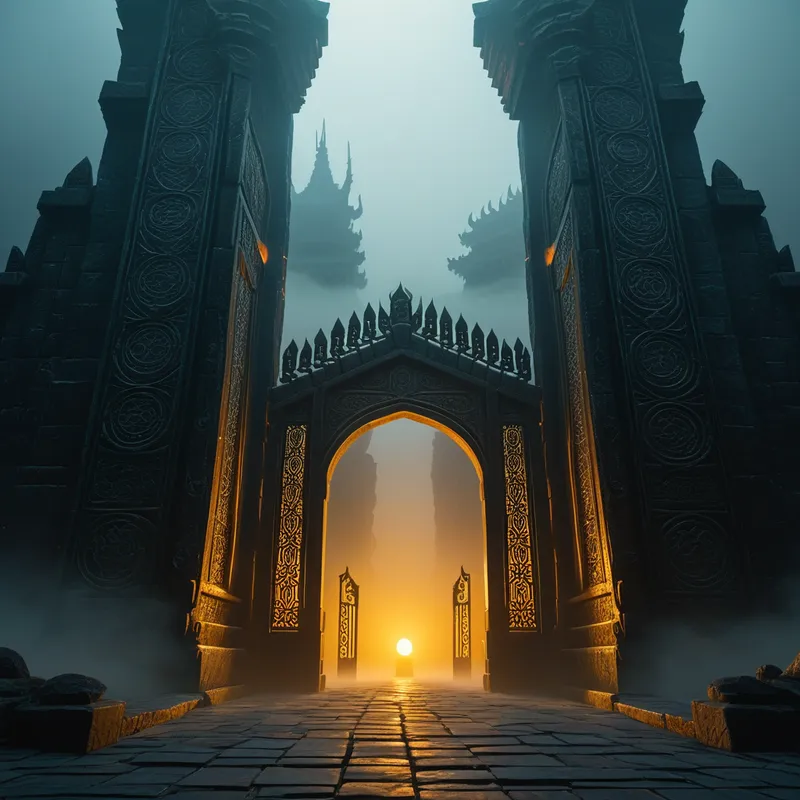
The Gates of Horn and Ivory Myth Meaning & Symbolism
A myth from Homer's Odyssey where two gates filter dreams, one of horn revealing truth, the other of ivory weaving deceptive fantasies.
The Tale of The Gates of Horn and Ivory
The air in the House of Hades is not like the air of the living world. It is thick, scentless, and cold, a silence that drinks sound and light. Here, the great hero Odysseus stood, his heart a drum of dread and purpose. He had poured out the dark blood of a sacrifice, a libation to summon the silent ones. And they came.
Shades drifted from the gloom like smoke, drawn to the vital scent. Among them, a form of terrible, remembered glory approached. It was the spirit of Achilles, swift-footed even in death. His eyes, once fierce with the fire of battle, now held the flat sheen of eternity’s dusk. Odysseus, with a voice choked by awe and pity, spoke to him of honor, of his son’s fame in the world above. But Achilles, a king among the dead, answered with a whisper that cut deeper than any sword:
“I would rather be a paid servant in a poor man’s house and be above ground than king of kings among the dead.”
The words hung in the stagnant air, a truth more devastating than any phantom’s wail. This was no heroic boast, but the raw revelation of a soul stripped of all illusion. The glory of Troy, the songs of poets, the eternal fame—all were as nothing against the simple, aching truth of being alive.
As the pale host of shades murmured and Odysseus prepared to depart that joyless place, another spirit drew near. It was the soul of Antikleia, his own mother, whom he had left alive in Ithaca. He wept, longing to embrace her, but three times his arms passed through her form like clutching at mist. In their sorrowful exchange, she spoke of his wife’s fidelity, his father’s decline, and her own death from longing for him.
Then, as the conversation turned to the nature of this place of dreams and shadows, she uttered the cryptic, lasting words. She explained the two paths that dreams take when they visit mortals. “There are two gates,” her voice echoed softly, “for the idle dreams to pass through. One is made of polished horn, the other, of gleaming white ivory. Those dreams that come through the gate of sawn ivory are deceptive, bringing messages that will not be fulfilled. But those that come through the gate of polished horn speak truth, to the mortal who sees them.”
With that, she faded back into the crowd of nameless dead. Odysseus was left alone at the threshold of that sunless realm, the image of the two gates burning in his mind—one a portal of clarity, the other a doorway of delusion—as he turned his face toward the world of the living, carrying a burden of truths more painful than any falsehood.
Cultural Origins & Context
This haunting episode is found in Book 11 of Homer’s Odyssey, the epic poem composed in the 8th century BCE but rooted in an older oral tradition. It is part of the Nekyia, a foundational text of ancient Greek eschatology and psychology. The bard, singing for an audience that saw dreams as divine messages and the underworld as a tangible reality, used this myth to explore the ultimate boundaries of human experience: life, death, and the nature of truth itself.
The myth functioned as more than a plot device. It was a philosophical and psychological tool. In a culture without a centralized religious doctrine, poets like Homer provided the framework for understanding the unseen world. The Gates offered a taxonomy for dreams, a way to categorize the often-confusing nocturnal visitations. They addressed a universal anxiety: how can we know if a vision, an omen, or even a waking hope is authentic? The myth provided a poetic answer, embedding the quest for discernment into the very architecture of the cosmos.
Symbolic Architecture
The Gates are not merely checkpoints; they are profound symbols of perception and the substance of reality. Horn, from a living animal, is fibrous, translucent, and can be polished to a clarity that allows light—and truth—to pass through. Ivory, from a tusk, is dense, opaque, and can be carved into beautiful, intricate illusions. The materials themselves tell the story.
The gate of horn is the eye of the soul, worn smooth by suffering and polished by experience until it becomes a lens for reality.
The gate of ivory is the mind’s workshop, where memory, fear, and desire are sculpted into convincing facsimiles of truth.
The myth presents a cosmic sorting mechanism. True dreams (oneira), which reveal the nature of things—like Achilles’ devastating insight into the value of life—pass through horn. False dreams (oneiroi), which weave fantasies that lead the dreamer astray, slip through ivory. The critical, terrifying lesson is that both are equally compelling in the moment. The spectral form of a loved one, whether speaking truth or comfort, feels real. The myth does not tell us how to distinguish them at the gate; it only tells us the gates exist, placing the burden of interpretation squarely on the mortal soul.
The Dreamer’s Resonance
When this myth stirs in the modern unconscious, it rarely appears as literal gates. Instead, we experience its pattern. It is the dream of receiving a message of shocking, painful clarity that upon waking feels undeniably true—a diagnosis of the soul. This is the horn at work. Conversely, it is the beautiful, wish-fulfilling dream that evaporates upon awakening, leaving a hollow ache, the residue of ivory.
The somatic process is one of discernment in the body. A “horn” dream often carries a somatic marker—a jolt, a deep sigh, a feeling of gravity or expansion. It resonates. An “ivory” dream, however lovely, may feel weightless, insubstantial, or leave a sense of anxious dissonance. The modern dreamer undergoing this is at a crossroads of self-knowledge. The psyche is presenting two versions of reality: one that aligns with the deep, often uncomfortable Self, and one that caters to the wishes of the ego. The tension between them is the work of integration.

Alchemical Translation
Psychic individuation is the long journey of learning to distinguish the horn from the ivory within one’s own psyche. Our complexes, our persona, our cherished self-narratives are often beautiful structures of ivory—convincing, polished, and ultimately insulating us from the raw truth of who we are.
The alchemical process modeled by the myth is one of calcinatio and sublimatio—burning away the false to reveal the essential. Odysseus’s journey to Hades itself is a nekyia, a descent into the underworld of the unconscious, where the comforting illusions of the heroic ego (his identity as a warrior, a king) are incinerated by the simple, bleak truth from Achilles. His mother’s revelation of the Gates is the subsequent gift of this ordeal: the cognitive framework to process the experience.
The work is not to destroy the gate of ivory, but to recognize its craftsmanship as our own, and to consciously choose to cultivate the transparency of horn.
For the modern individual, this translates to the difficult practice of brutal self-honesty. It is questioning our most comforting stories, listening to the painful feedback we ignore, and valuing the gritty, unpolished truth of a feeling over the elegant story we tell about it. It is realizing that the gate of horn often leads through shadow, but it leads through; the gate of ivory, for all its beauty, leads only to a hall of mirrors. The ultimate triumph is not in receiving only true dreams, but in developing the wisdom to know through which gate they have come, and to build one’s life accordingly, on the foundation of what is real.
Associated Symbols
Explore related symbols from the CaleaDream lexicon: