The Gardenia Spirit Myth Meaning & Symbolism
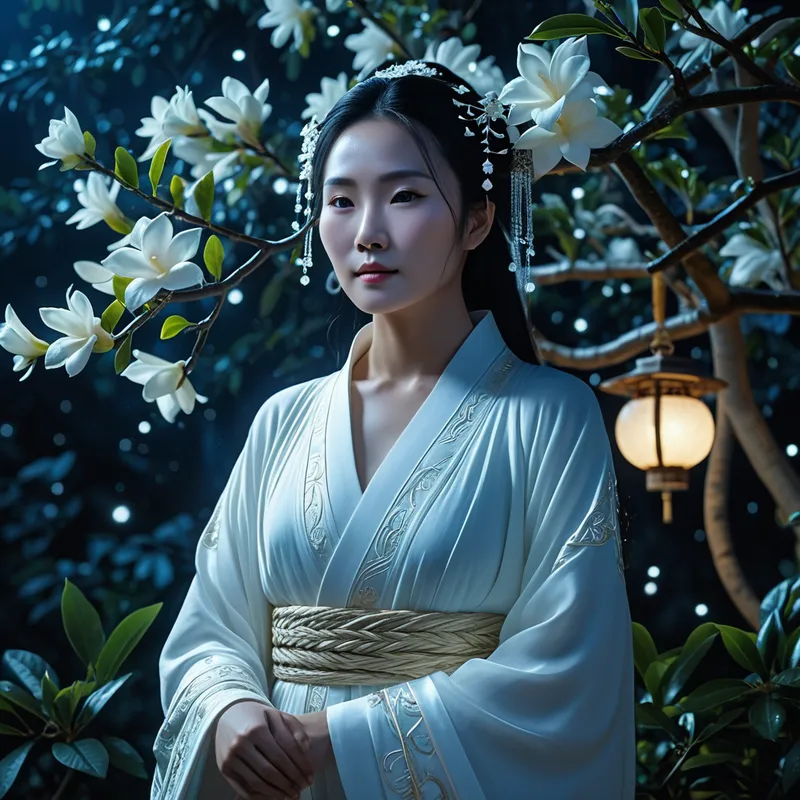
A celestial maiden descends, her spirit bound to a gardenia tree, weaving a tale of forbidden love, profound sacrifice, and the eternal fragrance of the soul.
The Tale of The Gardenia Spirit
Listen, and let the scent of a forgotten summer carry you back. Before the first empire was unified, when the world was still thick with magic and the boundaries between earth and heaven were as thin as a cicada’s wing, there was a mountain named Jade Cloud Peak. Upon its mist-shrouded slopes grew a gardenia tree unlike any other. Its blossoms were not merely white; they were luminous, holding the captured light of the moon, and their fragrance could calm a troubled heart or make a wise man weep with memories he never owned.
This tree was no ordinary plant. It was the earthly vessel of Zhi Xian, the Gardenia Spirit. She was a maiden of the highest heavens who, moved by the profound sorrow of the mortal world—the unspoken grief, the love lost before it was uttered—asked the Jade Emperor for permission to descend. Her wish was to absorb this human sadness, to purify it through her essence, and transform it into something beautiful. The Jade Emperor consented, but with a stern decree: her spirit was to remain bound to the tree. She could observe, she could feel, but she could never walk as a mortal, nor directly interfere.
For centuries, she dwelt thus. Scholars and poets made pilgrimages to sit beneath her branches, and in her presence, their stifled emotions would flow, finding release not in tears, but in sublime verse. Her spirit was content in this sacred duty.
Until a young scholar named Lin Wen arrived. He was not seeking inspiration for poetry, but solace for a heart shattered by betrayal. He did not speak. For seven days and seven nights, he simply sat in the tree’s shadow, his silence deeper than any lament. Zhi Xian, feeling the raw, unadulterated ache of his spirit, found her own celestial heart—a heart she never knew she possessed—stirring with a profound and forbidden empathy. One evening, as a rare qicai xiá painted the sky, she manifested her form just beyond the tree’s perimeter, a vision of heartbreaking beauty.
They did not speak of love, for the word was too small. They spoke of the texture of loneliness, the color of memory, and the silent language of the stars. Lin Wen’s heart began to mend, woven back together by threads of celestial compassion. But the laws of heaven are immutable. Their communion was discovered. The Jade Emperor’s voice echoed like thunder: the bond was broken, the mortal must forget, and the Spirit must be recalled to the heavens, her work on earth ended.
Here, the tale reaches its crux. Faced with eternal separation and the erasure of their bond, Zhi Xian made her choice. As celestial guards descended, she did not flee to her tree. Instead, she turned to Lin Wen one final time. “I will not take your sorrow,” she whispered. “I will become it, and in becoming, transform it forever.” Before the guards could seize her, she dissolved her form not into the tree, but into its very essence. A wave of radiant energy burst from the gardenia, and every blossom on its branches fell in a single, silent shower.
Where each petal touched the earth, a new gardenia plant sprang forth, blooming instantly. The mountain slope was transformed into a sea of white, their combined fragrance a tangible, gentle force. Lin Wen, kneeling amidst them, remembered nothing of the Spirit, only a overwhelming sense of peace and a mysterious, sweet scent that felt like a farewell and a promise intertwined. Zhi Xian was gone, but her spirit was now diffused into every gardenia that would ever bloom, her vow eternally kept.
Cultural Origins & Context
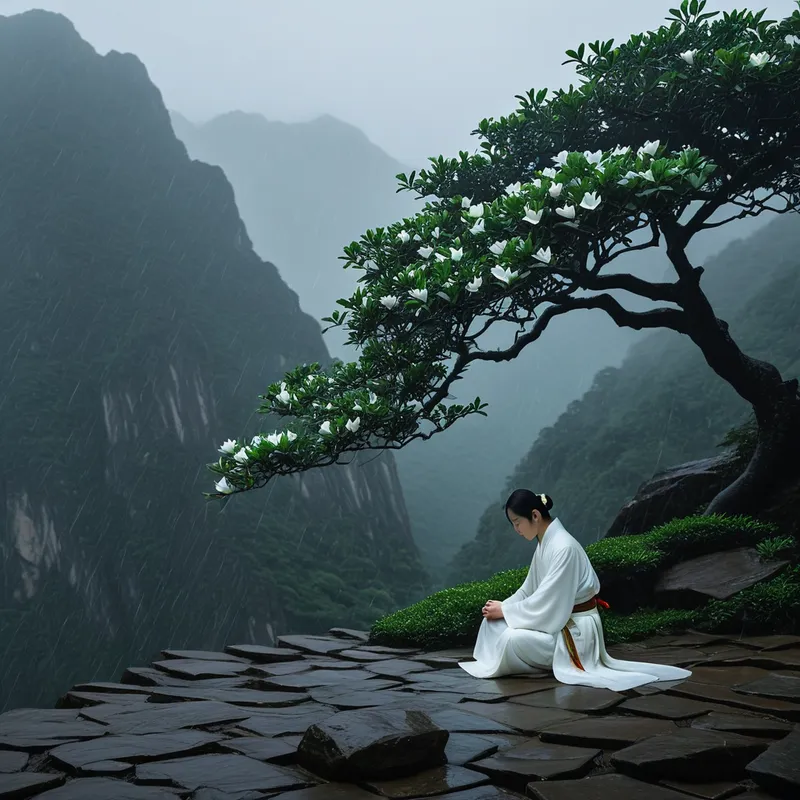
The myth of the Gardenia Spirit belongs to the vast and intricate tradition of hua yao gu shi (flower spirit tales) and jingguai lore in Chinese folklore. These stories flourished particularly during the Six Dynasties and Tang periods, a time when Daoist nature mysticism and literary romanticism deeply intertwined. It was not a canonical myth with a single textual source, but a living story passed down through oral tradition, often told by grandmothers, romantic poets, and traveling storytellers.
Its societal function was multifaceted. On one level, it was an etiological myth, explaining the origin of the gardenia’s (zhīzi) pervasive beauty and scent. On a deeper level, it served as a cultural container for complex emotions. In a society with structured propriety, the tale provided a safe, metaphorical space to explore themes of forbidden love, altruistic sacrifice, and the transformative power of melancholy. It reinforced the Daoist ideal of harmony between the human heart and the natural world, suggesting that deep emotion, even grief, is not a stain to be removed, but a potential seed for something transcendent.
Symbolic Architecture
At its core, the myth is a profound allegory for the fate of feeling in a world of separation. The Gardenia Spirit, Zhi Xian, symbolizes the anima in its purest form—not as a personal complex, but as the world-soul itself, the anima mundi, which feels the suffering of creation. Her descent is the archetypal movement of spirit into matter, of consciousness engaging with the pain of existence.
The tree is the body; the spirit is the feeling that animates it. To be bound is to be incarnated, to know the specific ache of a specific form.
The scholar Lin Wen represents the human ego, isolated in its personal wound. His silent sorrow is the unintegrated shadow, a pain so deep it has no words. Their connection signifies the moment the ego touches the transpersonal anima, not for possession, but for recognition. The celestial law that forbids their union is the immutable principle of reality: spirit and matter, the eternal and the temporal, can touch but cannot permanently merge without a fundamental change in nature.
The Spirit’s ultimate sacrifice—dissolving her singular form to proliferate her essence—is the key symbol.
True transformation is not escape, but fragmentation and dissemination. The sacred is not lost by being shared; it is fulfilled. Her individual ‘death’ gives birth to a universal presence.
The gardenia flower thus becomes a symbolic artifact of this alchemy: its radiant white purity is not innocence, but the whiteness that comes after, the result of sorrow fully felt, purified, and released as fragrance. It is the embodied symbol of grief alchemized into grace.
The Dreamer’s Resonance
When this myth stirs in the modern unconscious, it often surfaces in dreams of poignant beauty and profound loss. To dream of a singular, overwhelmingly beautiful white flower that one cannot quite reach, or that withers upon touch, may echo Zhi Xian’s bound and elusive nature. It speaks to a longing for a purity of connection or feeling that seems just beyond the laws of one’s current life.
Dreams of being in a vast, misty garden where a familiar yet unplaceable fragrance evokes a deep, somatic sadness—a “sweet sorrow”—point directly to the myth’s core. This is not the chaos of nightmare, but the melancholic clarity of the anima world. The dreamer is likely at a point of emotional crystallization, where a long-carried grief or love is finally becoming conscious enough to be felt in its entirety, rather than merely suffered. The psyche is performing the Spirit’s initial function: absorbing the sorrow to begin its transformation. The somatic sensation is often a tightness in the chest simultaneously with a feeling of expansion, as if the heart is both the wound and the vessel for its own healing.
Alchemical Translation
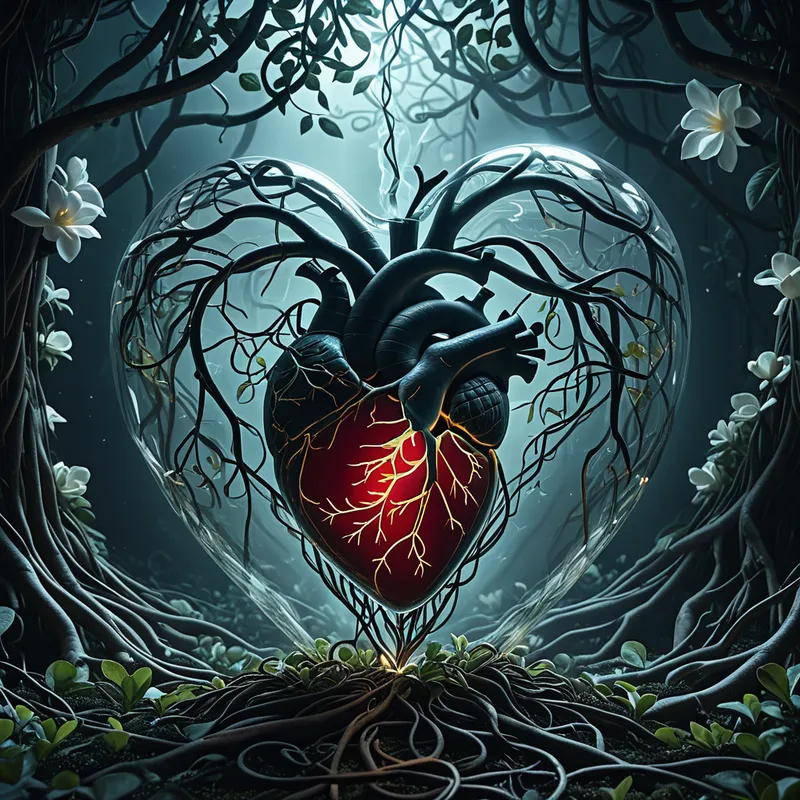
For the individual on the path of individuation, the Gardenia Spirit’s journey is a precise map of psychic transmutation. The process begins with the descent: the conscious ego (the scholar) must acknowledge its deepest, most silent wound and sit with it, without demand or narrative. This is the pilgrimage to the mountain.
The encounter with the anima (the Spirit) is the recognition that this personal pain is also a universal one. It is the moment we see our suffering not as a personal failure, but as a fragment of the world’s sorrow, making it paradoxically easier to bear. The forbidden love is the ego’s desire to own this healing, transcendent feeling, to make it a permanent part of one’s personal identity.
The crucible of the myth is the enforced separation. The ego cannot keep the anima; it can only be transformed by it.
The alchemical mortificatio and multiplicatio occur in the Spirit’s dissolution. Psychologically, this translates to the necessary sacrifice of a cherished self-image—the “wounded one,” the “romantic,” the “special sufferer.” One must let the singular, dramatic story of one’s pain die. In its place, what emerges is not a grand cure, but a proliferation of small, integrated insights—a newfound capacity for empathy (the fragrance that comforts others), moments of pure, unburdened beauty, and a gentle, pervasive peace that infuses ordinary life. The individual spirit does not achieve heaven by escaping, but by becoming so essential, so diffused, that it becomes a quality of the world itself. The ego, like Lin Wen, may not remember the dramatic encounter, but it lives forever in the garden that grew from it. The work is complete not when the pain is gone, but when it has become the soil from which compassion flowers.
Associated Symbols
Explore related symbols from the CaleaDream lexicon: