The Garden of Iram Myth Meaning & Symbolism
A king builds a paradise to rival the gods, only to be swallowed by the desert sands as punishment for his cosmic arrogance.
The Tale of The Garden of Iram
Listen, and hear the whisper of [the wind](/myths/the-wind “Myth from Various culture.”/) over the Rub’ al Khali, the Empty Quarter. It carries a name, a sigh of lost grandeur: Iram of the Pillars. Once, under the rule of the mighty King Shaddad ibn ‘Ad, a hunger was born—not for more land or gold, but for a memory. He had heard the tales whispered by travelers and sages of the gardens promised to the faithful in the hereafter, a paradise of eternal shade and flowing [water](/myths/water “Myth from Chinese culture.”/).
A fire ignited in Shaddad’s heart, a fire of defiance and profound longing. “Why should we wait for death to taste eternity?” he proclaimed to his architects and sorcerers. “We shall build our own paradise here, upon [the earth](/myths/the-earth “Myth from Hindu culture.”/), and it shall be more splendid than any celestial promise.”
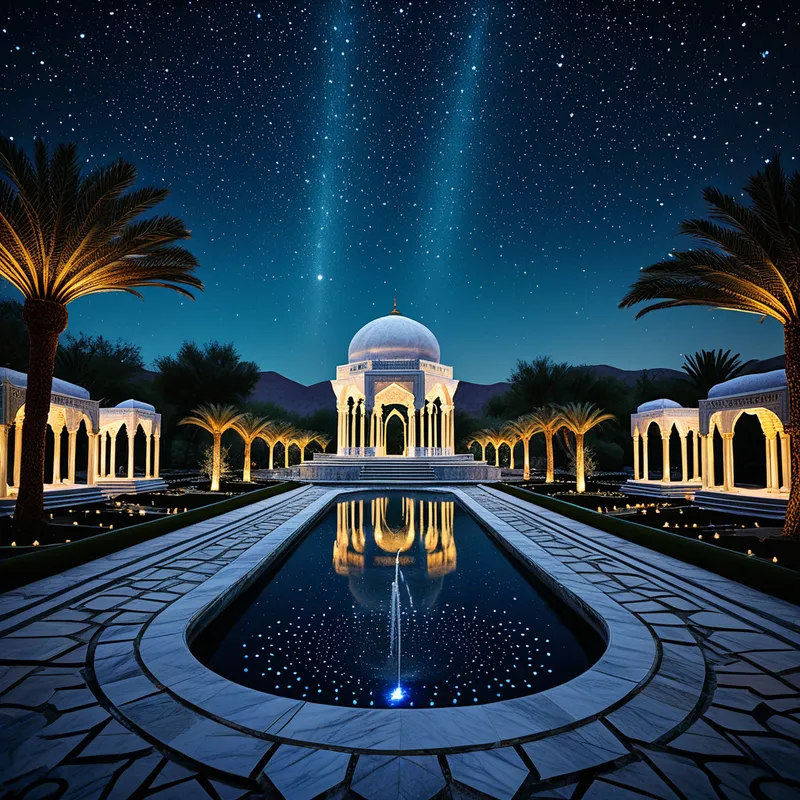
And so, [the great work](/myths/the-great-work “Myth from Alchemical culture.”/) began. For three hundred years, the wealth of a thousand kingdoms flowed into [the desert](/myths/the-desert “Myth from Biblical culture.”/). They did not merely plant a garden; they sculpted a blasphemy of beauty. Pillars of solid gold were raised, not to hold roofs, but to catch the first and last light of the sun. Canals of liquid silver cut through groves of trees whose leaves were hammered from emeralds and whose fruit were perfect rubies and pearls. Pavilions of white marble, cool to the touch even at noon, housed libraries of crystal tablets and halls where the very air was perfumed by a thousand captured dawns. This was the Garden of Iram, a monument not to a god, but to the will of a man who sought to become one.
The news of this earthly paradise reached the heavens. It was not admiration it stirred, but a terrible, silent judgment. The garden was a challenge, a mirror held up to the divine realm, saying, “See what man can do without you.” The order was given, not with thunder, but with a stillness.
A single messenger, a man of unwavering faith named Hud, was sent to Shaddad. He stood before the jeweled gates and spoke not of envy, but of warning. “This place is built on sand,” Hud said, his voice quiet against the splendor. “Not the sand of the desert, but the sand of hubris. You have built a cage of beauty and called it freedom. Dismantle it. Remember your place.”
Shaddad laughed, a sound that echoed through the gemstone orchards. “My place? I have made a new place. Let the heavens keep their garden. I have mine.”
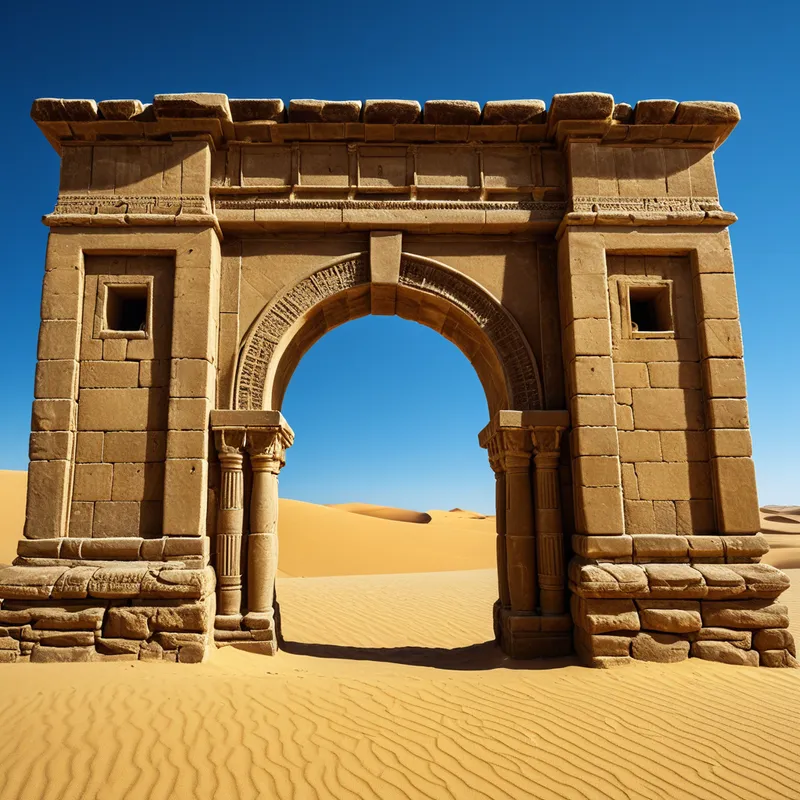
Hud departed, and with him went the last chance. For seven nights and eight days, a wind began to stir—a wind unlike any other. It did not howl; it hissed. It was the sound of shifting sands, but also of erasure. It rose not from [the horizon](/myths/the-horizon “Myth from Various culture.”/), but from the earth itself. The silver canals filled with dust. The golden pillars groaned as the desert, patient for centuries, reclaimed its own. [The emerald](/myths/the-emerald “Myth from Medieval European culture.”/) leaves tinkled like broken glass as they were scoured away. The Garden of Iram, the paradise built in defiance, was not burned, not shattered, but swallowed. It was buried under wave upon wave of silent, golden sand, until no pillar stood, no fountain bubbled. Only the wind remained, telling its tale of a king, a garden, and the price of a paradise built on sand.
Cultural Origins & Context
The legend of Iram finds its roots not in the classical Achaemenid corpus, but in the rich tapestry of pre-Islamic Arabian lore that was absorbed and retold within the broader Persianate world, particularly through the lens of epic poetry and mystical (Sufi) literature. It is most famously preserved in the Quran (89:6-8) as a lesson for the tribe of ‘Ad, and was later elaborated upon by historians like al-Tabari and immortalized in the timeless stories of the One Thousand and One Nights.
In this cultural transmission, the tale moved from a purely Arabian admonition into a Persian metaphysical parable. Storytellers in bazaars and khanqahs would recite it not just as a history of a lost city, but as a deep psychological and spiritual allegory. Its societal function was dual: as a public morality tale warning against arrogance and overreach, and as a private, mystical map warning the spiritual aspirant against the dangers of constructing a beautiful ego, a “spiritual” identity, that could become a prison more dazzling—and more isolating—than any material palace.
Symbolic Architecture
At its core, the Garden of Iram is not a place, but a state of [consciousness](/symbols/consciousness “Symbol: Consciousness represents the state of awareness and perception, encompassing thoughts, feelings, and experiences.”/). It represents the [pinnacle](/symbols/pinnacle “Symbol: The highest point or peak, representing achievement, culmination, or spiritual transcendence.”/) of [the ego](/myths/the-ego “Myth from Jungian culture.”/)‘s creative and defensive capabilities. Shaddad is the archetypal ego at its most potent and most fragile, attempting to create a permanent, self-sufficient [reality](/symbols/reality “Symbol: Reality signifies the state of existence and perception, often reflecting one’s understanding of truth and life experiences.”/) to ward off the existential truths of [mortality](/symbols/mortality “Symbol: The awareness of life’s finitude, often representing transitions, impermanence, or existential reflection in dreams.”/), dependency, and the unconscious.
The most beautiful prison is one you build yourself, where every gem is a justification and every wall is a rationalization.
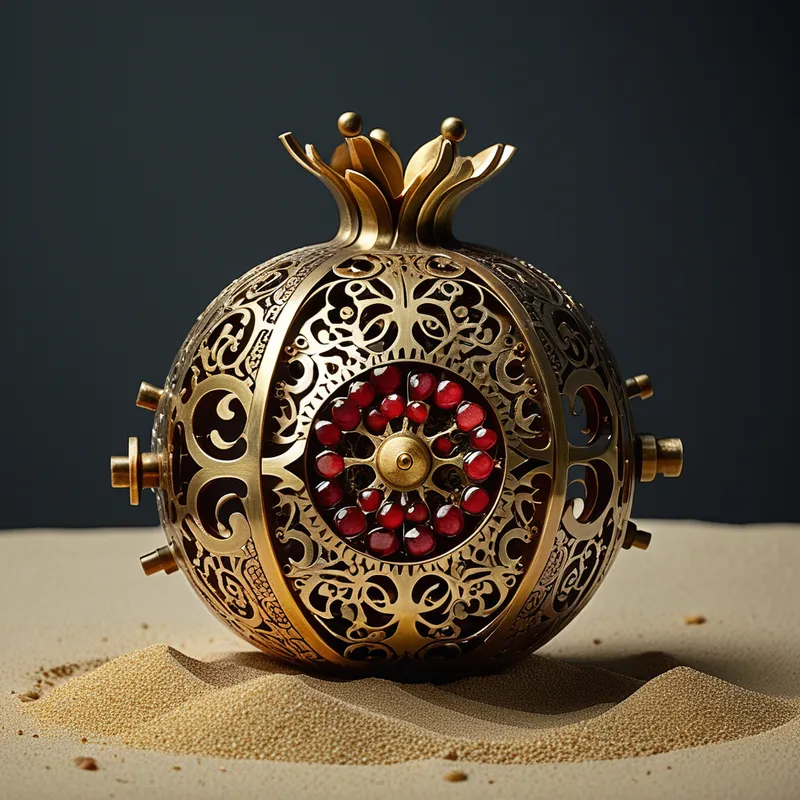
The garden’s physical perfection is its ultimate flaw. The trees of jewel and canals of silver symbolize a reality that is [static](/symbols/static “Symbol: Static represents interference, disruption, and the breakdown of clear communication or signal, often evoking feelings of frustration and disconnection.”/), untouchable, and devoid of true [life](/symbols/life “Symbol: The symbol of ‘Life’ represents a journey of growth, interconnectedness, and existential meaning, encompassing both the joys and challenges that define human experience.”/)—[water](/symbols/water “Symbol: Water symbolizes the subconscious mind, emotions, and the flow of life, representing both cleansing and creation.”/) that does not nourish, [fruit](/symbols/fruit “Symbol: Fruit symbolizes abundance, nourishment, and the fruits of one’s labor in dreams.”/) that cannot be eaten. It is a [monument](/symbols/monument “Symbol: A structure built to commemorate a person, event, or idea, often representing legacy, memory, and cultural identity.”/) to the [image](/symbols/image “Symbol: An image represents perception, memories, and the visual narratives we create in our minds.”/) of [paradise](/symbols/paradise “Symbol: A perfect, blissful place or state of being, often representing ultimate fulfillment, harmony, and transcendence beyond ordinary reality.”/), not its living essence. The desert sands that reclaim it symbolize the relentless, impersonal force of the Self and of [nature](/symbols/nature “Symbol: Nature symbolizes growth, connectivity, and the primal forces of existence.”/) itself, which will inevitably dissolve any [structure](/symbols/structure “Symbol: Structure in dreams often symbolizes stability, organization, and the framework of one’s life, reflecting how one perceives their environment and personal life.”/) that denies its fundamental laws. The [prophet](/symbols/prophet “Symbol: A messenger or seer who receives divine revelations, often warning of future events or guiding moral direction.”/) Hud represents the voice of [the Self](/myths/the-self “Myth from Jungian culture.”/), the call to remember one’s place in a larger, sacred order—a call that is often perceived by the inflated ego not as salvation, but as an insult.
The Dreamer’s Resonance
When the Garden of Iram appears in the modern [psyche](/myths/psyche “Myth from Greek culture.”/), it rarely manifests as a literal, jeweled city. Instead, one may dream of a breathtakingly beautiful but eerily silent house they have built, a perfect but joyless career achievement, or a relationship that looks ideal from the outside but feels sterile within. The somatic sensation is often one of awe mixed with dread, of being trapped in exquisite stillness.
This is the psyche signaling that a complex—a patterned cluster of thoughts, feelings, and memories—has been “perfected.” The dreamer may have constructed a brilliant intellectual defense, a flawless [persona](/myths/persona “Myth from Greek culture.”/), or a meticulously controlled life environment to avoid some core wound or vulnerability (the desert of the unconscious). The dream of Iram marks the point where this construction, however splendid, has become a sarcophagus. The rising “wind” in the dream—perhaps as anxiety, a sudden loss, or a wave of depression—is the unconscious beginning its necessary, destructive work of reintegration. The ego is being asked to relinquish its masterpiece for the messier, more fertile ground of authentic being.
Alchemical Translation
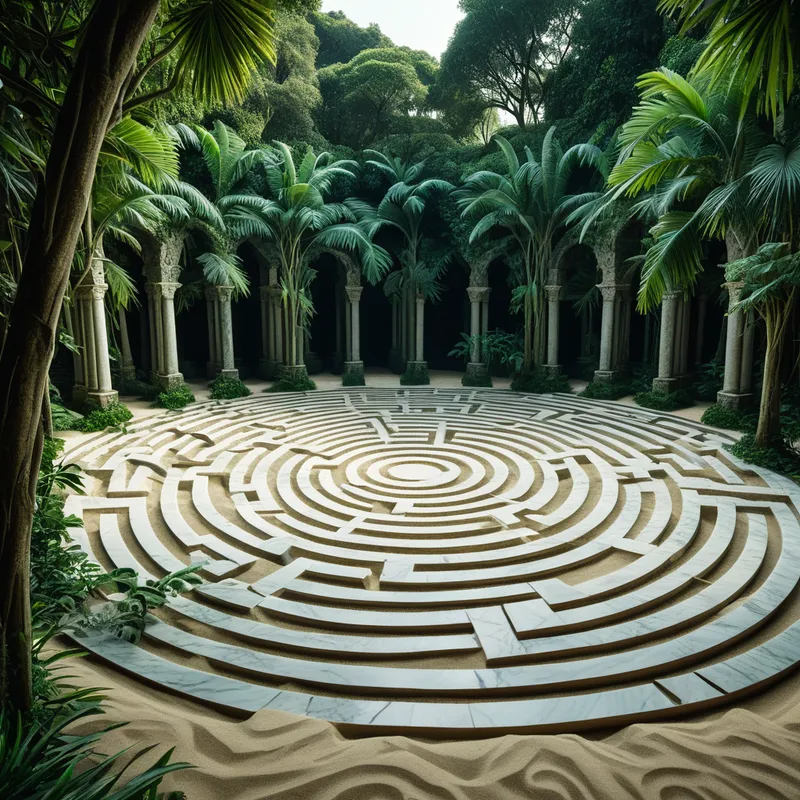
The alchemical journey mirrored in Iram’s myth is the [Nigredo](/myths/nigredo “Myth from Alchemical culture.”/), the essential first stage of putrefaction and dissolution. The proud, solar consciousness of King Shaddad (the ego) must be humbled and dissolved back into the [prima materia](/myths/prima-materia “Myth from Alchemical culture.”/) of the desert sands (the unconscious).
Individuation does not begin with building a tower, but with the courageous consent to let the sand take the first stone.
For the modern individual, the “Garden” is any aspect of the personality that has become rigidly identified with perfection, control, or self-sufficiency. The alchemical work is not to destroy beauty, but to transmute dead splendor into living growth. This requires heeding the “Hud” within—the quiet, often ignored voice of conscience or intuition that speaks of a deeper truth. The burial by sand is not a punishment, but a painful mercy. It is the process of letting a false self die so that something organic can eventually grow in its place. The paradise that emerges after this psychic death is not built; it is allowed. It is not a monument to the will, but an ecosystem that includes shadow, decay, and wild, untamable life—a true garden, rooted in earth and fed by real water, not a reflection in a jewel.
Associated Symbols
Explore related symbols from the CaleaDream lexicon: