The Garden of Eden as a primor Myth Meaning & Symbolism
The foundational story of a perfect world, a transgressive choice, and the irrevocable fall into self-awareness, responsibility, and the world of time.
The Tale of The Garden of Eden as a primor
In the beginning, before memory, there was a Pattern. Not a place, but a perfect state—a living equation of harmony. The [Ruach](/myths/ruach “Myth from Hebrew culture.”/) moved upon the deep, and from [the void](/myths/the-void “Myth from Buddhist culture.”/) of potential, it spun a garden of such coherence that every leaf knew its purpose, every creature its song. This was Eden, the first template of being, where the first humans, Adam and Chavah, walked in a state of seamless belonging. They did not know they were naked, for they were clothed in the very light of the garden itself.
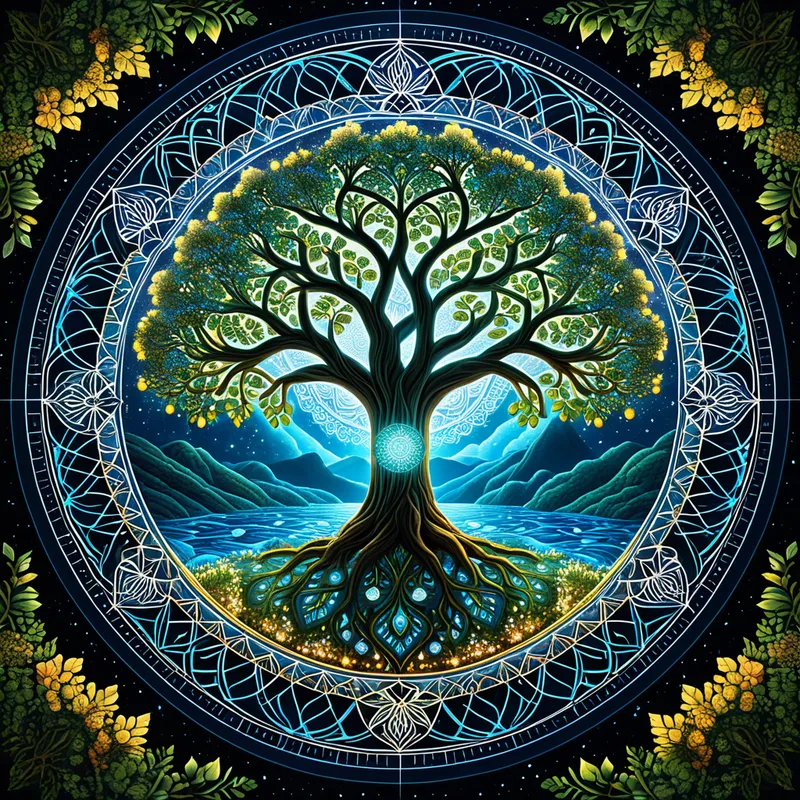
At the heart of this geometric paradise grew two trees. The [Tree of Life](/myths/tree-of-life “Myth from Kabbalistic culture.”/), whose roots drank from the four sacred rivers, pulsed with a rhythm that sustained the garden’s timeless dream. And beside it, the Tree of the Knowledge of Good and Evil, its fruit glowing with a cold, beautiful intelligence. A prohibition was given, a single boundary in a world without walls: “You shall not eat of it, for on the day you do, you shall surely die.”
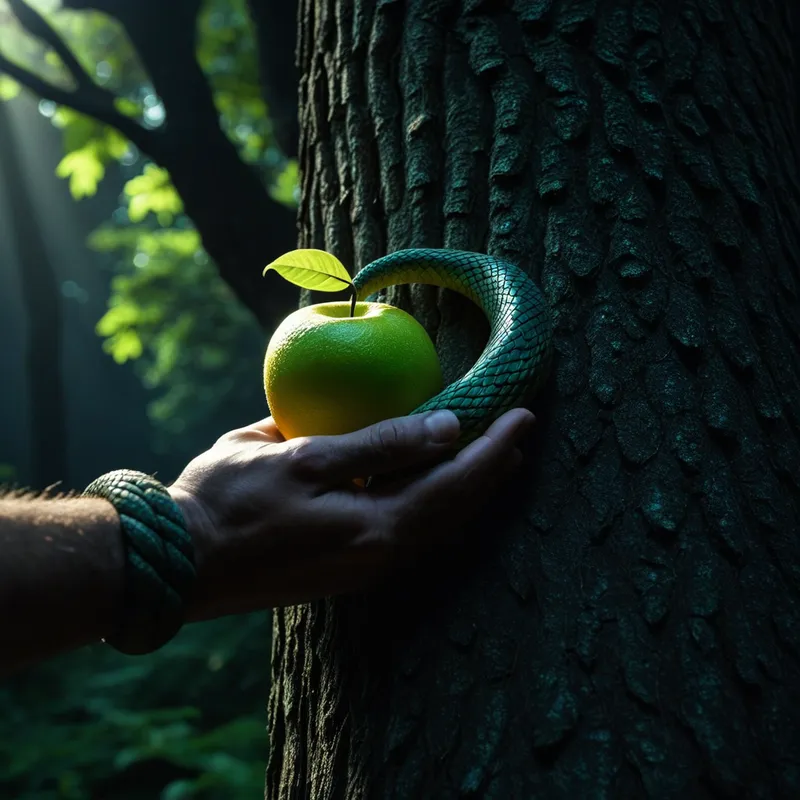
But the garden held another intelligence, the most subtle of the creatures. The Nachash did not crawl in dust but moved with a liquid grace. It posed not a threat, but a question that had never before been asked: “Has God truly said…?” Its voice was the sound of possibility cracking open. “You will not die. For God knows that on the day you eat of it, your eyes will be opened, and you will be like divine beings, knowing good and evil.”
The woman saw the fruit. It was not merely food; it was a vessel of a new kind of sight. The desire was not for rebellion, but for a completeness beyond innocence—to know as the Knowers know. She took. She ate. She gave to the man, and he ate. And in that moment, the perfect equation shattered.
The sound was not a [thunderclap](/myths/thunderclap “Myth from Various culture.”/), but a great silence falling away. Their eyes were opened, and they saw—they saw themselves, separate, vulnerable, exposed. The garden’s light now felt like a searchlight. They scrambled for fig leaves, weaving the first human artifact: clothing to hide the newly-discovered self. Then came the sound of the Voice walking in the garden in [the wind](/myths/the-wind “Myth from Various culture.”/) of the day, and they hid among the trees, their hearts a drumbeat of fear.
“Where are you?” The question echoed in the newly-created space between being and knowing. “I heard Your voice in the garden, and I was afraid, because I am naked, and I hid.” The unraveling was swift. Blame flowed from the man to the woman to the serpent. The garden, the perfect primor, could no longer hold them. Curses were spoken, not as punishments, but as descriptions of the new, fractured world now born: struggle with [the earth](/myths/the-earth “Myth from Hindu culture.”/), pain in creation, and enmity where there was once only flow.
And so, the Keruvim were placed at the east of the garden, with a flaming sword that turned every way, to guard [the way](/myths/the-way “Myth from Taoist culture.”/) to [the Tree of Life](/myths/the-tree-of-life “Myth from Kabbalistic culture.”/). The humans were sent out, not into a wasteland, but into [the world](/myths/the-world “Myth from Tarot culture.”/)—a world of thorns and sweat, of birth and death, of time. They looked back only once, at the receding glow of the pattern, now forever closed behind them, the first and last exiles.
Cultural Origins & Context
The story of [the Garden of Eden](/myths/the-garden-of-eden “Myth from Global/Universal culture.”/) is the foundational primor myth of the Abrahamic traditions, primarily preserved in the Book of Genesis, the first book of the Hebrew Torah. Its origins are a complex tapestry woven from Mesopotamian, Canaanite, and distinct Israelite threads. Elements like the cosmic garden, the cunning serpent, and the life-giving tree find echoes in older myths such as the Sumerian tale of Enki and Ninhursag or [the Epic of Gilgamesh](/myths/the-epic-of-gilgamesh “Myth from Mesopotamian culture.”/).
It was not a story told for historical record, but a profound etiological and theological narrative passed down through priestly and wisdom traditions. Its societal function was multifaceted: it explained the human condition—why we labor, why we feel shame, why we die. It established a covenant relationship with the divine, defined by law and moral choice. Most importantly, it framed the entire human journey as beginning with a fall from unity into a world of moral complexity and striving, setting the stage for all subsequent biblical themes of exile, redemption, and the longing for return.
Symbolic Architecture
The Garden is not a historical [location](/symbols/location “Symbol: The symbol of ‘Location’ signifies a sense of place, context, and the environment in which experiences unfold.”/), but the symbolic [architecture](/symbols/architecture “Symbol: Architecture in dreams often signifies structure, stability, and the framing of personal identity or life’s journey.”/) of the unconscious, pre-conscious state. It represents the [womb](/symbols/womb “Symbol: A symbol of origin, potential, and profound transformation, representing the beginning of life’s journey and the unconscious source of creation.”/) of undifferentiated being, where [the self](/myths/the-self “Myth from Jungian culture.”/) is perfectly integrated with its environment and the divine. There is no [separation](/symbols/separation “Symbol: A spiritual or mythic division between realms, states of being, or consciousness, often marking a transition or loss of connection.”/), no [reflection](/symbols/reflection “Symbol: Reflection signifies self-examination, awareness, and the search for truth within oneself.”/), no “I.”
The Fall is not a crime, but the first, traumatic act of consciousness. To know good and evil is to perceive duality, to see the self as an object in a field of other objects.
The [Tree](/symbols/tree “Symbol: In dreams, the tree often symbolizes growth, stability, and the interconnectedness of life.”/) of the [Knowledge](/symbols/knowledge “Symbol: Knowledge symbolizes learning, understanding, and wisdom, embodying the acquisition of information and enlightenment.”/) of Good and Evil symbolizes the [dawn](/symbols/dawn “Symbol: The first light of day, symbolizing new beginnings, hope, and the transition from darkness to illumination.”/) of discernment, the cognitive function that splits the world into categories. Eating its [fruit](/symbols/fruit “Symbol: Fruit symbolizes abundance, nourishment, and the fruits of one’s labor in dreams.”/) is the irreversible acquisition of self-[awareness](/symbols/awareness “Symbol: Conscious perception of self, surroundings, or internal states. Often signifies awakening, insight, or heightened sensitivity.”/), which simultaneously bestows great power (like divine beings) and exiles one from the [bliss](/symbols/bliss “Symbol: A state of profound happiness and spiritual contentment, often representing fulfillment of desires or alignment with one’s true self.”/) of unconscious unity. The Nachash is the archetypal [trickster](/symbols/trickster “Symbol: A boundary-crossing archetype representing chaos, transformation, and the subversion of norms through cunning and humor.”/) and the catalyst of [consciousness](/symbols/consciousness “Symbol: Consciousness represents the state of awareness and perception, encompassing thoughts, feelings, and experiences.”/) itself—the [inner voice](/symbols/inner-voice “Symbol: A spiritual or subconscious guide representing intuition, conscience, or higher self, often seen as a connection to divine wisdom or ancestral knowledge.”/) of curiosity, doubt, and the drive to transcend limits, often clothed in the [shadow](/symbols/shadow “Symbol: The ‘shadow’ embodies the unconscious, repressed aspects of the self and often represents fears or hidden emotions.”/) of deceit.
The Keruvim and the flaming sword represent the impossibility of [regression](/symbols/regression “Symbol: A psychological or spiritual return to earlier states of being, often involving revisiting past patterns, memories, or developmental stages for insight or healing.”/). Once consciousness is attained, one cannot simply “go back” to [innocence](/symbols/innocence “Symbol: A state of purity, naivety, and freedom from guilt or corruption, often associated with childhood and moral simplicity.”/). The [path](/symbols/path “Symbol: The ‘path’ symbolizes a journey, choices, and the direction one’s life is taking, often representing individual growth and exploration.”/) is sealed; the only way is forward through the difficult world of experience.
The Dreamer’s Resonance
When this myth stirs in modern dreams, it often manifests as a profound somatic and psychological crossroads. The dreamer may find themselves in a pristine, beautiful environment—a perfect house, a serene landscape—that suddenly reveals a hidden flaw, a forbidden room, or a lurking, intelligent animal. There is a palpable tension between the comfort of the place and a compelling, anxious urge to know what is hidden or to cross a boundary.
The psychological process is one of impending awakening. The dream ego is on the cusp of integrating a piece of knowledge about itself that will change everything. This is often accompanied by somatic sensations of exposure (dreams of being naked in public) or of being caught (hiding, hearing footsteps). The dream signals that a state of naive [projection](/myths/projection “Myth from Alchemical culture.”/) or unconscious identification is ending. The price of this new knowledge is the loss of a previous, simpler sense of self and belonging—a mini-exile. The dreamer is processing the grief and fear that accompanies psychological birth.

Alchemical Translation
The alchemy of the Eden myth is the transmutation of unconscious paradise into conscious, responsible individuality—the core of Jungian individuation. [The prima materia](/myths/the-prima-materia “Myth from Alchemical culture.”/) is the state of innocent projection, where we blame the outer world (the serpent, the woman, God) for our condition. [The opus](/myths/the-opus “Myth from Alchemical culture.”/) is to reclaim the eaten fruit, not as sin, but as the stolen fire of consciousness.
The goal is not to re-enter the Garden, but to cultivate the conscious temenos within the field of exile. We must become the gardeners of our own divided nature.
[The first stage](/myths/the-first-stage “Myth from Alchemical culture.”/) ([nigredo](/myths/nigredo “Myth from Alchemical culture.”/)) is the confrontation with [the shadow](/myths/the-shadow “Myth from Jungian culture.”/), represented by the serpent and the discovery of nakedness. We must own our capacity for transgression and discernment. The second stage (albedo) is the washing clean of pure blame; we integrate the fact that our consciousness, with all its pain, is also our divine spark. The final stage ([rubedo](/myths/rubedo “Myth from Alchemical culture.”/)) is the reconciliation of opposites: the Tree of Life and the [Tree of Knowledge](/myths/tree-of-knowledge “Myth from Abrahamic culture.”/) are seen as two aspects of one reality. The flaming sword is not a barrier, but a transformative fire that forges the conscious individual who can bear the weight of knowledge and still choose life-affirming action. The exiled one becomes the responsible creator, tending the world—their inner and outer world—with hard-won wisdom, having made the long journey from primor to person.
Associated Symbols
Explore related symbols from the CaleaDream lexicon: