
The Garden of Eden Myth Meaning & Symbolism
A story of primordial unity, a forbidden choice, and the irrevocable dawn of consciousness, exiling humanity into the world of time and toil.
The Tale of The Garden of Eden
In the beginning of beginnings, before the word “before” had meaning, there was a garden. Not a garden as we know it, of labor and season, but a place of pure emanation. It was called Eden, and it was the navel of the world, watered from beneath by a deep, mysterious spring that parted into four great rivers carrying the essence of life to the corners of creation. Here, the air was not air but a fragrant breath; the light did not fall but simply was, clothing every leaf and petal in a soft, eternal gold.
Into this tapestry of unbroken unity, the Lord God placed the human, Adam, formed from the red clay of the earth and animated by the divine breath. His task was simple: to tend and keep. To name. He walked in a state of nakedness that knew no shame, for he was of one substance with the garden itself. Seeing his solitude, God crafted from his side a companion, Eve. Bone of his bone, flesh of his flesh. They were two, yet one—a mirrored harmony in the heart of paradise.
At the center of the garden grew two trees. The Tree of Life, and the Tree of the Knowledge of Good and Evil. Of the latter, God spoke a single, resonant command: “You shall not eat of it, for in the day that you eat of it, you shall surely die.”
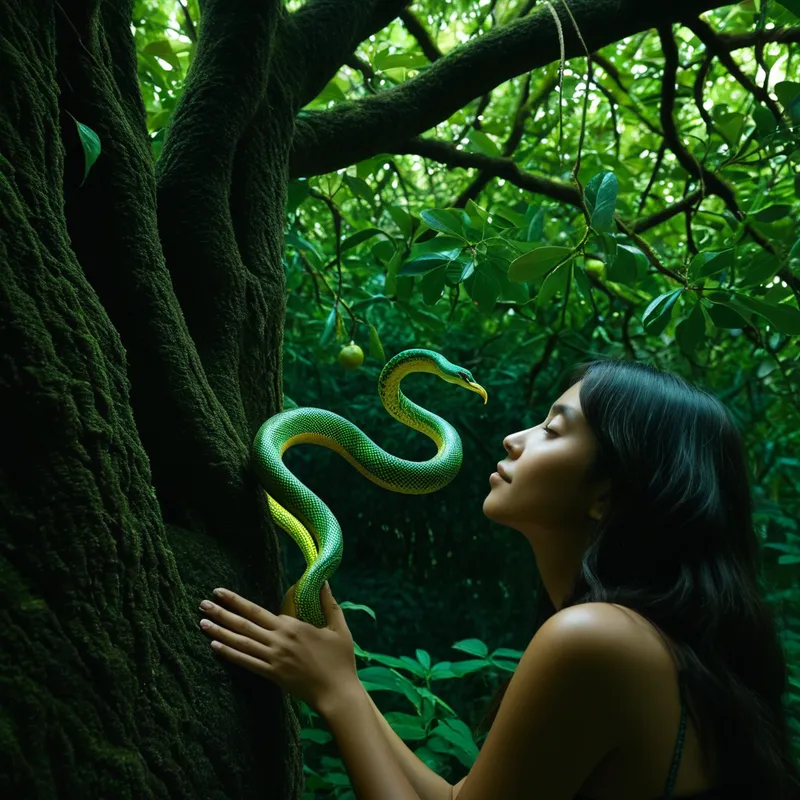
Then came the serpent, the most subtle of all creatures. It did not slither as a thief, but moved with a knowing grace. “Has God said you shall not eat of any tree?” it whispered, its voice the sound of wind through ripe wheat. Eve corrected, but the seed was sown. “You will not surely die,” the serpent continued. “For God knows that when you eat of it, your eyes will be opened, and you will be like God, knowing good and evil.”
The woman looked at the tree. She saw that it was good for food, a delight to the eyes, and desirable to make one wise. The fruit hung, heavy with potential. She took. She ate. She gave to her man, who was with her, and he ate.
And in that moment, the world cracked. Their eyes were opened, and they knew they were naked. They heard the sound of the Lord God walking in the garden in the cool of the day, and for the first time, they hid—sewing fig leaves into crude aprons, their hearts pounding a new, frantic rhythm called fear.
“Where are you?” called the voice that once was home.
One by one, the questions fell. The man blamed the woman. The woman blamed the serpent. And the serpent had no defense. Then came the pronouncements, not as curses, but as the inevitable grammar of a new reality. Pain in childbirth. Toil from thorn-infested ground. And finally, exile. “Behold, the man has become like one of us, knowing good and evil. Now, lest he put out his hand and take also of the Tree of Life, and eat, and live forever…” So the Lord God sent them out from the garden of Eden, to till the ground from which they were taken. He placed cherubim and a flaming sword that turned every way, to guard the way to the Tree of Life.
They walked out, hand in hand, into the east. Into the world of time, of sweat, of death, and of story.
Cultural Origins & Context
This narrative forms the foundational myth of the Abrahamic traditions—Judaism, Christianity, and Islam—originating in the Hebrew Bible’s Book of Genesis. Its precise origins are woven from ancient Near Eastern threads, resonating with Mesopotamian myths of a lost primordial paradise and a great flood. It is a cosmogonic and etiological tale, composed by priestly and wisdom traditions to answer profound human questions: Why do we labor? Why do we feel shame? Why are we mortal? Why is there suffering?
It was not merely a story of the past but a living template for understanding the human condition. It established a covenant relationship with the divine, defined the concepts of commandment, transgression, and consequence, and framed history as a narrative of fall and potential redemption. For millennia, it has been transmitted through sacred text, sermon, art, and literature, serving as the bedrock for Western conceptions of sin, free will, and the nature of knowledge itself.
Symbolic Architecture
The Garden is not a location, but a state of being: the unconscious unity of the psyche before the dawn of ego-consciousness. It is the womb of the world, where the self and the other are undifferentiated.
The Fall is not a moral catastrophe, but a psychological necessity. It is the birth of the ego, the painful emergence of the “I” from the oceanic “We.”
Adam represents nascent humanity, existing in pure potential but without self-awareness. Eve is the catalyst for consciousness—the anima that draws the psyche toward experience and relationship. The serpent is the trickster, the embodiment of the deep, chthonic wisdom of the unconscious that pushes growth, even through subversion. It is the necessary shadow that forces evolution.
The fruit is the symbol of consciousness itself—bitter and sweet, bringing both the burden of moral choice (knowledge of good and evil) and the exile from instinctual paradise. The Tree of Life represents the static, eternal state of unconscious immortality, now forever out of reach. The true “death” warned of is the death of unconscious innocence.
The Dreamer’s Resonance
When this myth stirs in the modern dreamscape, it signals a profound transition in the dreamer’s psychic life. Dreaming of a pristine, walled garden may reflect a longing for security, a retreat from complexity, or a feeling of being trapped in a state of childish innocence. Dreaming of eating a forbidden fruit often coincides with a real-life choice that carries the weight of consequence—leaving a relationship, changing a career, speaking a difficult truth—actions that irrevocably alter one’s self-perception and place in the world.
The somatic feeling is often one of simultaneous thrill and dread. One may wake with a sense of guilt without a clear cause, or a profound loneliness, as if cast out from a familiar emotional home. This is the psyche processing its own “fall” into greater consciousness, mourning the simpler self that must be left behind to make room for a more complex, and more responsible, identity.
Alchemical Translation
The alchemical journey does not seek a return to the Garden, for that is the prima materia—the unconscious, leaden state of beginning. The goal is the lapis philosophorum—the Philosopher’s Stone—which is a conscious, earned wholeness that integrates the knowledge gained in exile.
The flaming sword guards not against our return, but against a regression. Our task is not to re-enter Eden, but to cultivate its essence within the field of our own conscious, toiled existence.
The process begins with Acknowledgement (The Taste of the Fruit): confronting the shadow, the serpentine wisdom within us that compels us toward difficult knowledge and breaks our naive projections. This is the nigredo, the blackening, where we feel the shame and alienation of our own complexity.
It proceeds through Confrontation (The Questions in the Garden): owning our choices without blame. This is the albedo, the whitening, where we purify our narrative, separating our true responsibility from the fig leaves of excuse.
It culminates in Integration (The Tilling of the Ground): accepting exile as the condition for creativity. The cursed ground becomes the alchemical vessel. Our toil—our relationships, our art, our suffering—is the slow, conscious work of transmuting the base metal of experience into the gold of meaning. We cannot live forever in unconscious bliss, but through the labor of consciousness, we can create something durable and sacred in the finite world. The true “Tree of Life” we seek is not a relic behind us, but the living, growing tree of the individuated Self, rooted in the hard earth of reality, reaching for a sky it now consciously perceives.
Associated Symbols
Explore related symbols from the CaleaDream lexicon:
- Garden
- Lush Garden
- Bountiful Orchard
- Fertile Valley
- Celestial Garden
- Fruitful Orchard
- Lush Expanse
- Nostalgic Prologue
- Suburban Neighborhood
- Utopian Community
- Rustic Farmstead
- Forgotten Garden
- Aromatic Herb Garden
- City Park
- Forgotten Sanctuary
- Tended Garden Plot
- Self’s Garden
- Sandbox
- Setting
- Secret Garden