The Furies Myth Meaning & Symbolism
Ancient goddesses of blood vengeance transformed into guardians of justice, embodying the psyche's unyielding demand for moral order and integration.
The Tale of The Furies
Hear now a tale not of bright Olympus, but of the deep and ancient dark. A tale of blood that cries from the ground, and of the ones who answer.
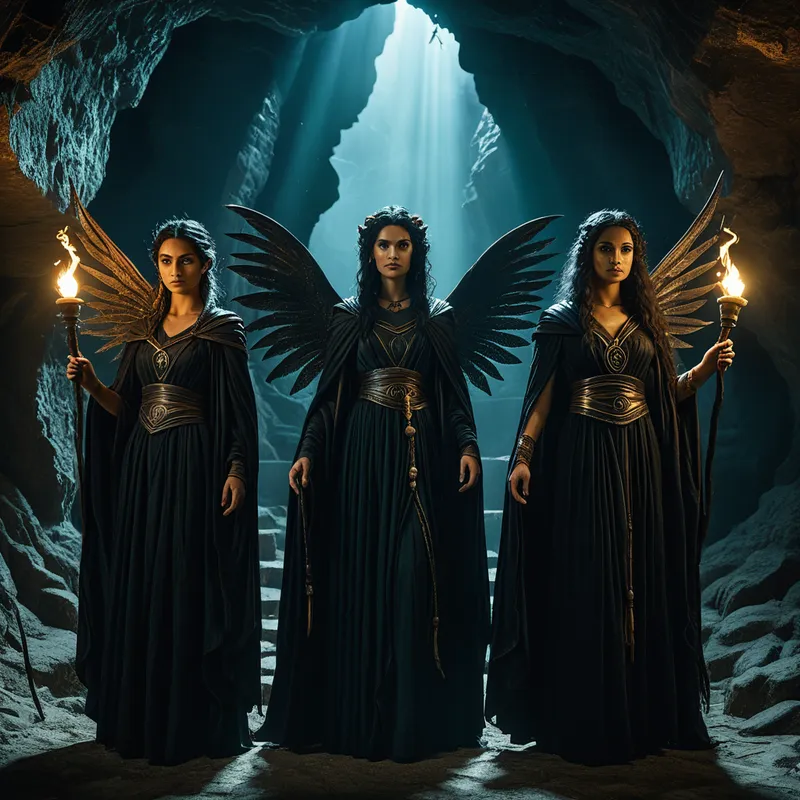
Before the reign of Zeus, in the first raw days of the world, the goddess Gaia was stained by the blood of her husband, the sky-god Ouranos, cast down by his son. From those drops that fell into her dark soil, she birthed them: the Erinyes. They were the Daughters of the Night, older than time, older than law. They had no temples, for their shrine was the human heart in turmoil. Their hair was a nest of black serpents, their eyes wept tears of blood, and their breath was the stench of decay. They carried brazen whips and torches that cast no comforting light, only the shadow of a deed undone.
Their purpose was singular, absolute: to hound those who shed kindred blood. No prayer could sway them, no offering appease them. They were the curse given form, the ghost of the crime made flesh.
And so they found Orestes. His father, King Agamemnon, was slain in his bath by his wife, Clytemnestra. The blood cried out, and the Furies descended upon the queen, a torment of buzzing wings and whispered accusations. But then, bound by a darker filial duty, Orestes raised his sword. He avenged his father by spilling his mother’s life upon the same stones. In that instant, the old curse doubled. The Furies, sated by one death, were awakened anew by another. They turned from the cooling body of the mother to the living son.
They did not strike him down. That was not their way. They became his shadow, his constant companions. Where Orestes fled, they followed—a chorus of shrieks only he could hear, a vision of gore only he could see. They coiled around his mind, whispering of the matricide, showing him his mother’s accusing eyes in every pool of water. He ran across the world, from Delphi to Athens, a man pursued not by armies, but by the very fabric of his own shattered soul. He found no rest, for they were his restlessness incarnate.
His flight ended in Athens, at the court of the goddess Athena. Here, under the cold gaze of the new Olympian order, a trial was held. The Furies, ancient and terrible, stood as prosecutors. Apollo, shining and rational, stood as Orestes’s defender. The argument echoed in the marble hall: the old law of blood-for-blood against the new law of civic justice. The jury of Athenian citizens was tied. Then Athena, born not of a mother but from the head of Zeus, cast her vote for Orestes. He was acquitted.
But the story does not end with his freedom. Look at the Furies. Robbed of their prey, they howled in rage, threatening to poison the very soil of Athens with their wrath. And here, Athena did not banish them. She spoke to them, not as monsters, but as potent, necessary powers. She offered them a new home, a new honor. She renamed them the Eumenides, the “Kindly Ones.” No longer would they haunt the wilds; they would have a sacred cave beneath the city, and receive offerings from its citizens. They would become guardians of justice from below, protectors of the social order, the sacred terror that keeps oaths unbroken. Their fury was not destroyed, but transformed. The torches they once carried to hunt the guilty would now light the way for bridal processions. The ancient dark was invited in, given a seat at the hearth, and in doing so, the world was made whole.
Cultural Origins & Context
The myth of the Furies is not a singular story from one author, but a deep, collective strand in the tapestry of Greek religious thought. Their earliest mentions are in the works of Homer and Hesiod, where they are already established as terrifying, primordial forces. They represent a layer of belief older than the Olympian pantheon—chthonic deities connected to the earth, death, and the absolute, pre-political morality of the clan.
Their primary societal function was as the ultimate enforcement mechanism for the most sacred Greek law: the prohibition against kin-slaying. In a world before police or courts, the fear of the Furies was a powerful social glue. They externalized the inevitable psychological torment of the guilty, making it a divine, inescapable certainty. The myth was performed most famously in Aeschylus’s trilogy, The Oresteia, which was staged for the citizenry of Athens in the 5th century BCE. This was not mere entertainment; it was a profound piece of civic theology. Performed during the festival of Dionysus, the play used the ancient myth to dramatize Athens’ own transition from a culture of blood feud and tribal vengeance to one of civic law, trial by jury, and rational justice—a transition the city was actively navigating.
Symbolic Architecture
The Furies are the psyche’s own moral immune system, activated by a specific psychic toxin: the violation of fundamental, natural law.
They are the embodiment of conscience, not as a quiet voice, but as a festering, screaming wound that will not heal until the moral order is addressed.
Psychologically, they represent the Shadow in its most acute and personified form. They are everything the conscious mind wants to disown—guilt, rage, primitive instinct, the consequences of our actions. Orestes’s flight is the ego’s desperate attempt to outrun its own shadow, a futile endeavor, for the shadow is cast by the very light of one’s own being. The Furies are not evil; they are relentless. Their pursuit is an agonizing service: they force a confrontation with the deed that cannot be undone.
Their transformation into the Eumenides is the central symbolic miracle of the myth. It models the process of integrating the shadow. The terrifying, disruptive energy is not eliminated (which is impossible) but is re-contextualized. By giving them a home and a new name, Athena acknowledges their power and necessity. The raw, vengeful impulse is alchemized into a protective, social force. The personal guilt (Orestes’s crime) becomes the foundation for collective justice (the Athenian court).
The Dreamer’s Resonance
When the pattern of the Furies erupts in modern dreams, it signals that a deep, unconscious moral or ethical violation is demanding recognition. The dreamer is not necessarily a murderer, but they have committed a soul crime.
You may dream of being pursued by faceless, terrifying figures through endless corridors. You may hear a persistent, accusing whisper just beyond hearing, or feel a chilling presence in the room upon waking. The somatic experience is one of dread, tightness in the chest, and a restless anxiety that feels both personal and archetypal. The “Furies” in the dream are the psychological symptoms of repressed guilt, shame, or unacknowledged betrayal—whether you betrayed another, your own values, or were yourself betrayed. The dream is the psyche’s attempt to hunt you down, to force you to turn and face what you have been fleeing. The torment is the price of avoidance. The dream insists: you must stand trial in the court of your own soul.
Alchemical Translation
The myth of the Furies is a master blueprint for psychic alchemy—the transformation of leaden guilt into golden responsibility.
The first stage is the Crime (the spilling of kin blood, the betrayal of a deep trust). This is the catalyst. The second is the Pursuit (the Furies’ hounding). This is the necessary, painful period of symptomology—the depression, anxiety, and relational chaos that forces the issue to the surface. One cannot skip this stage; to try is to remain eternally haunted.
The third stage is the Trial. This is the conscious, often excruciating, work of introspection and accountability. The “Apollo” in us (rationalization, defense, intellectualization) argues for our innocence. But the trial is not about escape; it’s about hearing the full, terrible accusation. The final, alchemical stage is the Integration, presided over by the “Athena” principle—the higher, reconciling wisdom of the Self.
The goal is not acquittal from the consequences, but the transformation of the punishing Fury into the protective Eumenix within.
This means consciously taking the energy of our guilt, shame, or rage and redirecting it. The fury over a personal betrayal becomes a fierce commitment to honesty. The guilt over a past harm becomes active compassion. We build an inner “sacred cave” for this once-terrifying power, making it a guardian of our integrity rather than a persecutor of our peace. We rename our pain. We do not become innocent again; we become responsible. The myth teaches that our deepest torments, when faced with courage and wisdom, contain the seed of our most sacred guardianship. The Kindly Ones, once the Furies, now watch from within, ensuring we never again flee from the truth of our own deeds.
Associated Symbols
Explore related symbols from the CaleaDream lexicon: