The Fruit of Knowledge Myth Meaning & Symbolism
A foundational myth of consciousness, where a choice to eat forbidden fruit shatters innocence and births the human experience of self-awareness and mortality.
The Tale of The Fruit of Knowledge
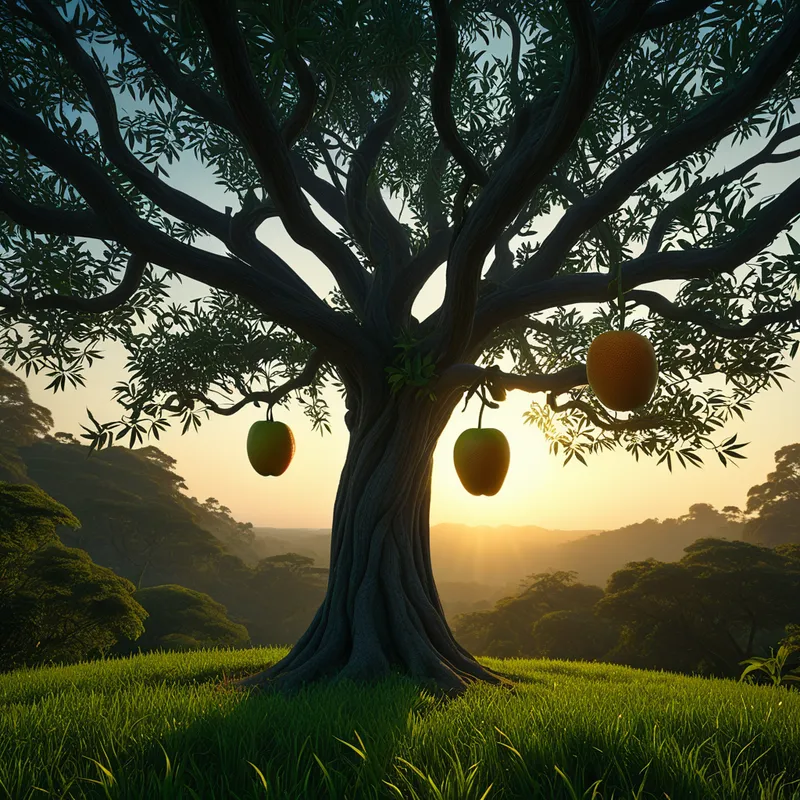
In the beginning, there was a garden. Not a garden as we know it, of weeds and toil, but a garden of utter completion. The air was a perfume of soil and blossom, the light a soft gold that knew no shadow. Rivers of milk and honey—four of them—watered the earth. And in the midst of this perfection, Adam walked, and beside him, Eve, bone of his bone, flesh of his flesh. They were naked and felt no shame, for they were like children in the mind of their maker, Yahweh.
But in the center of the garden grew two trees. One was the Tree of Life. The other was the Tree of the Knowledge of Good and Evil. A single command echoed in the stillness: “You may eat from every tree. But from this one tree, you shall not eat, for on the day you eat of it, you shall surely die.”
Then came the serpent, the most cunning of all the creatures Yahweh had made. It did not slither as a monster, but with a knowing grace. It found the woman by the forbidden tree and spoke, its voice a whisper that vibrated in the very roots of the world.
“Did God truly say you may not eat from any tree in the garden?”
The woman replied, “We may eat from the trees. But from the fruit of the tree in the middle of the garden, God said, ‘You shall not eat it, nor shall you touch it, lest you die.’”
The serpent’s whisper became a promise. “You will not die. For God knows that on the day you eat of it, your eyes will be opened, and you will be like gods, knowing good and evil.”
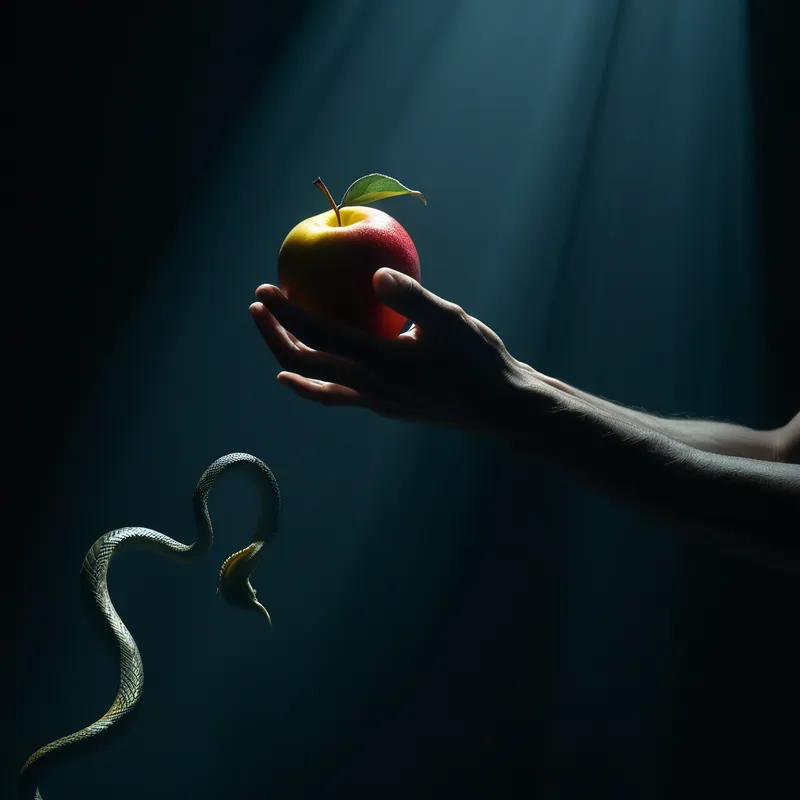
The woman looked at the tree. She saw that its fruit was good for food, a delight to the eyes, and desirable to make one wise. The air grew heavy with choice. She reached out, plucked the fruit, and ate. She gave some to her husband, who was with her, and he ate.
In that moment, the world cracked. The gold light turned sharp. Their eyes were opened, and they knew they were naked. They heard the sound of Yahweh walking in the garden in the cool of the day, and they hid among the trees, their hearts a drumbeat of terror.
“Where are you?” the voice called.
And the man, his voice trembling, answered from the shadows, “I heard the sound of you in the garden, and I was afraid, because I was naked, and I hid.”
Then came the questions, the blame—the man to the woman, the woman to the serpent. And the voice pronounced the consequences: enmity, pain in childbirth, toil upon cursed ground. And finally, expulsion. For now, having taken knowledge, they must be barred from the Tree of Life, lest they live forever in this state of fractured knowing.
So Yahweh sent them out, east of Eden, and placed cherubim and a flaming sword that turned every way to guard the way back to the garden. The humans turned their faces toward the unknown world, their backs to paradise, their minds now a landscape of morality, desire, shame, and death.
Cultural Origins & Context
This story forms the opening chapters of the book of Genesis. It is a foundational narrative for Judaism, Christianity, and Islam—the three great Abrahamic faiths. Its origins are complex, woven from ancient Near Eastern traditions and oral histories, likely refined during the Babylonian Exile in the 6th century BCE as the Israelites sought to define their unique relationship with the divine against a pantheon of other gods.
It was never meant as a literal, historical report. It is etiological myth—a story that explains why things are the way they are: why humans labor, why birth is painful, why we wear clothes, why we die, and most profoundly, why we possess a moral conscience and a sense of separation. It was told around fires, recited by priests, and pondered by sages to answer the most aching human question: “If the world is created good, why does it feel so broken?” It established the human condition not as a mere accident, but as the consequence of a primordial choice.
Symbolic Architecture
The myth is a dense matrix of symbols mapping the birth of psychological consciousness.
The fruit is not an apple of sin, but the seed of self-reflection.
The Garden represents the unconscious, paradisiacal state of infancy—a world of immediate need-fulfillment without differentiation between self and other. The Command is the first imposition of a boundary, the “No” that creates the possibility of choice and, therefore, of a self that can choose.
The Serpent is the trickster, the catalyst of consciousness. It is not pure evil, but the embodiment of questioning, cunning, and the disruptive force that ends stagnation. It speaks the uncomfortable truth: growth requires a break from imposed innocence.
The Fruit of Knowledge of Good and Evil is the dawn of duality. To “know” good and evil is to possess ethical discrimination, but also to experience the painful split between what is desired and what is forbidden, between self and world, between innocence and experience. This knowledge is the awareness of our own nakedness—our vulnerability, our mortality, our separateness.
Expulsion from Eden is not a punishment, but a necessity. One cannot become conscious and remain in the womb.
The Flaming Sword guarding Eden is a poignant symbol. It does not merely block return; it represents the irreversible nature of consciousness. You cannot unknow what you know. The journey is forward, into history, into the complexity of life, not backward into unconscious bliss.

The Dreamer’s Resonance
When this myth stirs in modern dreams, it signals a critical threshold in the dreamer’s psychological development. Dreaming of a forbidden, radiant fruit often coincides with a life stage where a long-held innocence or a comfortable ignorance is being challenged.
The somatic feeling is one of simultaneous dread and irresistible attraction—a tightness in the chest, a trembling hand. The dream-ego stands at the edge of a choice that promises wisdom but guarantees the end of a simpler self. Perhaps you dream of eating something you shouldn’t and suddenly seeing the hidden flaws in your relationships, your work, or your own psyche. This is the “eyes being opened” of the dream world. The subsequent shame or fear of discovery mirrors the integration of a new, often uncomfortable, self-awareness. You are, in the dream, experiencing your own personal “fall” into a more complex, more responsible, and more isolated state of being—the necessary death of a naive ego.

Alchemical Translation
Psychologically, the myth perfectly models the alchemical process of individuation. The goal is not to return to the unconscious Garden, but to transmute the raw material of the “Fall” into conscious gold.
The first stage, Nigredo (the blackening), is the expulsion itself—the depression, confusion, and sense of alienation that follows any major awakening or life crisis. We feel cursed to toil in the fields of our own psyche.
The work of soul is to take the knowledge of our nakedness and, instead of hiding, learn to weave garments of conscious identity.
The Albedo (the whitening) is the slow, painful work of understanding that knowledge. We examine our “good and evil”—our moral failures, our capacities, our shadows. We take responsibility, moving beyond blaming the serpent (our instincts) or our partner (our anima/animus).
Finally, the Rubedo (the reddening) is the achievement of a conscious paradise. It is the realization that the Tree of Life was never meant for the unconscious innocent, but for the one who has eaten the bitter fruit of experience and chosen integration anyway. The flaming sword remains, a reminder of our hard-won consciousness, but it no longer bars the way to wholeness; it illuminates the path. We cannot go back to not knowing, but we can move forward to a wisdom that encompasses both the garden and the fall, transforming the forbidden fruit from a symbol of transgression into the very nourishment for a mature soul.
Associated Symbols
Explore related symbols from the CaleaDream lexicon: