The Four Treasures Myth Meaning & Symbolism
The Tuatha Dé Danann brought four magical treasures to Ireland, each embodying a divine principle of sovereignty, truth, and psychic wholeness.
The Tale of The Four Treasures
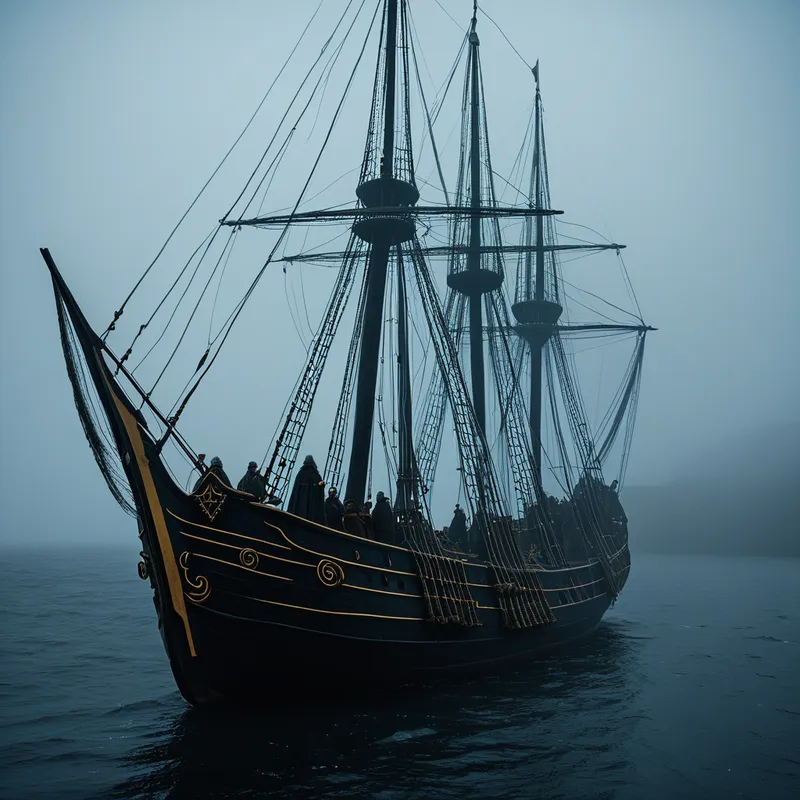
Listen, and let the mist of memory gather. It was a time before time was counted, when the world was younger and the veil between the worlds was thin as a moth’s wing. From the northern isles of the world, from the four mythic cities of learning, they came: the Tuatha Dé Danann, the People of the Goddess Danu. They did not come as conquerors, but as a mystery, arriving in a single day upon the shores of Éire. A great fog, conjured by their potent magic, cloaked the sun for three days, and when it lifted, they stood upon the land.
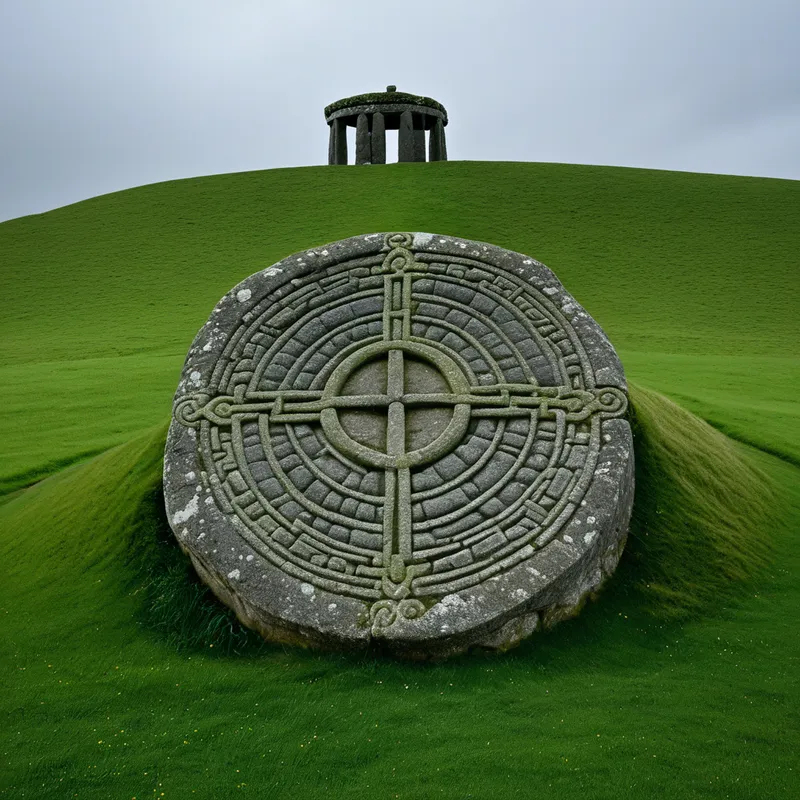
They were not empty-handed. From each of their four great cities, they bore a treasure, a hallowed gift and a testament to their nature. From Falias came the Lia Fáil. It was no ordinary rock, but the very soul of the land given form, a pillar of destiny that would shriek with a voice of thunder when the rightful sovereign stood upon it.
From Gorias they brought the Spear of Lugh. Forged in a sun that never set, it was a weapon that thirsted for battle, a flash of lightning made solid. None could stand against it, and none who wielded it could know defeat while it was in their hand.
From Findias was carried the Sword of Nuada. Its blade was of a metal that drank the light, so keen and terrible that once it was drawn from its jeweled scabbard, it would not be sheathed again until it had tasted blood.
And from the deep, watery halls of Murias came the greatest mystery of all: the Cauldron of the Dagda. No company, however vast, could empty it; it gave food according to the merit of the person, and from its depths, the slain could be returned to life, though they would thereafter speak only truths.
With these four powers—the stone of truth, the spear of will, the sword of justice, and the cauldron of rebirth—the Tuatha Dé Danann faced the Fir Bolg, the people who held the land. The First Battle of Mag Tuired was fierce and fateful. King Nuada lost his arm and, with it, his kingship, for a blemished king could not stand upon the Lia Fáil. The treasures were tested. The spear flashed, the sword sang, the cauldron restored. And though they prevailed, a shadow was cast, for a greater enemy, the monstrous Fomorians, stirred in the deep. The treasures had found their home, but their tale, and the fate of Ireland, had only just begun to unfold.
Cultural Origins & Context
The myth of the Four Treasures is preserved primarily within the medieval Irish textual tradition, most notably in the Lebor Gabála Érenn (The Book of Invasions), a pseudo-historical compilation that seeks to chronicle the successive settlements of Ireland. It is crucial to understand that these texts were written by Christian monks centuries after the pagan Celtic period, meaning the myths are refracted through a new theological lens. The treasures are not merely plot devices; they are foundational symbols of sovereignty and divine right.
The story functioned as a dindshenchas (lore of places), explaining and sanctifying the political landscape. The Hill of Tara, where the Lia Fáil resided, was the sacred seat of the High Kings. The myth thus provided a divine charter for kingship: true rule was not merely a matter of strength, but of a mystical, correct alignment with the land itself, verified by the stone’s cry. The treasures anchored the otherworldly Tuatha Dé Danann to the physical geography of Ireland, blending their magic with its soil and stones. They were told by filid (poet-seers) to affirm the cosmic order and the sacred contract between the ruler, the people, and the land.
Symbolic Architecture
The Four Treasures are not random magical items; they form a complete symbolic system, a quartet of primal powers necessary for a whole and sovereign existence, both for a kingdom and for a psyche.
The Treasures represent the four pillars of a complete world: the foundation that validates, the force that initiates, the boundary that defines, and the vessel that transforms.
The Lia Fáil (Stone) symbolizes the foundational Truth of the Self. It is the internal touchstone, the core identity and destiny that resonates only when one stands authentically in one’s own authority. Its “cry” is the somatic and psychic confirmation of alignment.
The Spear of Lugh represents focused Will and Aspiration. Lugh is the master of all arts, and his spear is the directed, piercing energy required to pursue a goal, to break through obstacles, and to initiate action from a place of skilled confidence.
The Sword of Nuada embodies Discrimination and Justice. It is the cutting faculty of the mind that separates, makes decisions, and upholds boundaries. Its unstoppable nature speaks to the inevitable consequences of choices once a decisive cut has been made.
The Cauldron of the Dagda is the archetype of Transformation and Nourishment. It is the unconscious, the womb, the container where raw experience is cooked into wisdom, where wounds are healed, and where endless creative potential is stewed. Its ability to restore speech as truth points to the integrative power of deep psychological work.
Together, they map a process: find your true foundation (Stone), direct your energy toward a goal (Spear), cut away what does not serve (Sword), and integrate the experience into nourishing wisdom (Cauldron).
The Dreamer’s Resonance
When this quartet of symbols arises in modern dreams, it signals a profound process of psychic reorganization—a calling to inner sovereignty. One might not dream of literal Celtic artifacts, but of their essences.
Dreaming of a foundation stone that vibrates or speaks often coincides with a life crossroads where one’s authentic path is being recognized. The somatic feeling is one of deep resonance or grounding, a “yes” from the body itself.
A piercing beam of light, a relentless pursuit, or a tool of exquisite precision mirrors the Spear. This dream emerges when concentrated willpower is needed, or when a latent talent is seeking conscious expression. There is a feeling of potent, channeled urgency.
Dreams featuring an unstoppable cutting action, a severing of ties, or a bright, sharp object that demands use embody the Sword’s energy. This can surface during necessary but painful decisions—ending a relationship, leaving a job, setting a firm boundary. The psychological process is one of necessary sacrifice for integrity.
Finally, dreams of a bottomless pot, a kitchen, a transformative bath, or being fed by an unknown source connect to the Cauldron. These dreams visit during periods of healing, integration, or deep creative incubation. The process is one of allowing, receiving, and being fundamentally nourished from the depths of the psyche.
Alchemical Translation
For the modern individual, the journey of the Four Treasures is a blueprint for individuation. It is the alchemical opus of building a sovereign, authentic self.
The operation begins with the Stone: the nigredo, the dark night of confronting one’s base, true nature. One must stand upon the raw, unadorned truth of who they are, listening for the inner cry of recognition, often amidst the “fog” of confusion or societal expectation.
The Spear’s work is the albedo, the whitening. It is the conscious, focused application of will to refine the raw material of the self. One must aim their life-energy with the precision of Lugh, mastering the arts required for their unique destiny.
Then comes the Sword’s rubedo, the reddening. This is the crucible of action and consequence. Individuation requires ruthless honesty and the courage to cut away personas, dependencies, and old narratives that imprison the true self. It is a bloody, necessary surgery of the soul.
Finally, the Cauldron achieves the citrinitas, the yellowing, or the ultimate synthesis. All that has been discovered, pursued, and severed is placed into the vessel of the heart and the deep unconscious. Here, it is cooked, transformed, and reborn as wisdom, resilience, and authentic creative power. The individual is no longer ruled by external forces but is nourished from an inner, inexhaustible source.
Thus, the myth teaches that wholeness is not a single treasure, but a dynamic quartet. We are called to be the standing stone, the aimed spear, the just sword, and the nurturing cauldron—a sovereign self, founded in truth, directed by will, defined by integrity, and renewed by transformation.
Associated Symbols
Explore related symbols from the CaleaDream lexicon: