The Four Roots of Empedocles Myth Meaning & Symbolism
The philosopher-poet Empedocles reveals a cosmos woven from four divine Roots, locked in an eternal dance by Love and Strife, a map of the soul's own composition.
The Tale of The Four Roots of Empedocles
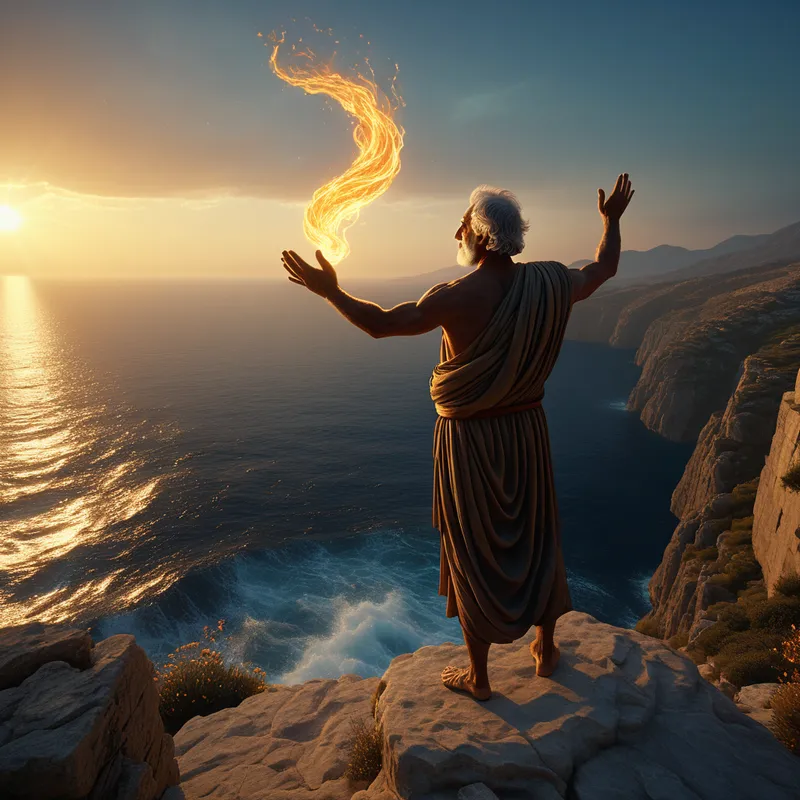
Hear now, not of heroes who walked the earth, but of the very fabric from which the earth was woven. In the age when gods were not merely stories but the breath of existence, there lived a man with the soul of a daimon. His name was Empedocles. He did not look upon the world and see chaos, but a divine order, a sacred poem written in the language of substance itself.
He walked the shores of Acragas, the salt spray on his face not merely water, but the tears of a goddess. The wind that tousled his hair was not empty air, but the sigh of an immortal. The rock beneath his feet was not inert, but the dreaming body of a titan. And the sun that warmed his skin was not a distant ball of flame, but the radiant gaze of a celestial being. He perceived the truth hidden from mortal eyes: the cosmos was not born from a single source, but from a quarternity of divine roots, eternal and uncreated.
These were not passive stuff, but active deities. First, Earth, broad-breasted and steadfast, the foundation of all that is solid and enduring. Then, Air, shimmering and omnipresent, the breath of life and the medium of thought. Next, Fire, sharp and insatiable, the purifier and the beacon in the dark. Finally, Water, life-giving and profound, the wellspring of emotion and the flow of time.
But these four mighty roots did not simply lie together. They were caught in the grip of two vast, cosmic forces, greater than even they. The first was Love (Philia). She was the force of union, the yearning that draws root to root, mingling earth with water to make clay, air with fire to make lightning, creating the myriad forms of the world—the oak tree, the eagle, the human heart. Under her gentle, irresistible sway, the universe became a perfect, harmonious Sphere, a divine oneness where all distinctions dissolved in bliss.
Yet, this unity could not last forever. For the second force, Strife (Neikos), stirred in the depths. Strife was the principle of separation, of individuality, of the sword that cuts the whole into parts. It was the force that drove the roots apart, asserting their unique natures, breaking the Sphere to create the world of plurality, conflict, and change we inhabit. The history of all things, Empedocles sang, was this eternal, rhythmic dance—the breathing in of Love, gathering all into one, and the breathing out of Strife, scattering the roots into multitude. Our world of life and death, of coming-to-be and passing-away, is the battlefield where these two immortal powers play their game with the four divine pieces.
Cultural Origins & Context
This myth did not emerge from the communal hearth of epic poets like Homer, but from the singular, revolutionary mind of a Pre-Socratic philosopher in the 5th century BCE. Empedocles was a figure straddling worlds: part mystic, part scientist, part political figure, and part performing sage. He presented his teachings not in dry prose, but in two grand hexameter poems, On Nature and The Purifications, fragments of which survive.
In the bustling, intellectually fertile Greek colonies of Sicily and Southern Italy, traditional mythology was being interrogated by reason. Empedocles’ myth of the Four Roots was a breathtaking synthesis. It paid homage to the ancient poetic and religious sensibility—personifying cosmic forces as gods—while offering a systematic, quasi-scientific theory of material reality. It was a bridge between the world of Homer’s anthropomorphic Olympians and the abstract principles of later philosophy. His work was passed down not by bards, but by students of natural philosophy, and later by doxographers, who preserved his radical vision of a universe governed by the interplay of attraction and repulsion upon a finite set of eternal elements.
Symbolic Architecture
Empedocles’ cosmology is a profound map of the psyche. The Four Roots are not just physical elements but the fundamental archetypal substances of experience.
Earth represents the somatic, the body, foundation, stability, and material reality. It is the ground of our being, our instincts, and our physical presence in the world.
Air symbolizes the intellect, consciousness, communication, and the realm of thought. It is the breath of spirit, the invisible medium through which ideas travel and the self reflects.
Fire embodies energy, passion, will, transformation, and the purifying force of desire. It is the drive that motivates, consumes, and enlightens.
Water signifies the emotional, the unconscious, intuition, fluidity, and the depths of the soul. It is the tide of feeling, memory, and psychic flow.
The dynamic forces of Love and Strife are the core psychic processes. Love is the urge toward connection, integration, and wholeness—the force of the Self. Strife is the necessary principle of differentiation, analysis, conflict, and ego-development. A psyche ruled only by Love would be a undifferentiated, unconscious mass. A psyche ruled only by Strife would be a collection of shattered, isolated complexes. Health is the eternal, tension-filled dance between them.
The Dreamer’s Resonance
When this myth stirs in the modern unconscious, it often manifests in dreams of elemental imbalance or synthesis. A dream of being trapped in parched, cracking earth may signal a disconnect from the body or a rigidity of spirit. Dreams of suffocation or silent, empty skies may point to an arid intellect cut off from emotion (Water) and instinct (Earth). Visions of uncontrollable conflagrations often speak of a psyche ruled by unintegrated, consuming passion (Fire) or anger. Flood dreams may warn of being overwhelmed by the unconscious or unprocessed emotion (Water).
Conversely, dreams of beautiful, balanced elemental interplay—a clear spring bubbling from rich soil, a warm fire safely contained on a hearth as rain falls outside—suggest a movement toward inner harmony. The dream ego may find itself consciously mixing elements: shaping wet clay (Earth and Water), lighting a lamp (summoning controlled Fire), or speaking a truth that clears the air. These are somatic signals of the psyche attempting its own alchemy, guided by the unseen hands of Love and Strife, seeking the right proportion for the soul’s current season.
Alchemical Translation
The individuation process is the human experience of the cosmic cycle of Love and Strife played out within the vessel of the self. We begin in a state of psychic unity with the world (the Sphere of Love), which must be broken by the necessary Strife of ego-development, separation, and encountering the shadow. This is the scattering of our elements into conflict: our Fire of passion battles our Water of empathy; our Air of reason disputes our Earth of instinct.
The work of wholeness is not to eliminate Strife, but to harness its differentiating power in service of a greater, more conscious Love.
The alchemical operation is to consciously gather our four psychic roots. We must ground our fiery passions in earthly reality (Fire + Earth). We must air out our watery emotions with conscious reflection (Water + Air). We must cool our airy intellects with intuitive wisdom (Air + Water) and warm our earthy habits with inspired action (Earth + Fire). This is the slow, deliberate crafting of the philosopher’s stone—the integrated Self. It is not a static state of perfection, but a dynamic, ever-adjusting equilibrium. We are forever the Empedocles of our own soul, standing on the cliff of awareness, observing the divine dance of our own composition, learning to invoke both the unifying Love and the clarifying Strife as sacred forces in the eternal poem of becoming.
Associated Symbols
Explore related symbols from the CaleaDream lexicon: