The Four Noble Truths Myth Meaning & Symbolism
A prince sees suffering, renounces his throne, and awakens under a tree, articulating a diagnosis and cure for the universal human condition.
The Tale of The Four Noble Truths
Listen. In a time when kings were gods and gods walked as men, there was a prince named Siddhartha Gautama. His father, the king, built for him a palace of perfumed breezes, where lotus blossoms never wilted and the music of silver strings drowned out the world’s discord. He was given a wife of surpassing beauty, a son of bright promise, and a destiny of unchallenged power. Yet, in the marrow of his bones, a quiet hunger stirred—a hunger not for more, but for real.
Driven by this unnamed thirst, the prince commanded his charioteer to take him beyond the gilded walls. On these journeys, he beheld the world unmasked. First, he saw an old man, body bent like a gnarled tree, eyes clouded with the milky film of years. “What is this?” asked the prince. “This is age,” whispered the charioteer, “which comes to all.” The prince’s heart grew heavy as stone.
On the second journey, he saw a man fever-wracked, trembling on the roadside, his skin the color of ash. “What is this?” “This is sickness,” came the reply, “which spares no one.” The stone in his heart cracked.
On the third, he saw a corpse being carried to the burning grounds, limbs stiff, loved ones wailing. “What is this?” “This is death,” said the charioteer, voice hollow, “the end of every path.” The stone shattered, and a cold wind blew through the prince’s soul.
But on a fourth journey, he saw a figure sitting in perfect stillness by the road. This one wore simple robes, held a begging bowl, and his eyes held a light that seemed to come from within, a profound and unshakable peace. “Who is this?” breathed the prince. “A seeker,” said the charioteer. “One who has renounced the world to find the end of sorrow.”
That night, the prince looked upon his sleeping wife and newborn son. The love he felt was a sweet, sharp pain. He knew then that to stay was to live within a beautiful lie. In the deepest watch of the night, he left. He exchanged silks for rags, cut his hair with a sword, and walked into the wilderness.
For years, he wandered. He sat at the feet of great teachers, mastering states of sublime trance. He joined ascetics who believed the body was the enemy, starving himself until his ribs showed like a cage and he could feel his spine through his stomach. He pushed himself to the very edge of life, seeking the answer in extremity. But no trance lasted; no starvation brought wisdom. Only exhaustion and a deeper despair remained. He realized the path of denial was just another palace wall.
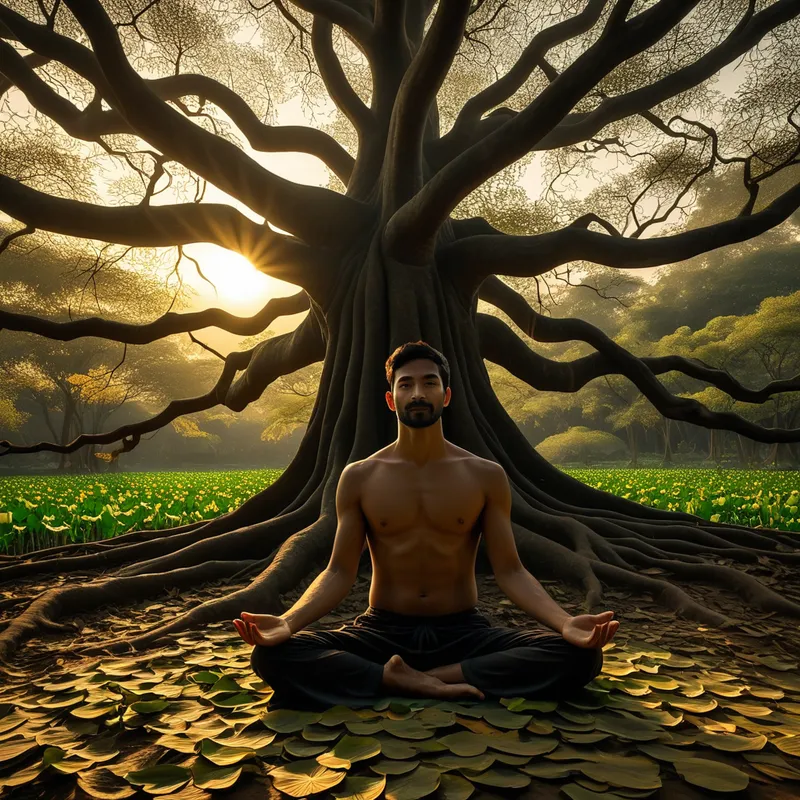
Near death, he accepted a simple bowl of milk-rice from a village girl. Strength returned, not as arrogance, but as a clear, steady resolve. He walked to a place near a flowing river and sat beneath a wide-spreading pipal tree, vowing not to rise until he had understood.
Mara, the tempter, the lord of illusion and death, came to him. He sent armies of demons, hurling flaming rocks and spears that turned to flowers. He sent his daughters, Desire, Discontent, and Delight, who danced with impossible beauty. He whispered of futility and fame. Through it all, the seeker remained unmoved, his hand touching the earth, calling the very ground to witness his right to be there. As dawn approached, Mara fled.
And in that first, pure light, the seeker saw. He saw the endless chain of cause and effect, the rising and passing of all conditioned things. He saw the root of the great wheel of suffering, and the way to make it stop. In that moment, he was no longer Siddhartha the seeker. He was the Buddha. He had awoken. And what he awoke to, he later articulated as the Four Noble Truths: the truth of suffering, the truth of its cause, the truth of its end, and the truth of the path leading to its end.
Cultural Origins & Context
This is not a myth of gods on mountaintops, but the foundational narrative of a human awakening. It originates in the Shramanic period of ancient India, a time of intense philosophical and spiritual fermentation where traditional Vedic ritual was being questioned. The story is the biographical core of the Buddhist tradition, first transmitted orally by the monastic community (Sangha) for centuries after the Buddha’s death before being committed to text in the Sutta Pitaka.
Its societal function was multifaceted. For the monastic community, it was a charter myth, validating the renunciant path and providing the ultimate model for their practice. For lay followers, it presented an accessible ideal of human potential and a compassionate framework for understanding the universal experience of distress. It democratized the pursuit of liberation, offering a path based on insight and ethical conduct rather than birthright or ritual privilege. The tale was a teaching tool, a psychological map, and a sacred history all in one.
Symbolic Architecture
The myth presents a profound symbolic architecture of the human psyche. The palace represents the constructed self—the ego, its identities, comforts, and narratives we believe will grant us permanent security. The four sights outside the walls are not random misfortunes but the inevitable incursions of reality (age, sickness, death) and the possibility of transcendence (the seeker) that eventually breach every ego-fortress.
The renunciation is not an act of rejection, but of turning toward. It is the ego’s consent to its own necessary deconstruction for the sake of a greater truth.
The extreme asceticism symbolizes the psyche’s misguided attempt to solve the problem of suffering through violent repression and control, a war on the flesh that is still a war within the self. The acceptance of nourishment is the critical turn toward integration, not annihilation. The battle with Mara is the final, internal confrontation with all that binds us: fear, desire, doubt, and the lure of lesser identities. The earth-touching gesture (Bhumisparsha Mudra) is a powerful symbol of grounding in reality itself, beyond all stories.
The Four Truths themselves are a perfect symbolic system: Diagnosis (Dukkha), Etiology (Samudaya), Prognosis (Nirodha), and Prescription (Magga). They model a move from unconscious participation in suffering, to conscious understanding of its mechanism, to the vision of freedom, and finally to the embodied practice that realizes it.
The Dreamer’s Resonance
When this myth stirs in the modern dreamer, it often signals a profound psychological turning point. Dreams of leaving a familiar, comfortable place (a house, a job, a relationship) without clear destination echo Siddhartha’s Great Departure. This is the psyche initiating a necessary separation from an outgrown identity or life structure, even when the conscious mind resists.
Dreams of encountering decay, illness, or mortality in unexpected or shocking ways mirror the four sights. They are the unconscious forcing an encounter with the reality of impermanence and the flaws in one’s current “palace” of beliefs. Dreams of extreme deprivation or being lost in a barren landscape may reflect the “ascetic phase” of the psyche—a period of emotional or spiritual dryness, where old ways of seeking meaning have failed.
Most powerfully, dreams of sitting in stillness while chaos erupts around you—storms, attacking figures, seductive voices—are direct encounters with the Mara-complex. The dream-ego is being tested on its commitment to a nascent, more authentic self. To remain seated in such a dream is a profound somatic experience of centering, indicating the consolidation of a new, more resilient psychological ground.
Alchemical Translation
The alchemical process mirrored here is the transmutation of leaden, suffering-bound consciousness into the gold of liberated awareness. The prima materia is the raw experience of dukkha itself—not as a mistake, but as the essential ingredient.
The first truth (Nigredo) is the blackening, the honest confrontation with the shadow of existence: the burnout, the anxiety, the deep sense that something is fundamentally off. It is the necessary dissolution of naive optimism. The second truth (Albedo) is the whitening, the analysis that separates the pure cause (craving, clinging) from the impure mass of suffering. It brings clarity: “This is how I create my own prison.”
The path is not a ladder to climb out of the self, but a way to walk fully into the reality of the self, until the walker and the path are not two.
The third truth (Citrinitas) is the yellowing, the dawning vision of possibility—Nirvana—not as a distant heaven but as the inherent peace available when the fires of craving are stilled. It is the glimpse of the goal that energizes the work. The final truth, the Eightfold Path, is the Rubedo, the reddening or embodiment. It is the practical, ethical, and mindful integration of the insight into every facet of life—speech, action, livelihood, and attention. The alchemical gold is not a new substance, but the purified essence of the original material: a human life, fully experienced, fully understood, and fully free. The myth maps the journey from being a passive subject of suffering to becoming the conscious artist of one’s own liberation.
Associated Symbols
Explore related symbols from the CaleaDream lexicon: