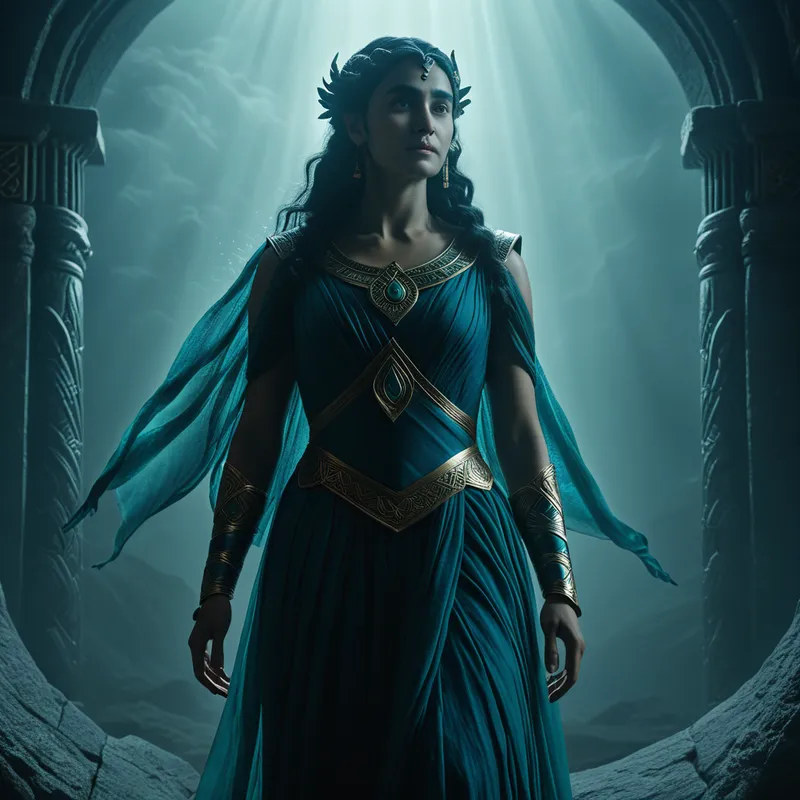
The Four Living Creatures
Four celestial beings from Hebrew tradition, each with unique animal features, serving as guardians of God's throne and symbols of divine power and cosmic order.
The Tale of The Four Living Creatures
In the year that King Uzziah died, the prophet [Isaiah](/myths/isaiah “Myth from Abrahamic culture.”/) saw the Lord. He was seated upon a throne, high and exalted, and the train of his robe filled [the temple](/myths/the-temple “Myth from Jewish culture.”/). Above him stood the [seraphim](/myths/seraphim “Myth from Christian culture.”/), each with six wings. But this vision, profound as it was, was but a prelude to the fuller, more terrifying revelation granted to another prophet in exile by [the river](/myths/the-river “Myth from Buddhist culture.”/) Kebar.
Ezekiel, priest of a people uprooted and broken, looked into the heavens. A storm wind was coming from the north, a great cloud with flashing fire and brilliant light. At its heart was something like glowing metal, and from within this crucible of divine presence emerged the likeness of [four living creatures](/myths/four-living-creatures “Myth from Abrahamic culture.”/). They were not angels as one might imagine, not gentle messengers, but composite beings of awesome and unsettling power. Their form was human, yet each bore four faces and four wings. Their legs were straight, and the soles of their feet were like the sole of a calf’s foot, gleaming like burnished bronze. Under their wings were human hands.
But it was their faces that held the cosmos. Each creature looked simultaneously in four directions: the face of a human, the face of a lion on the right side, the face of an ox on the left side, and the face of an eagle. Their wings touched one another, and they did not turn as they moved; they went straight forward, each facing its own direction. Wherever the spirit would go, they went, without turning. And in the midst of the creatures was something like burning coals of fire, like torches moving between them. The fire was bright, and lightning flashed from it. The creatures darted to and fro like flashes of lightning.
Their movement was a symphony of terrifying unity. The sound of their wings was like the sound of many waters, like the voice of the Almighty, a sound of tumult like the sound of an army. When they stood still, they let down their wings. And above the expanse over their heads was something like a throne, in appearance like sapphire. Seated upon it was a figure with the appearance of a man, but this was the likeness of the glory of the Lord. When Ezekiel saw it, he fell on his face.
Later, in the Isle of Patmos, another exiled seer, John, witnessed a similar majesty. Before the throne of heaven, he saw four living creatures, full of eyes in front and behind. The first was like a lion, the second like an ox, the third had the face of a man, and the fourth was like a flying eagle. Each had six wings and was full of eyes all around and within. Day and night they never ceased to sing, “Holy, holy, holy, is the Lord God Almighty, who was and is and is to come!” And whenever these creatures gave glory and honor and thanks to the one seated on the throne, the twenty-four elders fell down and worshipped.
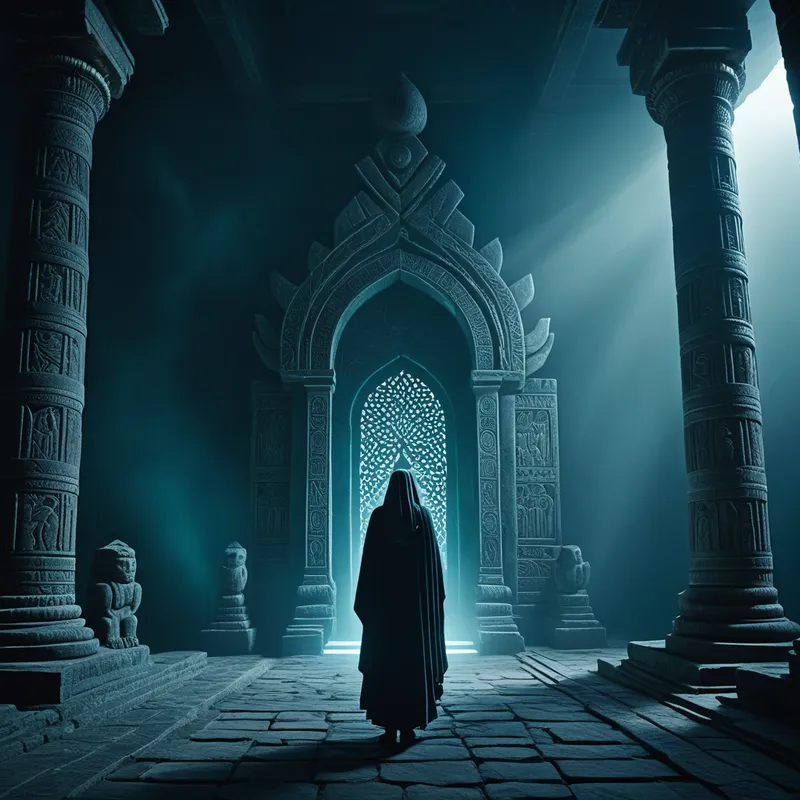
Cultural Origins & Context
The vision of the Four Living Creatures erupts from [the crucible](/myths/the-crucible “Myth from Alchemical culture.”/) of the Babylonian Exile. Ezekiel, a priest, is by the rivers of Babylon, a man whose entire world—the Temple, the monarchy, the land—has been obliterated. The old symbols of divine presence and cosmic order lie in ruins. In this psychological and spiritual vacuum, the prophet’s consciousness is pierced by a vision of order so radical and transcendent it redefines divinity itself. It is not a vision of comfort, but of reorientation.
These beings are not drawn from a vacuum. They resonate with ancient Near Eastern motifs of composite guardian creatures, such as the [lamassu](/myths/lamassu “Myth from Mesopotamian culture.”/) of Assyria or the [cherubim](/myths/cherubim “Myth from Judeo-Christian culture.”/) that adorned the Israelite [Ark of the Covenant](/myths/ark-of-the-covenant “Myth from Jewish culture.”/). Yet, they are distinctly transformed. While Mesopotamian guardians often served royal palaces, the Living Creatures are the animated chassis of God’s own mobile throne-chariot (the [Merkabah](/myths/merkabah “Myth from Hebrew culture.”/)). They embody a theology in motion: Yahweh is not a god confined to a ruined temple in [Jerusalem](/myths/jerusalem “Myth from Biblical culture.”/), but a sovereign whose throne moves with his people, whose authority encompasses all directions and all realms of creation. They are the answer to exile: God’s dominion is not diminished, but revealed as cosmic, dynamic, and terrifyingly present even in the land of captors.
Symbolic Architecture
The [architecture](/symbols/architecture “Symbol: Architecture in dreams often signifies structure, stability, and the framing of personal identity or life’s journey.”/) of these creatures is a masterpiece of symbolic compression. They are a living map of [reality](/symbols/reality “Symbol: Reality signifies the state of existence and perception, often reflecting one’s understanding of truth and life experiences.”/).
- The Four Faces: These are not random animals. They represent the [pinnacle](/symbols/pinnacle “Symbol: The highest point or peak, representing achievement, culmination, or spiritual transcendence.”/) of creation: the wild ([lion](/symbols/lion “Symbol: The lion symbolizes strength, courage, and authority, often representing one’s inner power or identity.”/)), the domesticated (ox), the [human](/symbols/human “Symbol: The symbol of a human represents individuality, complexity of emotions, and social relationships.”/) (man), and the celestial ([eagle](/symbols/eagle “Symbol: The eagle is a symbol of power, freedom, and transcendence, often representing a person’s aspirations and higher self.”/)). Together, they encompass the totality of the terrestrial and aerial realms. They are the four pillars of the perceived world. In later tradition, particularly [Christian](/symbols/christian “Symbol: The symbol represents the faith, teachings, and cultural values associated with Christianity, including themes of love, salvation, and morality.”/) exegesis, they became associated with the four Gospels, but their primal meaning is cosmological: all creation is enrolled in the service and [revelation](/symbols/revelation “Symbol: A sudden, profound disclosure of truth or insight, often through artistic or musical means, that transforms understanding.”/) of the divine.
- The [Movement](/symbols/movement “Symbol: Movement symbolizes change, progress, and the dynamics of personal growth, reflecting an individual’s desire or need to transform their circumstances.”/) and the Eyes: Their movement—“wherever the [spirit](/symbols/spirit “Symbol: Spirit symbolizes the essence of life, vitality, and the spiritual journey of the individual.”/) would go, they went”—signifies a perfect, instantaneous alignment with divine will. There is no deliberation, no [resistance](/symbols/resistance “Symbol: An object or tool representing opposition, struggle, or the act of pushing back against external forces or internal changes.”/). The profusion of eyes (in John’s [vision](/symbols/vision “Symbol: Vision reflects perception, insight, and clarity — often signifying the ability to foresee or understand deeper truths.”/)) signifies total [awareness](/symbols/awareness “Symbol: Conscious perception of self, surroundings, or internal states. Often signifies awakening, insight, or heightened sensitivity.”/), omniscient [perception](/symbols/perception “Symbol: The process of becoming aware of something through the senses. In dreams, it often represents how one interprets reality or internal states.”/). Nothing is hidden from the gaze that upholds the [cosmos](/symbols/cosmos “Symbol: The entire universe as an ordered, harmonious system, often representing the totality of existence, spiritual connection, and the unknown.”/).
- The Unity of the Four: Perhaps the most profound [symbol](/symbols/symbol “Symbol: A symbol can represent an idea, concept, or belief, serving as a powerful tool for communication and understanding.”/) is their fourfold-yet-singular [nature](/symbols/nature “Symbol: Nature symbolizes growth, connectivity, and the primal forces of existence.”/). They are four distinct creatures, yet they move as one [body](/symbols/body “Symbol: The body in dreams often symbolizes the dreamer’s self-identity, personal health, and the relationship they have with their physical existence.”/). This is a vision of reconciled multiplicity. In a world (and a [psyche](/myths/psyche “Myth from Greek culture.”/)) fractured by [exile](/symbols/exile “Symbol: Forced separation from one’s homeland or community, representing loss of belonging, punishment, or profound isolation.”/), sin, and [chaos](/symbols/chaos “Symbol: In Arts & Music, chaos represents raw creative potential, uncontrolled expression, and the breakdown of order to forge new artistic forms.”/), they present a model of harmonious order where [difference](/symbols/difference “Symbol: Difference symbolizes diversity, change, and the contrast between ideas or people.”/) does not lead to conflict but to coordinated, majestic [purpose](/symbols/purpose “Symbol: Purpose signifies direction, meaning, and intention in life, often reflecting personal ambitions and core values.”/).
They are the divine imagination made manifest—not as a static idea, but as a living, moving, seeing engine of perception. They are how God beholds His own creation, and how creation, in its perfected form, beholds God.
Their constant cry of “Holy, holy, holy” is not mere praise; it is the foundational vibration of reality. It is the sound that keeps non-being at bay, the triple affirmation that sustains the separation and awe necessary for a cosmos to exist.
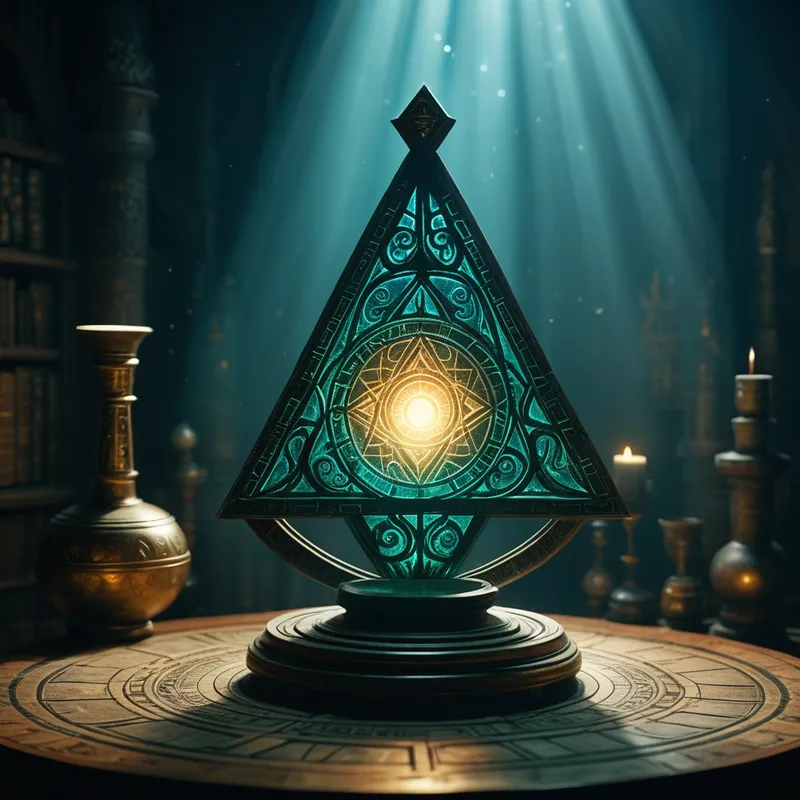
The Dreamer’s Resonance
To encounter the Four Living Creatures in the inner landscape—whether in dream, vision, or active imagination—is to confront the psyche’s own archetypal guardians of order and meaning. They appear not when life is comfortable, but when [the ego](/myths/the-ego “Myth from Jungian culture.”/)’s personal world is in exile: when career, relationships, identity, or faith structures collapse. They are the psyche’s drastic response to [chaos](/myths/chaos “Myth from Greek culture.”/).
The human face looks at us, confronting us with our own conscious identity and responsibility. The lion’s face roars with raw instinct, courage, and royal authority we may have disowned. The ox’s face grounds us with patience, endurance, and connection to the earthy, laboring, nourishing aspects of life. The eagle’s face offers the soaring perspective, the synoptic view that sees our petty dramas from the height of spirit. To integrate this vision is not to become angelic, but to become whole—to allow these disparate, often conflicting, facets of [the self](/myths/the-self “Myth from Jungian culture.”/) to move in concert under the direction of a central, unifying spirit (the Self). They represent the terrifying but necessary process of psychical reorganization at the deepest level.
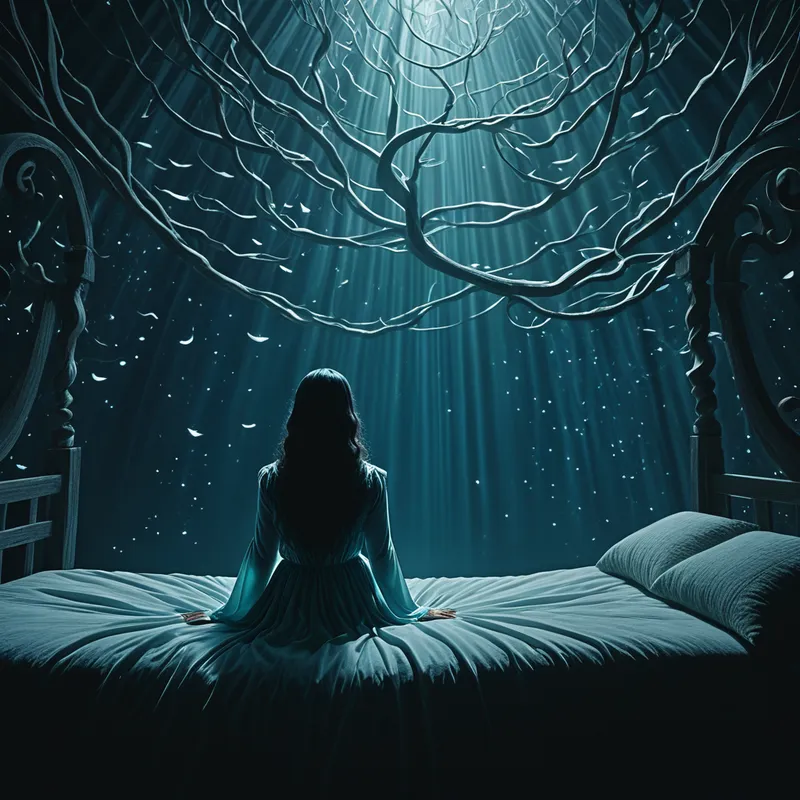
Alchemical Translation
In the alchemy of the soul, the Four Living Creatures represent the quadratura circuli—[the squaring of the circle](/myths/the-squaring-of-the-circle “Myth from Alchemical culture.”/). The circle is the divine unity, [the prima materia](/myths/the-prima-materia “Myth from Alchemical culture.”/) of the spirit. [The square](/myths/the-square “Myth from Platonic culture.”/) is the fourfold material world, the elements, the directions, the fixed structures of existence. The vision shows the impossible made manifest: the square (the four creatures) in perfect, dynamic service to the circle (the throne, the spirit that moves them).
They are the living embodiment of the unio mentalis, the mental union where opposites are held in tension without annihilation. Human and animal, wild and tame, earth and sky—all are contained. Their ceaseless movement and song represent the [opus circulatorium](/myths/opus-circulatorium “Myth from Alchemical culture.”/), the endless cyclic work of refinement and praise that is the very process of conscious existence. To “see” them is to have one’s inner elements—thought, feeling, sensation, intuition—recognize their true sovereign and begin to move in a coordinated, purposeful way toward a state of integrated being.
The alchemical fire that flashes between them is the ignis divinus, the divine fire that separates and purifies. It is the same fire that burns away the dross of the personal ego, leaving only that which can participate in the majestic movement of the whole.
They are not a goal to be reached, but a process to be inhabited. Their song is the sound of the Self at work, integrating the fourfold fragments of the personality into a vehicle worthy of bearing the divine presence.
Associated Symbols
Explore related symbols from the CaleaDream lexicon:
- Throne — The seat of ultimate authority and divine presence, representing the fixed center around which all cosmic order revolves and from which sovereignty emanates.
- Chariot — A vehicle of transcendent movement and power, symbolizing the means by which divine will or spiritual energy is conveyed through the realms of existence.
- Wheel — A symbol of cosmic cycles, divine law, and perfect motion, often representing the structure of the universe and the revolution of fate or time.
- Eye — The organ of absolute perception and omniscience, representing divine watchfulness, enlightenment, and the light of consciousness that illuminates all hidden things.
- Wings — Emblems of spiritual ascent, swiftness, and the capacity to transcend earthly boundaries, connecting the material realm with the heights of the celestial.
- Lightning — A sudden, illuminating force of divine power and revelation, representing the terrifying and instantaneous [flash of insight](/myths/flash-of-insight “Myth from Alchemical culture.”/) that splits the darkness of ordinary understanding.
- Voice — The creative and commanding sound of the divine, representing the foundational word or vibration that brings order, law, and reality into being.
- Fire — The purifying and transformative element of the spirit, representing both the consuming presence of the divine and the luminous energy that animates creation.
- Circle — The perfect geometric form of unity, wholeness, and eternity, representing the boundless nature of the divine and the cyclical patterns of cosmic order.
- Creature — A composite being formed from the essence of multiple realms, symbolizing the integration of natural and supernatural, the familiar and the utterly alien, into a single conscious form.