The Fountain of Youth Myth Meaning & Symbolism
A timeless myth of a hidden spring granting immortality, reflecting humanity's deepest longing to transcend decay and the relentless flow of time.
The Tale of The Fountain of Youth
Listen, and you will hear the whisper that has haunted kings and paupers since time began. It is not a sound, but a pull—a tug on the soul’s deepest vein. It speaks of a place where the great river of time slows to a trickle, where the sun’s arc halts, and [the moon](/myths/the-moon “Myth from Tarot culture.”/) forgets her phases. They say it lies beyond the last known map, in a land where geography yields to desire.
The seeker is always one whose eyes have seen too much sun and too much shadow. Perhaps it is a conquistador, his armor rusted by salt spray, his heart a hollow vessel for a monarch’s impossible decree. Or a sage from the East, his scrolls speaking of Penglai, where jade maidens dance in peach orchards that bear fruit once a millennium. He journeys through swamps that breathe decay, across deserts that mirror the desiccation he fears within. He is guided by stars that seem to wink with secret knowledge and by the fragmented tales of those who turned back, mad with a glimpse.
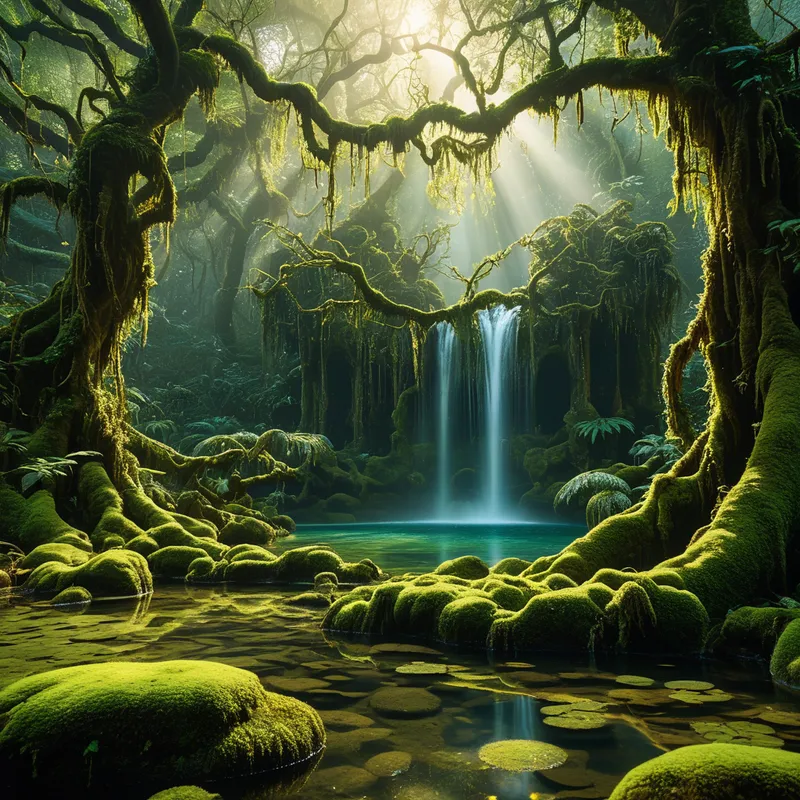
The forest that guards it is no ordinary wood. The trees are ancient librarians, their bark etched with forgotten alphabets. The air is heavy, not with moisture, but with the weight of potential. Every rustle is a sigh, every birdcall a warning or a lure. Finally, he finds it—not a roaring cataract, but a serene spring. Its [water](/myths/water “Myth from Chinese culture.”/) is clearer than thought, bubbling from a fissure in stone smoother than skin. It does not sparkle; it glows with a soft, silver luminescence, like captured moonlight. [Ferns](/myths/ferns “Myth from Celtic culture.”/) of impossible emerald curl at its edges. The silence here is absolute, a listening silence.
He kneels. His hand, gnarled and marked by years, hovers over the surface. In the perfect mirror of the water, he does not see his face as it is, but as a palimpsest—the boy he was, the man he is, the dust he will become, all shimmering in one unstable image. This is the moment of the myth’s cruel heart. He drinks. The water is cold and sweet, a vibration rather than a liquid. He feels a surge—a cellular sigh, a tightening of skin, a sharpening of sight. He has cheated the reaper.
But the forest watches. And as he turns, renewed, to retrace his steps, he finds the path has dissolved. The landmarks have shifted. [The world](/myths/the-world “Myth from Tarot culture.”/) outside has moved on, but he is now a fixed point, an anomaly. The gift becomes the cage. The whisper that called him now becomes the only sound in an eternity of changing seasons he must watch, untouched. He found the fountain, but lost his place in the story of life and death. The water still flows, waiting for the next heart pierced by the arrow of time.

Cultural Origins & Context
The [Fountain of Youth](/myths/fountain-of-youth “Myth from Various culture.”/) is a rare myth that belongs emphatically to “Various” culture—it is a planetary daydream. Its earliest clear literary incarnation is in the writings of the Greek historian Herodotus, who spoke of a Macrobian people with astonishing longevity. The legend was then woven into the Alexander Romance, where the conqueror searches for the Water of Life. It blossomed in the medieval European imagination, intertwined with the quest for the Prester John and his magical kingdom.
Its most famous vector into the modern mind was the 16th-century Spanish exploration of the Americas. Tied to the figure of Juan Ponce de León, the myth ceased to be purely literary and became a geographical imperative, driving colonization and immense suffering. Yet parallel streams existed: in Chinese Daoist traditions, the quest for the elixir of life was a spiritual-alchemical pursuit; in Hindu lore, the amrita granted by the gods serves a similar function.
Societally, this myth functioned as both compass and consolation. For rulers, it was a promise of eternal dominion. For the common person, it was a tale that acknowledged the universal terror of decay and oblivion, giving that fear a shape and, tantalizingly, a solution. It was told by sailors, cartographers, alchemists, and storytellers—not as a confirmed truth, but as a “what if” that lived just beyond [the horizon](/myths/the-horizon “Myth from Various culture.”/) of the known world, forever pulling humanity forward.
Symbolic Architecture
Psychologically, the [Fountain](/symbols/fountain “Symbol: A symbol of purification, renewal, and abundance, fountains evoke themes of life-giving water and wisdom flowing freely.”/) is not a literal place but a [symbol](/symbols/symbol “Symbol: A symbol can represent an idea, concept, or belief, serving as a powerful tool for communication and understanding.”/) of the [psyche](/myths/psyche “Myth from Greek culture.”/)’s desire to transcend [the ego](/myths/the-ego “Myth from Jungian culture.”/)’s most fundamental [anxiety](/symbols/anxiety “Symbol: Anxiety in dreams reflects internal conflicts, fears of the unknown, or stress from waking life, often demonstrating the subconscious mind’s struggle for peace.”/): its own [dissolution](/symbols/dissolution “Symbol: The process of breaking down, dispersing, or losing form, often representing transformation, release, or the end of a state of being.”/). The [Fountain](/symbols/fountain “Symbol: A symbol of purification, renewal, and abundance, fountains evoke themes of life-giving water and wisdom flowing freely.”/) represents the unconscious itself—the deep, primordial [source](/symbols/source “Symbol: The origin point of something, often representing beginnings, nourishment, or the fundamental cause behind phenomena.”/) of [life](/symbols/life “Symbol: The symbol of ‘Life’ represents a journey of growth, interconnectedness, and existential meaning, encompassing both the joys and challenges that define human experience.”/) and renewal that exists outside of time.
The Fountain is the soul’s memory of its own timelessness, mistaken for a promise to the perishable self.
The [journey](/symbols/journey “Symbol: A journey in dreams typically signifies adventure, growth, or a significant life transition.”/) is the critical element. It symbolizes the descent into the unconscious, the “[night](/symbols/night “Symbol: Night often symbolizes the unconscious, mystery, and the unknown, representing the realm of dreams and intuition.”/) sea journey” where the conscious mind (the [seeker](/symbols/seeker “Symbol: A person actively searching for meaning, truth, or a higher purpose, often representing the dreamer’s own quest for identity or fulfillment.”/)) must traverse the swamps and deserts of its own repressed [material](/symbols/material “Symbol: Material signifies the tangible aspects of life, often representing physical resources, desires, and the physical world’s influence on our existence.”/), its fears, and its illusions. The [guardian](/symbols/guardian “Symbol: A protector figure representing safety, authority, and guidance, often embodying parental, societal, or spiritual oversight.”/) [forest](/symbols/forest “Symbol: The forest symbolizes a complex domain of the unconscious mind, representing both mystery and potential for personal growth.”/) represents the complexity and [danger](/symbols/danger “Symbol: The symbol of ‘Danger’ often indicates a sense of threat or instability, calling for caution and awareness.”/) of the unconscious [terrain](/symbols/terrain “Symbol: Terrain in dreams often represents the landscape of one’s life, including challenges, opportunities, and feelings about one’s current circumstances.”/), which is not meant to be conquered, but understood.
The [water](/symbols/water “Symbol: Water symbolizes the subconscious mind, emotions, and the flow of life, representing both cleansing and creation.”/) is the symbol of life, potential, and the fluid [nature](/symbols/nature “Symbol: Nature symbolizes growth, connectivity, and the primal forces of existence.”/) of the psyche. Its “[youth](/symbols/youth “Symbol: Youth symbolizes vitality, potential, and the phase of life associated with growth and exploration.”/)-giving” [property](/symbols/property “Symbol: Property often represents one’s personal value, possessions, or self-worth.”/) points to the regenerative power of connecting with [the Self](/myths/the-self “Myth from Jungian culture.”/), the central [archetype](/symbols/archetype “Symbol: A universal, primordial pattern or prototype in the collective unconscious that shapes human experience, behavior, and creative expression.”/) of wholeness. However, the myth’s twist—the [isolation](/symbols/isolation “Symbol: A state of physical or emotional separation from others, often representing a need for introspection or signaling distress.”/) and [curse](/symbols/curse “Symbol: A supernatural invocation of harm or misfortune, often representing deep-seated fears, guilt, or perceived external malevolence.”/) of obtaining it—reveals a profound [truth](/symbols/truth “Symbol: Truth represents authenticity, honesty, and the quest for knowledge beyond mere appearances.”/): to seek literal immortality for the personal ego is a violation of the natural psychic order. It is an attempt to arrest the process of individuation, which requires [death](/symbols/death “Symbol: Symbolizes transformation, endings, and new beginnings; often associated with fear of the unknown.”/) and [rebirth](/symbols/rebirth “Symbol: A profound transformation where old aspects of self or life die, making way for new beginnings, growth, and renewal.”/) of psychic structures, not their [petrification](/symbols/petrification “Symbol: A state of being turned to stone, representing paralysis, permanence, or transformation in the face of overwhelming fear, trauma, or awe.”/).
The Dreamer’s Resonance
When this myth surfaces in modern dreams, it rarely appears as a classical fountain. It manifests as the dreamer discovering a secret room in their house with a healing pool, finding a vial of glowing liquid, or turning on a tap that flows with revitalizing energy. The somatic feeling is often one of immense relief, wonder, and hope.
This dream pattern signals a profound psychological process: a deep, often unconscious, yearning for renewal. The dreamer may be at a life stage where they feel “dried up,” weary, or trapped in a cycle of decay—perhaps in a career, relationship, or their sense of identity. The Fountain dream is the psyche’s announcement that a source of regeneration exists within them. The conflict in the dream (e.g., being unable to reach the water, the water turning to sand, or being watched) mirrors the internal resistance—the fear of change, [the shadow](/myths/the-shadow “Myth from Jungian culture.”/)’s sabotage, or the ego’s misunderstanding of what true renewal entails. It is an invitation to begin the inner journey, to seek not the cessation of time, but the source of meaning that makes time bearable.

Alchemical Translation
The alchemical process mirrored in this myth is not the creation of gold, but the production of the Elixir Vitae. This is the work of individuation. The base material (materia prima) is the leaden, mortal, time-bound ego. The journey through the perilous landscape is the stage of [nigredo](/myths/nigredo “Myth from Alchemical culture.”/), where one confronts the shadow and the reality of one’s limitations.
The true Elixir is not a substance that stops time, but a state of consciousness that learns to drink from the eternal spring within the moment.
The Fountain itself represents the aqua permanens, the permanent water—the transformative substance of the psyche that can dissolve rigid structures. To “drink” is to integrate this fluid consciousness. The myth’s warning is the key to the alchemical translation: the goal is not to escape the cycle of life, death, and rebirth (the [Magnum Opus](/myths/magnum-opus “Myth from Alchemical culture.”/)), but to participate in it consciously. The modern individual’s [triumph](/myths/triumph “Myth from Roman culture.”/) is not in finding eternal youth, but in performing the psychic transmutation where the fear of death is alchemized into a commitment to life. One becomes, not an immortal, but a vessel through which the timeless can momentarily flow, finding the Fountain not at a journey’s end, but in the depth of the soul’s present, ever-renewing waters.
Associated Symbols
Explore related symbols from the CaleaDream lexicon: