The Founding of Goryeo Myth Meaning & Symbolism
A sacred dream of a golden chest reveals a divine mandate, guiding a warrior to unite a fractured land and birth a new dynasty from celestial prophecy.
The Tale of The Founding of Goryeo
Listen, and hear the tale whispered by the wind through the Goryeo pines. It is the end of an age, a time when the land bled from a hundred wounds. The great Silla had crumbled into dust and strife, and in its place rose the Later Three Kingdoms, locked in a bitter, endless dance of sword and fire. The earth groaned under the weight of ambition, and the heavens turned a weary eye from the chaos below.
In this crucible of iron and ash, a man named Taejo Wang Geon marched. He was a son of the sea, a general of keen mind and stout heart, serving under Gung Ye. But the king he served was descending into a tyranny born of madness, seeing betrayal in every shadow, demanding worship as a living Buddha. The land cried out for a true center, a pillar to hold up the crumbling sky.
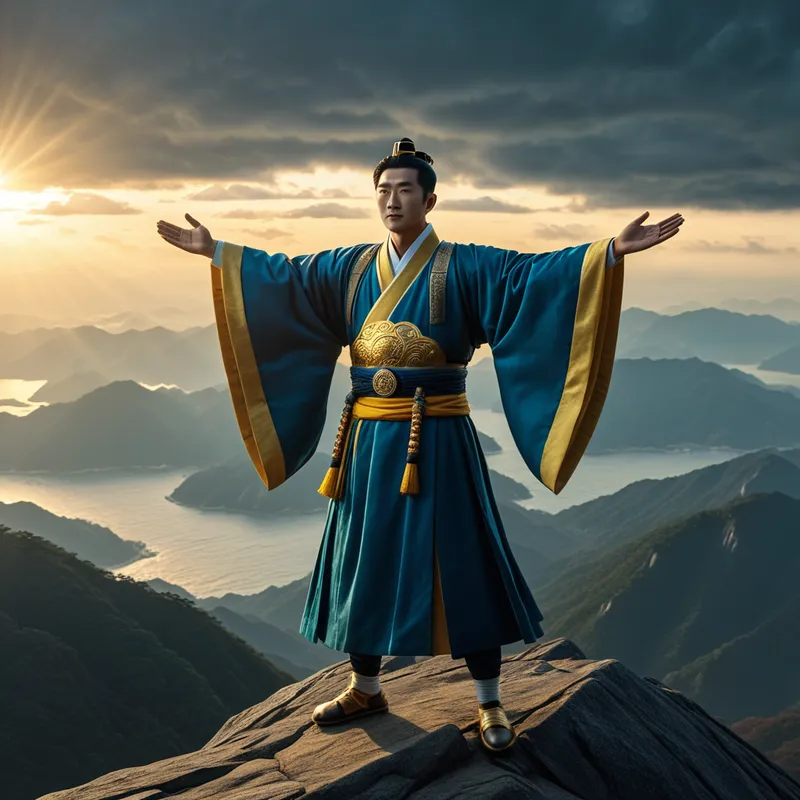
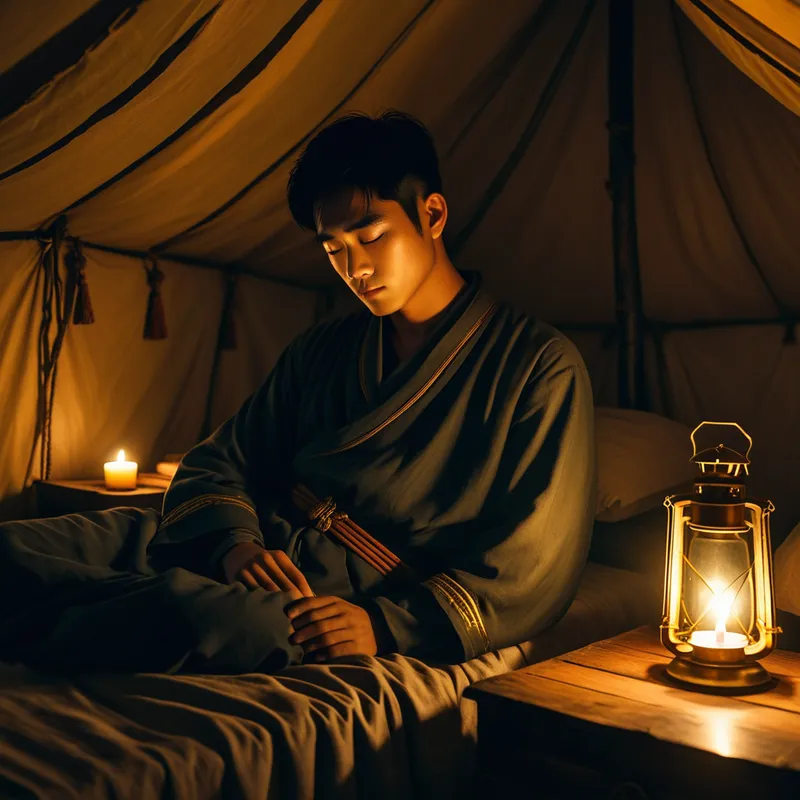
Then came the dream. Not a gentle whisper, but a vision that shook the foundations of his soul. In the deep watch of the night, in a campaign tent smelling of leather and cold earth, Wang Geon slept. And the celestial world opened to him. He found himself on the sacred Mount Songak. The air was still and charged. From the east, a figure of impossible majesty descended—Okhwang Sangje, the Jade Emperor himself, clad in robes of stars. His voice was the sound of distant thunder and deep rivers.
“The mandate of heaven has departed from your lord,” the deity intoned. “The people suffer. The land fragments. You have been chosen.”
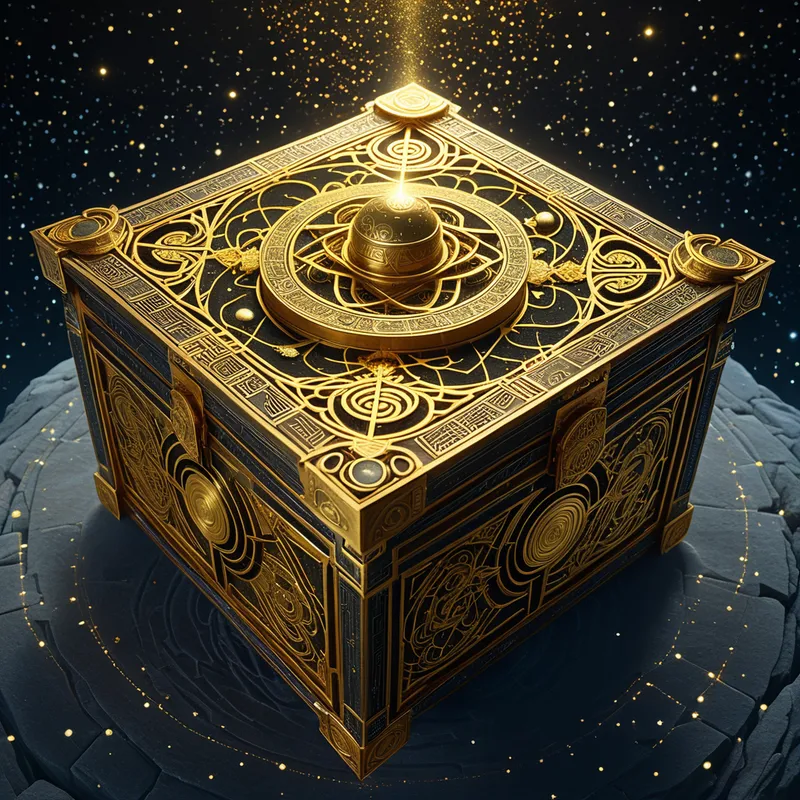
And then, the emperor presented a gift. A chest, but no ordinary casket. It was wrought of pure, radiant gold, its surface alive with the dance of constellations and the flow of primordial qi. As the chest was placed before him, its lid opened without a touch. Inside, blazed not treasure, but a light that was both a map and a command—a vision of a unified peninsula, peaceful, prosperous, and whole under a single just rule. The light did not simply show; it sealed a covenant within his very bones.
Wang Geon awoke, his body thrumming with the echo of divinity, the scent of ozone and mountain air still clinging to him. The dream was no phantom; it was a seed of destiny planted in the fertile soil of his spirit. He knew his path was irrevocably altered. The subsequent fall of Gung Ye was not merely a political shift; it was the clearing of a field ordained by heaven. When the people and the scholars, weary of bloodshed, turned their eyes to the virtuous, capable general who spoke of unification and benevolence, they were answering a call they too could feel in the wind. Wang Geon did not seize the throne; he ascended to it, accepting the weight of the golden chest’s promise. In 918, Goryeo was proclaimed—not just a new kingdom, but a living embodiment of a celestial dream, a nation forged from a divine vision in the heart of a sleeping warrior.
Cultural Origins & Context
This foundational myth is recorded in the Goryeosa, the official history of the dynasty compiled in the Joseon period. It exists within a rich East Asian tradition of “cheonmyeong,” where heaven bestows its mandate on a virtuous ruler and withdraws it from a tyrant. The myth served a critical political and social function for the nascent Goryeo dynasty. It was not mere propaganda, but a foundational narrative that answered profound questions: Why does this king rule? Why does this dynasty deserve legitimacy after the collapse of Silla and the chaos of the Later Three Kingdoms?
The answer was rooted in a cosmology familiar to the people. By invoking Okhwang Sangje, the myth tapped into Taoist celestial bureaucracy, while the dream-vision format resonated with deep shamanic and animistic traditions indigenous to the Korean peninsula. It positioned Wang Geon not as a mere usurper or conqueror, but as a divinely appointed rectifier of cosmic and earthly order. The story was told and retold by scholars, court historians, and likely by storytellers, cementing the dynasty’s heavenly sanctioned right to rule and its central ideology of unifying and bringing peace to the land—a direct contrast to the fragmentation it ended.
Symbolic Architecture
At its core, the myth is a profound [allegory](/symbols/allegory “Symbol: A narrative device where characters, events, or settings represent abstract ideas or moral qualities, conveying deeper meanings through symbolic storytelling.”/) for the [emergence](/symbols/emergence “Symbol: A process of coming into being, rising from obscurity, or breaking through a barrier, often representing birth, transformation, or revelation.”/) of [consciousness](/symbols/consciousness “Symbol: Consciousness represents the state of awareness and perception, encompassing thoughts, feelings, and experiences.”/) and order from the unconscious and chaotic. The fractured “Later Three Kingdoms” represent a psyche in a state of civil war, where disparate complexes (ambition, paranoia, fear) rule without a unifying ego or a [connection](/symbols/connection “Symbol: Connection symbolizes relationships, communication, and bonds among individuals.”/) to the deeper, ordering Self.
The golden chest from heaven is the archetypal symbol of the Self descending into the realm of the ego. It is not created by the hero; it is received.
Wang Geon, the capable but initially loyal general, represents the nascent ego-consciousness that is functional but not yet sovereign. He serves a “mad [king](/symbols/king “Symbol: A symbol of ultimate authority, leadership, and societal order, often representing the dreamer’s inner power or external control figures.”/)” (Gung Ye), which can symbolize a ruling complex that has become inflated, paranoid, and disconnected from [reality](/symbols/reality “Symbol: Reality signifies the state of existence and perception, often reflecting one’s understanding of truth and life experiences.”/)—a tyrannical [inner voice](/symbols/inner-voice “Symbol: A spiritual or subconscious guide representing intuition, conscience, or higher self, often seen as a connection to divine wisdom or ancestral knowledge.”/) that must be deposed for wholeness to emerge.
The sacred dream on Mount Songak is the critical [moment](/symbols/moment “Symbol: The symbol of a ‘moment’ embodies the significance of transient experiences that encapsulate emotional depth or pivotal transformations in life.”/) of [revelation](/symbols/revelation “Symbol: A sudden, profound disclosure of truth or insight, often through artistic or musical means, that transforms understanding.”/). The [mountain](/symbols/mountain “Symbol: Mountains often symbolize challenges, aspirations, and the journey toward self-discovery and enlightenment.”/) is the [axis](/symbols/axis “Symbol: A central line or principle around which things revolve, representing stability, orientation, and the fundamental structure of reality or consciousness.”/) mundi, the point where [heaven](/symbols/heaven “Symbol: A symbolic journey toward ultimate fulfillment, spiritual transcendence, or connection with the divine, often representing life’s highest aspirations.”/), [earth](/symbols/earth “Symbol: The symbol of Earth often represents grounding, stability, and the physical realm, embodying a connection to nature and the innate support it provides.”/), and the [underworld](/symbols/underworld “Symbol: A symbolic journey into the unconscious, representing exploration of hidden aspects of self, transformation, or confronting repressed material.”/) meet. The dream occurs not in the busy court, but in the liminal [space](/symbols/space “Symbol: Dreaming of ‘Space’ often symbolizes the vastness of potential, personal freedom, or feelings of isolation and exploration in one’s life.”/) of a campaign [tent](/symbols/tent “Symbol: A tent often symbolizes temporary shelter, transition, and the need for safety.”/), a place between battles, between identities. This is where the deep Self can communicate. The [Jade](/symbols/jade “Symbol: A precious stone symbolizing purity, protection, and spiritual connection, often associated with wisdom, longevity, and harmony.”/) Emperor is the personification of the ultimate ordering, celestial principle—the [archetype](/symbols/archetype “Symbol: A universal, primordial pattern or prototype in the collective unconscious that shapes human experience, behavior, and creative expression.”/) of the wise old man and supreme ruler combined. The gift of the [chest](/symbols/chest “Symbol: The chest symbolizes the core of one’s being, encompassing emotions, identity, and the protective barriers we create around ourselves.”/) is the infusion of the individual with a [pattern](/symbols/pattern “Symbol: A ‘Pattern’ in dreams often signifies the underlying structure of experiences and thoughts, representing both order and the repetitiveness of life’s situations.”/) of wholeness, a “mandate” from the core of one’s own being to integrate the fragmented parts into a cohesive, functioning whole.
The Dreamer’s Resonance
When a modern dreamer encounters the pattern of this myth, they are often at a pivotal point of inner reorganization. It may manifest not as a literal golden chest, but as a potent, numinous symbol arriving in a period of life crisis or transition—a time when old structures (a career, a relationship, a self-concept) have collapsed into their own “Later Three Kingdoms” period of internal conflict and chaos.
The somatic experience is often one of a profound, awe-filled charge upon waking—a sense of having been addressed by something vast. There may be a feeling of a burden or a weighty responsibility being given, alongside a clear, inexplicable knowing of a new direction. Psychologically, the dreamer is being shown that the power to unify their inner conflict does not come from mustering more willpower from the existing, tired ego, but from surrendering to and accepting a deeper, pre-existing pattern of wholeness from the unconscious. The conflict is between clinging to the familiar, fractured order (serving the “mad king” of an old complex) and accepting the terrifying, magnificent call to become the sovereign of one’s own psyche.

Alchemical Translation
The alchemical process mirrored here is that of individuation, specifically the stage where the lapis philosophorum, or philosopher’s stone, is revealed. The prima materia—the raw, chaotic stuff of the soul—is the warring post-Silla landscape. The nigredo, the blackening, is the despair and madness of the ruling complex.
The descent of the golden chest is the albedo, the whitening—the arrival of the illuminating, unifying symbol that makes sense of the darkness.
Wang Geon’s journey is the model for the modern individual’s path to psychic sovereignty. First, one must be competent in the world (the capable general). Then, one must recognize the tyranny of an outdated, inflated complex (rejecting Gung Ye’s madness). But the crucial, non-egoic step is the receptive, humble vigil—the sleep in the campaign tent—where one makes space for the unconscious to speak. The acceptance of the heavenly mandate is the act of aligning the conscious ego with the will of the Self. Founding Goryeo is the lifelong work of building a psyche where this alignment dictates one’s actions: establishing inner “laws” (values), creating “capitals” (centers of identity), and “unifying the land” (integrating shadow, anima/animus, and other autonomous complexes) under this new, central authority.
The myth assures us that within every period of inner fragmentation and civil war, a pattern of wholeness already exists in the depths, waiting for the moment of receptivity to deliver its golden, transformative charge. Our task is not to conquer the chaos by force, but to dream the dream that will re-found our world.
Associated Symbols
Explore related symbols from the CaleaDream lexicon:
- Dream — The vessel for the divine mandate, representing direct communication from the collective unconscious and the supra-personal Self to the individual psyche.
- Destiny — The inescapable pattern revealed within the golden chest, a fate not of predetermination but of alignment with one’s deepest, archetypal purpose.
- Order — The celestial principle embodied by the Jade Emperor and the ultimate goal of the myth: the transformation of psychic and worldly chaos into a harmonious, functioning whole.
- Mountain — The sacred meeting point of heaven and earth, Mount Songak, symbolizing the axis mundi where transcendent revelation becomes possible.
- Chest — The golden receptacle of destiny, a container for the unmanifest potential and the divine pattern of wholeness waiting to be unlocked.
- Sky — The realm of the Jade Emperor and celestial order, from which the transformative symbol descends to influence the earthly realm of human action.
- Hero — Wang Geon as the receptive vessel for the divine call, whose heroism lies not in brute force but in accepting and enacting a sacred responsibility.
- Light — The illuminating content of the golden chest, representing consciousness, revelation, and the clarifying vision that ends inner darkness and confusion.
- King — The archetype of the sovereign ruler, which Wang Geon must integrate, representing the ego’s capacity to govern the inner kingdom with authority and justice.
- Journey — The campaign and the path from general to founder, symbolizing the lifelong process of individuation and the enactment of one’s destined role.
- Stone — The foundational, enduring quality of the new dynasty and the solidified, realized form of the dream-vision once it is grounded in reality.
- Circle — The symbol of the unified peninsula and the wholeness of the Self, representing the completion and integration sought after fragmentation.