The Forms Myth Meaning & Symbolism
A tale of the soul's ascent from a shadowy cave to the blinding light of perfect, eternal archetypes, revealing the true nature of reality.
The Tale of The Forms
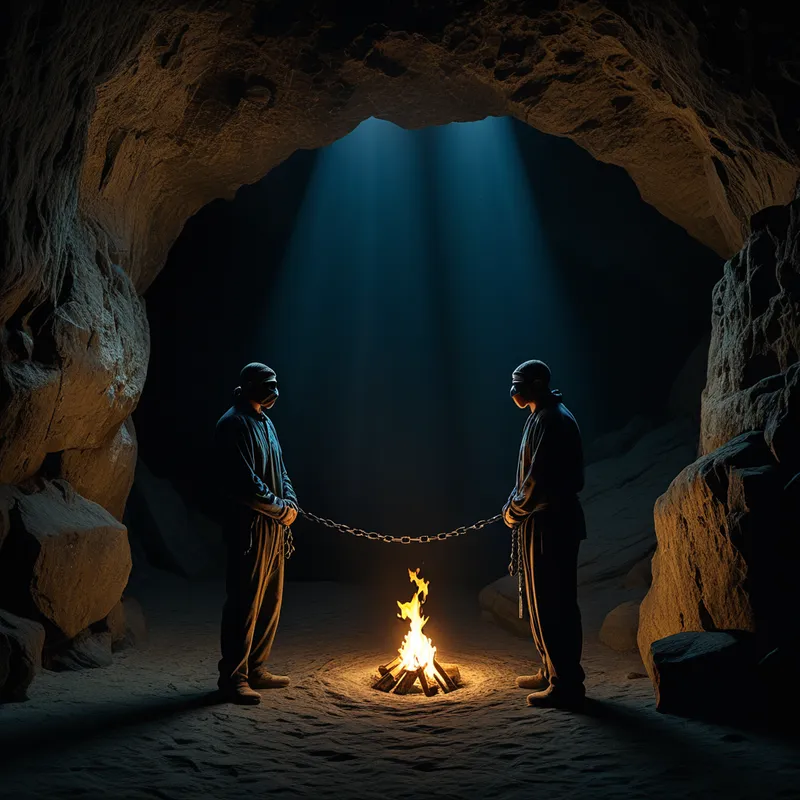
Listen. There is a place beneath the world, a deep and echoing cavern. Here, men and women have lived since the dawn of memory, bound by chains of iron and habit. Their necks are fixed, their gaze forever forward, staring at the blank stone wall before them. Behind them, a great fire roars, and between the fire and the prisoners, a low wall runs. Along this wall, other people pass, carrying aloft figures of men and beasts, of trees and tools, carved from wood and stone. The fire casts the shadows of these passing puppets onto the wall the prisoners face. This flickering dance of darkness is their only reality. They name the shadows, debate their sequences, and believe themselves wise in the ways of the world.
But imagine… one prisoner is unchained.
The sound of the iron breaking is a thunderclap in that silent world. He is forced to stand, to turn his head, to walk toward the fire. The light is agony. It burns his eyes, long accustomed to the gentle gloom. The figures carried along the wall seem crude, ugly, nonsensical compared to the clean shadows he knew. He stumbles, confused, his mind a riot of pain and disbelief. He is dragged further, up a rough and steep passage he never knew existed, toward a light so fierce it seems to devour the very air.
He emerges.
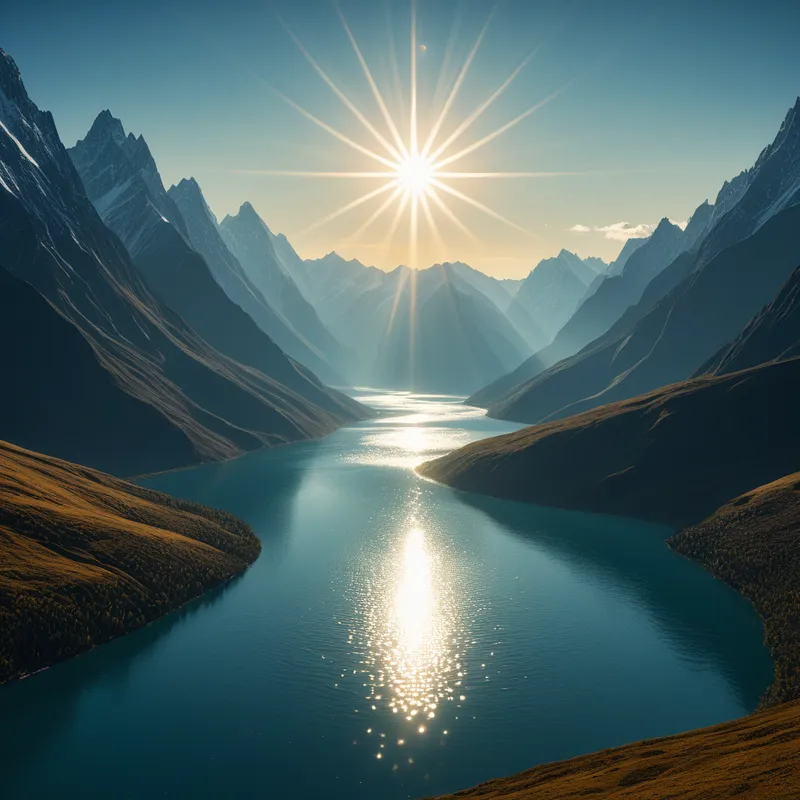
At first, he is blind. The light of the true sun is a white-hot spear in his skull. He falls to his knees, weeping. Slowly, as his eyes adjust, he begins to see reflections—in a pool of water, the shimmering likeness of a tree. Then, lifting his gaze, he sees the tree itself, solid and green and breathing. He sees color for the first time. He feels the wind. He looks up, and there, in the vault of heaven, he beholds the moon and the stars, and finally, the sun itself—not as a disk of fire, but as the source of all life, the cause of all visibility, the very principle of truth and being.
He understands. The shadows were nothing. The fire was a cheap imitation. Here, in the upper world, are the true things. And beyond even these, in the realm of pure thought, exist their perfect originals: the Forms. The Form of Tree, of Justice, of Beauty, of the Good. He has ascended from a world of copies into the world of reality.
His heart fills with pity for those still in the cave. He descends back into the darkness, his eyes now useless in the gloom. He tries to tell them of the sun, of the true forms, of the glorious world above. They laugh at his ruined sight. They declare him mad, dangerous. They resolve, if they could, to kill anyone who tries to free another and lead them up to the light.
Cultural Origins & Context
This is not a myth of Olympus, but of the Academy. It is the central allegory of Plato, recounted by his teacher Socrates in the dialogue Republic. In the intellectual culture of 4th-century BCE Athens, it functioned not as a religious hymn but as a philosophical and pedagogical tool. It was passed down not by bards around a fire, but by students in a colonnaded garden, through rigorous dialectic. Its societal function was revolutionary: to reorient the entire purpose of education and governance away from the manipulation of shadows (rhetoric, politics, sensory pleasure) and toward the arduous ascent to truth. It was a myth for the mind, a story that mapped the soul’s potential journey from opinion (doxa) to knowledge (episteme).
Symbolic Architecture
The Cave is the persona and the collective unconscious of a society—the world of accepted images, conventional wisdom, and mediated experience. We are all born chained to its wall.
The shadow on the wall is not the enemy; it is the only truth we have ever been fed. The chains are not of metal, but of identification.
The Fire is the ego’s constructed reality—the limited, subjective light by which we interpret the puppets of our culture, our family narratives, and our personal traumas. The Ascent is the brutal, disorienting process of analysis—of questioning every assumption, enduring the pain of cognitive dissonance, and deconstructing the very self that was formed in the dark.
The Sun, the Form of the Good, represents the Self—the central, unifying archetype of the psyche that is both the source of consciousness and its ultimate goal. It is not a “thing” to be seen, but the precondition for seeing anything truly. The prisoner’s return to the cave symbolizes the philosopher’s—or the integrated individual’s—tragic and necessary duty to re-engage with the shadow-world, armed with a truth that it cannot hear and does not want.
The Dreamer’s Resonance
When this myth stirs in the modern dreamer, it often manifests as dreams of claustrophobic tunnels, of being trapped in basements or elevators, or of staring at screens showing meaningless, flickering data. The somatic sensation is one of profound constraint in the chest and neck—the body remembering its chains.
Conversely, the ascending arc appears in dreams of sudden, startling vistas: finding a hidden door that opens onto a breathtaking mountain range, or breaking through the surface of water to gasp in clean air under a blinding sky. These are dreams of psychological breakthrough, where a long-held, limiting belief (a shadow) is suddenly seen for what it is—a mere projection. The emotional tone is first terror, then awe, and finally, a serene and lonely clarity. The dreamer is undergoing the initial, involuntary rupture of the ego’s cave-wall.
Alchemical Translation
The alchemy of the Cave is the transmutation of leaden opinion into golden knowledge. It is the opus of individuation.
The first stage, nigredo, is the darkness of the cave itself—the acknowledged misery of living a life based on borrowed images. The turning of the head is the beginning of albedo, the whitening: a painful confrontation with the fire of one’s own subjective biases and the crude “puppets” of personal history and complex. This is the dissolution of the old identity.
The ascent is not an acquisition, but a shedding. One does not climb toward light carrying the shadows; one must leave the very idea of “shadow” and “wall” behind.
The emergence into the sunlight is citrinitas, the yellowing or enlightenment—the direct, intuitive apprehension of archetypal patterns (the Forms) within one’s own psyche. One sees the Form of the Mother not as my mother, but as the eternal pattern of nurturing and constraint; the Form of the Hero not as a story, but as the psychic imperative toward courage.
The final stage, rubedo, the reddening, is the return. It is the integration of that blinding sun-consciousness back into the blood and earth of human relationship and service. The redeemed one must take the form of the sun and become a new, gentler fire in the darkness—not to cast clearer shadows, but to inspire, by their very presence, the aching suspicion that there might be a way to turn one’s head. The triumph is not in escaping the cave, but in transforming one’s purpose within it, having known the sun.
Associated Symbols
Explore related symbols from the CaleaDream lexicon: