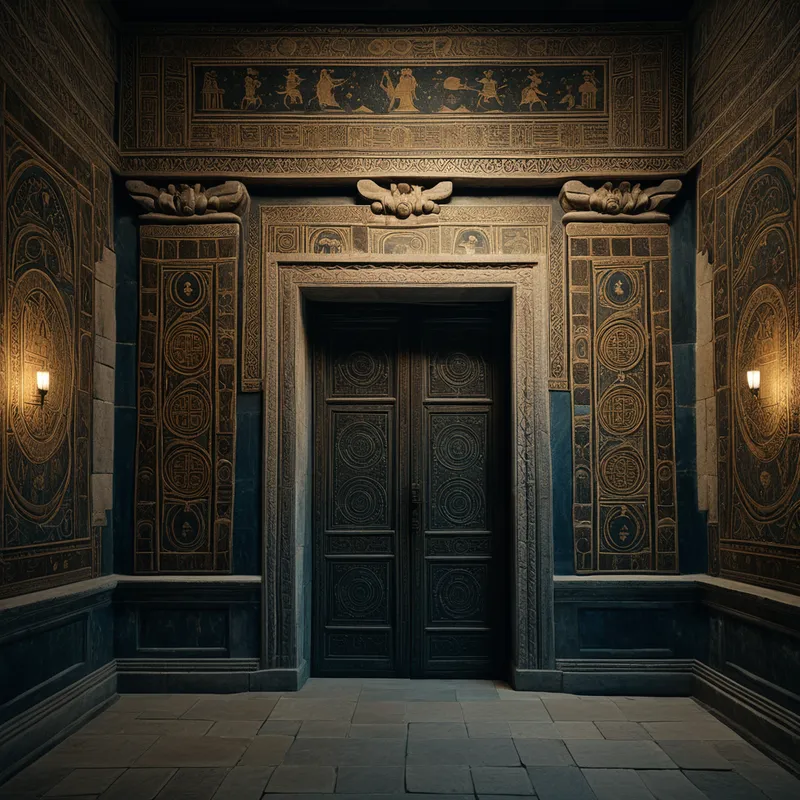
The Forbidden Room Myth Meaning & Symbolism
A universal tale where a hero is granted access to a great house but forbidden from entering one room, a taboo they inevitably break, unleashing consequences.
The Tale of The Forbidden Room
Listen, and hear a story told in the firelight of a hundred lands, whispered in [the market](/myths/the-market “Myth from Various culture.”/) squares of a thousand cities. It is the story of the house with a thousand doors, and the one that must remain shut.
There was once a seeker—a wanderer, a servant, a spouse, a curious child—who stood before a being of immense power. This being could be a sky-king, a sorceress-queen, or a wealthy lord of a vast estate. To the seeker, this powerful one offered a boon beyond measure: the freedom of a magnificent dwelling. “All within is yours,” the voice would thunder or softly croon. “Roam the sun-drenched galleries. Feast in the hall of a hundred hearths. Sleep in the chamber hung with [the moon](/myths/the-moon “Myth from Tarot culture.”/) and stars. But one door you must not open. One room you must never seek. Swear this to me, and all else is your domain.”
The seeker, heart swelling with gratitude and awe, would swear. And for a time, paradise was real. The house was a world unto itself, filled with wonders that sang to the soul. Yet, as days turned to cycles of the moon, the forbidden door began to call. Not with a voice, but with a silence deeper than any other. It stood plain among ornate carvings, a simple slab of wood or iron in a hallway of gold. It became a [lodestone](/myths/lodestone “Myth from Greek culture.”/) for the eye, a splinter in the mind. The memory of the oath would war with a rising tide of need—a need not for more treasure, but for the answer to the question the door itself posed: Why?
Whispers would come. Perhaps from a mischievous servant-spirit, or from the seeker’s own doubling shadow. “What horror can it hold?” “What secret power is kept from you?” “Are you a guest, or a prisoner?” The pressure would build, a psychic fever, until the seeker stood once more before the door, the oath a cold ash on their tongue. With a breath held in the throat like a stone, they would reach out. The handle, cool to the touch, would turn. The door, with a sigh that seemed to come from [the earth](/myths/the-earth “Myth from Hindu culture.”/) itself, would swing inward.
And within… was not a monster, not a treasure, but a truth. Sometimes, it was a vision of the powerful one in their naked, suffering state—a god wounded, a queen weeping. Sometimes, it was a churning primordial chaos, barely contained. Sometimes, it was a simple, dreadful object: a bloody key, a [forbidden fruit](/myths/forbidden-fruit “Myth from Christian culture.”/), a mirror showing a hidden face. In that moment of witnessing, [the world](/myths/the-world “Myth from Tarot culture.”/) would fracture. A wail would echo through the halls. The benevolent power would appear, not in anger, but in profound grief or terrible wrath. “You have looked upon what was not for your eyes. The compact is broken.”
The consequence would descend. For some, it was exile, cast out from paradise into a world of toil and mortality. For others, a curse transformed them or their loved ones. For all, the innocence of the house was forever lost, replaced by the hard, bright light of a knowledge that could not be unknown. The door, once shut, was now eternally open in the soul.
Cultural Origins & Context
The tale of The Forbidden Room is not the property of a single culture, but a narrative mytheme that appears with startling consistency across the globe. We find it in the Greek story of [Pandora](/myths/pandora “Myth from Greek culture.”/) and her jar (a contained “room”), in the Slavic tale of Baba Yaga giving warnings to those who seek shelter, in the Biblical narrative of Eden with its forbidden tree (a natural “room”), and in countless folktales from Japan ([Urashima Taro](/myths/urashima-taro “Myth from Japanese culture.”/) opening a forbidden box) to the Americas.
Its primary function was pedagogical, told by elders and storytellers not merely to entertain, but to inculcate the foundational social contract. It dramatized the tension between individual curiosity and collective taboo, between the desire for full knowledge and the necessity of boundaries for societal (and cosmic) order. It was a story about the price of revelation. In oral traditions, its telling would have been a communal ritual, reinforcing the authority of tradition (the “powerful one”) and the dire, yet understandable, consequences of breaking from it. The seeker is every human; the house is the ordered world or the bounty provided by tradition/the gods; the room is the ultimate, destabilizing mystery that the order is built to keep at bay.
Symbolic Architecture
Psychologically, the myth maps the [structure](/symbols/structure “Symbol: Structure in dreams often symbolizes stability, organization, and the framework of one’s life, reflecting how one perceives their environment and personal life.”/) of the developing [psyche](/myths/psyche “Myth from Greek culture.”/) itself. The “great house” represents the conscious ego and the [persona](/symbols/persona “Symbol: The social mask or outward identity one presents to the world, often concealing the true self.”/)—the acceptable, ordered, and gifted [identity](/symbols/identity “Symbol: Identity represents the sense of self, encompassing personal beliefs, cultural background, and social roles.”/) we inhabit in the world. It is the sum of our talents, our social standing, our cultivated self.
The Forbidden Room is the contents of the personal and collective unconscious, specifically the shadow and the Self.
The powerful one who sets the taboo is the archetypal [authority](/symbols/authority “Symbol: A symbol representing power structures, rules, and control, often reflecting one’s relationship with societal or personal governance.”/)—initially, our parents and society, later internalized as the superego or the guiding principle of our current conscious [adaptation](/symbols/adaptation “Symbol: The process of adjusting to new conditions, often involving psychological or physical change to survive or thrive.”/). Their rule is the psychic [defense](/symbols/defense “Symbol: A protective mechanism or barrier against perceived threats, representing boundaries, security, and resistance to external or internal challenges.”/) [mechanism](/symbols/mechanism “Symbol: Represents the body’s internal systems, emotional regulation, or psychological processes working together like a machine.”/) that says, “This part of yourself, this [memory](/symbols/memory “Symbol: Memory symbolizes the past, lessons learned, and the narratives we construct about our identities.”/), this primal [energy](/symbols/energy “Symbol: Energy symbolizes vitality, motivation, and the drive that fuels actions and ambitions.”/), is too dangerous to integrate. Leave it be.”
The act of opening the [door](/symbols/door “Symbol: A door symbolizes transition, opportunity, and choices, representing thresholds between different states of being or experiences.”/) is the inevitable, necessary [crisis](/symbols/crisis “Symbol: A crisis symbolizes turmoil, urgent challenges, and the need for immediate resolution or change.”/) of individuation. Curiosity here is not mere mischief, but the call of [the Self](/myths/the-self “Myth from Jungian culture.”/), the total, integrated psyche, which demands acknowledgment of the repressed. What is released or seen—the suffering god, the chaotic void—is the [shadow](/symbols/shadow “Symbol: The ‘shadow’ embodies the unconscious, repressed aspects of the self and often represents fears or hidden emotions.”/) in its raw form: the wounded, ashamed, powerful, or chaotic aspects of our own [nature](/symbols/nature “Symbol: Nature symbolizes growth, connectivity, and the primal forces of existence.”/) that we have locked away to maintain the “[paradise](/symbols/paradise “Symbol: A perfect, blissful place or state of being, often representing ultimate fulfillment, harmony, and transcendence beyond ordinary reality.”/)” of a frictionless, but incomplete, conscious [life](/symbols/life “Symbol: The symbol of ‘Life’ represents a journey of growth, interconnectedness, and existential meaning, encompassing both the joys and challenges that define human experience.”/).
The consequence—[exile](/symbols/exile “Symbol: Forced separation from one’s homeland or community, representing loss of belonging, punishment, or profound isolation.”/), transformation, [curse](/symbols/curse “Symbol: A supernatural invocation of harm or misfortune, often representing deep-seated fears, guilt, or perceived external malevolence.”/)—is not a [punishment](/symbols/punishment “Symbol: A dream symbol representing consequences for actions, often tied to guilt, societal rules, or internal moral conflicts.”/) from an external god, but the natural, often painful, result of psychic [expansion](/symbols/expansion “Symbol: A symbol of growth, increase, or extension beyond current boundaries, often representing personal development, opportunity, or overwhelming change.”/). The old, simple paradise of unconscious compliance is shattered forever. One can never “unsee” [the shadow](/myths/the-shadow “Myth from Jungian culture.”/) once it has been consciously confronted.
The Dreamer’s Resonance
When this myth pattern activates in modern dreams, the dreamer is at a precipice of self-discovery. The dream setting adapts: the “house” may be one’s workplace, childhood home, or a vast, futuristic complex. The “forbidden room” is consistently a door that feels psychically charged—it may be a basement door, a locked attic, a server room, or a closet.
The somatic experience in the dream is key: a palpable mix of dread and irresistible attraction, a tightening in the chest, a literal trembling. This is the body sensing the approach of repressed material—a childhood trauma, a denied ambition, a forbidden desire, or a vast, untapped creative force. Dreaming of standing before the door, paralyzed, reflects a conscious life at an impasse, where growth is stalled by an unacknowledged taboo. Dreaming of opening it and being flooded with light, shadow, or transformative imagery often follows, or precipitates, a major life crisis or breakthrough. The dream is the psyche’s ritual enactment of the taboo’s breaking, a safe(ish) space to rehearse the integration of what has been deemed “unacceptable.”
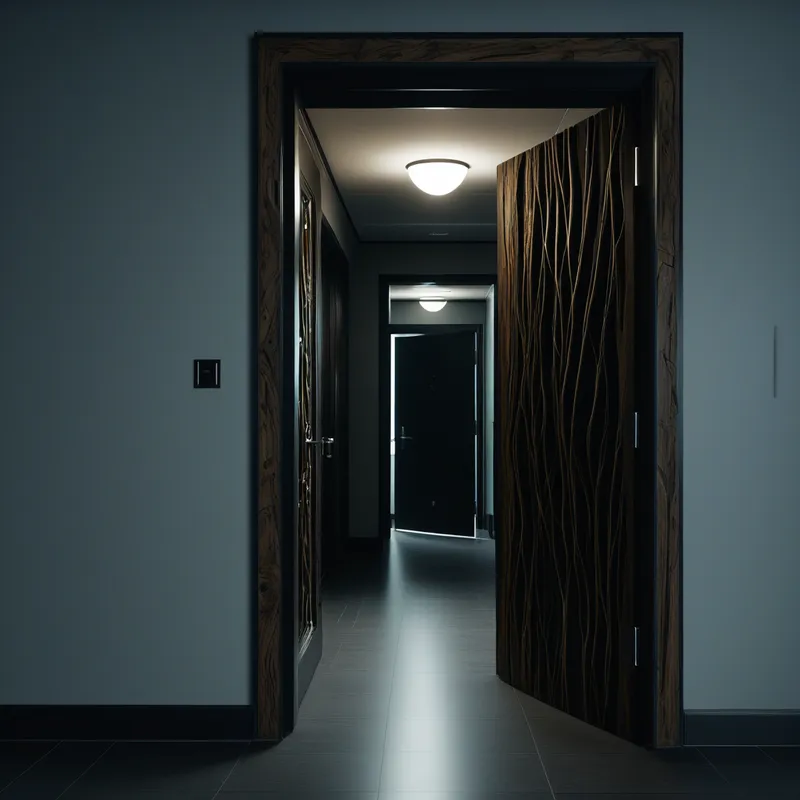
Alchemical Translation
The alchemical journey is one of transmutation: turning leaden, unconscious material into the gold of integrated consciousness. The Forbidden Room myth is a perfect map of this [nigredo](/myths/nigredo “Myth from Alchemical culture.”/) phase.
The oath to stay out is the ego’s pact with its own limitations. The opening of the door is the sacred violation that begins all true transformation.
First, one must inhabit the “house”—develop a stable enough conscious identity (the [prima materia](/myths/prima-materia “Myth from Alchemical culture.”/)). Then, the pressure builds; the integrated Self cannot tolerate the lie of omission forever. The act of turning the handle is the moment of surrender, where [the ego](/myths/the-ego “Myth from Jungian culture.”/) relinquishes its total control and agrees to face the shadow.
What is found inside—the “wounded god”—is the anima mundi trapped in one’s own complexes. To see it is to begin the ablutio, the cleansing flood of awareness. The ensuing “exile” is not a failure, but the beginning of the albedo. One is cast out of the naive paradise of the unconscious into the conscious, difficult world where this new knowledge must be worked with, embodied, and understood.
The final goal is not to return to the house as it was, but to rebuild the entire structure with the Forbidden Room integrated into its plan. The once-taboo space becomes a sanctum, its contents—the acknowledged shadow, the met trauma, the accepted desire—now a source of wisdom and power rather than fear. The curse becomes a calling. The exile becomes the journey of the true, whole self, no longer living in a gifted palace, but sovereign in a self-created kingdom that includes all its rooms, light and dark.
Associated Symbols
Explore related symbols from the CaleaDream lexicon: