The Forbidden Garden Myth Meaning & Symbolism
A primal myth of a sealed paradise, a divine prohibition, and the fateful act of tasting forbidden knowledge that forever changes humanity.
The Tale of The Forbidden Garden
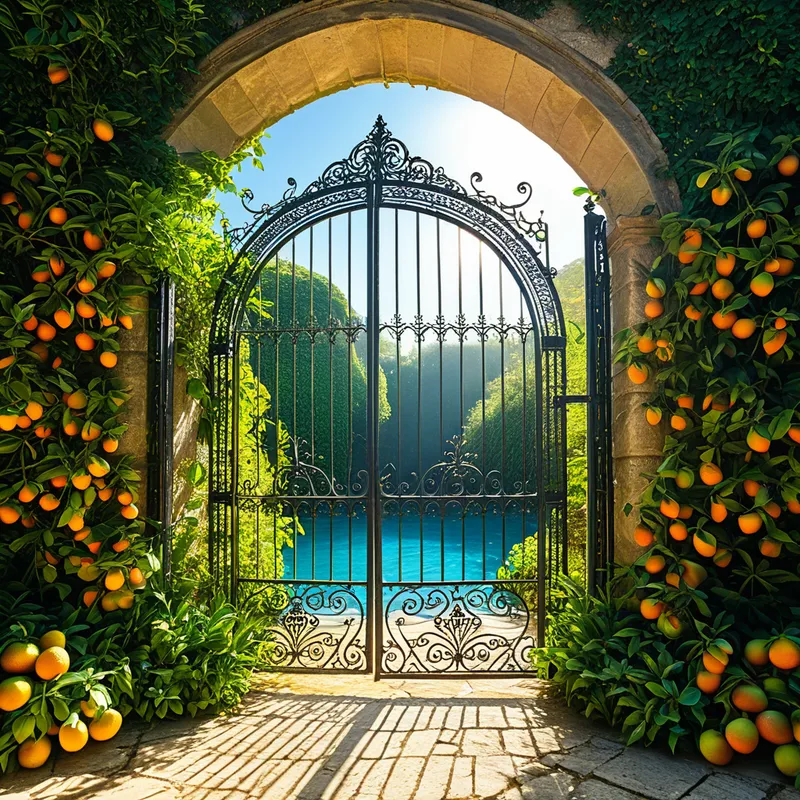
Listen, and I will tell you of the First Garden, the place before places, the time before time. It was called Eden, or Arcadia, or Dilmun. Its air was the breath of the gods, sweet with the scent of flowers that knew no decay. Rivers of milk and honey, of wine and clear [water](/myths/water “Myth from Chinese culture.”/), flowed without source or end, watering trees that bore not just fruit, but light, music, and perfect understanding.
In the center stood two trees. One was the [Tree of Life](/myths/tree-of-life “Myth from Kabbalistic culture.”/), its roots drinking from the deep well of eternity, its branches heavy with fruit that pulsed with a gentle, golden rhythm. The other was the Tree of the Knowledge of Good and Evil. Its bark was dark and smooth like obsidian, and from its branches hung fruit like captured nebulae, swirling with dark and light. A solemn prohibition echoed through the groves: “You may eat of every tree’s bounty, but of this one tree, you shall not eat, for on the day you do, you will surely die.”
The first humans, Adam and Eve, or Adapa, lived in the Garden’s embrace. They knew no shame, for they knew no other. They walked with the divine presence as a child walks with a parent, in trustful ignorance. But in the dappled shadows, a whisper began. It came from the Serpent, coiled upon the wall. Its voice was not a hiss, but the sound of dry leaves rustling with secret logic.
“You will not surely die,” it murmured, its eyes holding fragments of [the forbidden fruit](/myths/the-forbidden-fruit “Myth from Biblical culture.”/). “For the gods know that on the day you eat of it, your eyes will be opened, and you will be like them, knowing good and evil.”
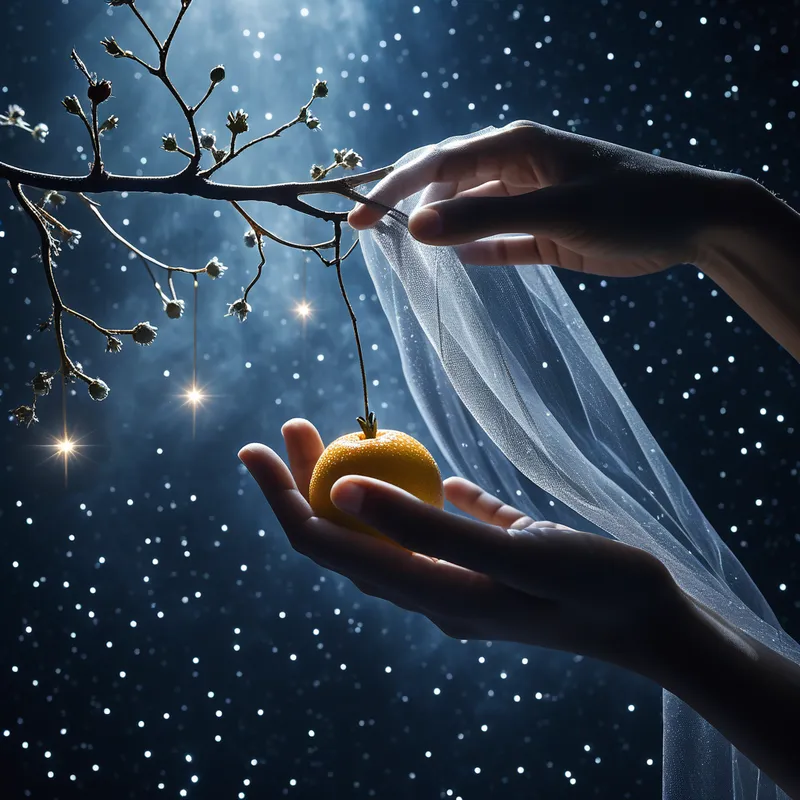
The woman looked at the tree. She saw not just fruit, but a doorway. The prohibition, which had been a simple fact of [the world](/myths/the-world “Myth from Tarot culture.”/), now became a wall. And what is a wall but an invitation to see what lies beyond? The desire bloomed in her, not for rebellion, but for completion. To know. She took the fruit. The taste was not sweet, but immense—a flood of cold fire and piercing light. She gave it to the man, and he ate.
The world did not end. But it changed. The first chill they felt was not of the air, but of their own nakedness. The harmony shattered. Where there was unity, now there was self and other. Where there was instinct, now there was judgment—good and evil. They heard the footsteps of the divine presence in the cool of the day, and for the first time, they hid, their hearts pounding with a new, sharp rhythm: fear.
“Where are you?” the voice called, not in anger, but in a sorrow as deep as the foundations of the world.
They were cast out. Not with a thunderous wrath, but with a terrible, gentle inevitability. A Cherubim with a flaming sword was placed at the eastern gate, turning every way to guard the path to [the Tree of Life](/myths/the-tree-of-life “Myth from Kabbalistic culture.”/). The gates of the Garden closed behind them forever. They stepped into the world of thorns and sweat, of birth-pangs and burial mounds, into the long, hard daylight of history.
Cultural Origins & Context
The pattern of the Forbidden Garden is not a single story, but a psychic imprint found across continents and epochs. Its most codified form comes from the Book of Genesis, compiled during the Babylonian Exile, where a displaced people grappled with themes of lost unity, divine law, and the origins of human suffering. Parallels shimmer in older Mesopotamian myths, like the tale of Adapa, who broke the “bread of life” and was denied immortality by the god Anu.
In Greek thought, the Garden echoes in the myth of [Pandora](/myths/pandora “Myth from Greek culture.”/) and her sealed jar—a divine prohibition violated, releasing suffering but also leaving hope trapped inside. It resonates in the [Golden Age](/myths/golden-age “Myth from Universal culture.”/) described by Hesiod, a time of effortless abundance from which humanity fell due to its own nature.
This story was never mere entertainment. It was a foundational etiological narrative, told by priests, elders, and storytellers to answer the most painful human questions: Why do we toil? Why do we feel shame? Why are we separated from the divine and from a state of natural grace? Its function was to establish a cosmic moral order, explain the human condition, and often, to reinforce the authority of the divine command and the social structures built upon it.
Symbolic Architecture
The Garden is not a historical place, but a psychological state: the unconscious, paradisiacal unity of [infancy](/symbols/infancy “Symbol: A symbol of beginnings, vulnerability, and foundational development, often representing a return to origins or a state of pure potential.”/), where need and fulfillment are seamless, and [the self](/myths/the-self “Myth from Jungian culture.”/) is undifferentiated from the world and the [parent](/symbols/parent “Symbol: The symbol of a parent often represents authority, nurturing, and protection, reflecting one’s inner relationship with figures of authority or their own parental figures.”/). It is the state of [nature](/symbols/nature “Symbol: Nature symbolizes growth, connectivity, and the primal forces of existence.”/) before the [emergence](/symbols/emergence “Symbol: A process of coming into being, rising from obscurity, or breaking through a barrier, often representing birth, transformation, or revelation.”/) of the conscious ego.
The Forbidden Fruit is not an apple, but the awakening of consciousness itself. The taste is the irreversible moment of reflection, where the self looks upon itself and knows itself as separate.
The Prohibition represents the necessary [boundary](/symbols/boundary “Symbol: A conceptual or physical limit defining separation, protection, or identity between entities, spaces, or states of being.”/) that creates the possibility of [choice](/symbols/choice “Symbol: The concept of choice often embodies decision-making, freedom, and the multitude of paths available in life.”/). Without a “thou shalt not,” there is no morality, no will, only instinct. It is the [structure](/symbols/structure “Symbol: Structure in dreams often symbolizes stability, organization, and the framework of one’s life, reflecting how one perceives their environment and personal life.”/) that makes freedom meaningful. The [Serpent](/symbols/serpent “Symbol: A powerful symbol of transformation, wisdom, and primal energy, often representing hidden knowledge, healing, or temptation.”/) is the catalyst of the [psyche](/myths/psyche “Myth from Greek culture.”/), the [trickster](/symbols/trickster “Symbol: A boundary-crossing archetype representing chaos, transformation, and the subversion of norms through cunning and humor.”/) [archetype](/symbols/archetype “Symbol: A universal, primordial pattern or prototype in the collective unconscious that shapes human experience, behavior, and creative expression.”/) that disrupts stagnant perfection. It is curiosity, the drive for [differentiation](/symbols/differentiation “Symbol: The process of distinguishing or separating parts of the self, emotions, or identity from a whole, often marking a developmental or psychological milestone.”/), the embodied voice of the unconscious pushing towards growth, however painful.
The “[death](/symbols/death “Symbol: Symbolizes transformation, endings, and new beginnings; often associated with fear of the unknown.”/)” that follows is not physical annihilation, but the death of psychic [innocence](/symbols/innocence “Symbol: A state of purity, naivety, and freedom from guilt or corruption, often associated with childhood and moral simplicity.”/). It is the [birth](/symbols/birth “Symbol: Birth symbolizes new beginnings, transformation, and the potential for growth and development.”/) of [the ego](/myths/the-ego “Myth from Jungian culture.”/), with all its attendant gifts and burdens: self-[awareness](/symbols/awareness “Symbol: Conscious perception of self, surroundings, or internal states. Often signifies awakening, insight, or heightened sensitivity.”/), moral discernment, [anxiety](/symbols/anxiety “Symbol: Anxiety in dreams reflects internal conflicts, fears of the unknown, or stress from waking life, often demonstrating the subconscious mind’s struggle for peace.”/), and the existential [loneliness](/symbols/loneliness “Symbol: A profound emotional state of perceived isolation, often signaling a need for connection or self-reflection.”/) of a separated [consciousness](/symbols/consciousness “Symbol: Consciousness represents the state of awareness and perception, encompassing thoughts, feelings, and experiences.”/). The Flaming Sword at the gate symbolizes the impossibility of [regression](/symbols/regression “Symbol: A psychological or spiritual return to earlier states of being, often involving revisiting past patterns, memories, or developmental stages for insight or healing.”/). One cannot un-know, un-see, or return to unconscious [bliss](/symbols/bliss “Symbol: A state of profound happiness and spiritual contentment, often representing fulfillment of desires or alignment with one’s true self.”/) once [consciousness](/symbols/consciousness “Symbol: Consciousness represents the state of awareness and perception, encompassing thoughts, feelings, and experiences.”/) has dawned.
The Dreamer’s Resonance
When this myth stirs in the modern dreamer, it often manifests as dreams of a hidden, beautiful room in a familiar house; a lush, walled garden discovered behind one’s own backyard; or a secret, pristine beach accessible only through a forbidden cave. The mood is one of awe mixed with trespass.
The somatic experience is key: a racing heart, a sense of exhilarating dread, the feeling of being watched. Psychologically, this dream pattern signals a critical threshold in the individuation process. The dreamer is on the verge of assimilating a piece of forbidden knowledge—about themselves. This could be acknowledging a repressed desire, facing a shadow aspect of their personality, or accepting a painful truth about their life or relationships.
The act of crossing [the threshold](/myths/the-threshold “Myth from Folklore culture.”/), touching the forbidden object, or eating the fruit in the dream represents the ego’s courageous (or compulsive) decision to integrate this previously unconscious content. The aftermath—the fear of discovery, the changed landscape—mirrors the real, often disorienting, psychological shift that follows such an integration. The paradise is “lost” because a simpler, more naive way of being is no longer possible.

Alchemical Translation
The alchemical journey begins in the massa confusa, the primal, unconscious unity—the Garden. The prohibition is the [prima materia](/myths/prima-materia “Myth from Alchemical culture.”/), the initial, leaden state that must be violated to begin the work. The serpent is the [Mercurius](/myths/mercurius “Myth from Alchemical culture.”/), the volatile, transformative spirit that initiates the [nigredo](/myths/nigredo “Myth from Alchemical culture.”/), the blackening.
The exile from Eden is not a punishment, but the first, necessary step of the opus. One must leave the unconscious paradise to undertake the conscious work of creating the philosopher’s stone—the integrated Self.
Eating the fruit is the [separatio](/myths/separatio “Myth from Alchemical culture.”/), the crucial division of consciousness from the unconscious, the light from the dark, the knowing subject from the known object. This is a painful, mortifying process (the “death”). The toil of the world outside the Garden represents the long labor of albedo and citrinitas—the washing and yellowing, the slow work of understanding and refining the raw materials of one’s complex nature.
The ultimate goal is not to re-enter the childish Garden, but to achieve the [rubedo](/myths/rubedo “Myth from Alchemical culture.”/), the reddening, the creation of a conscious, embodied wholeness that includes the knowledge of good and evil, suffering and joy, yet is not destroyed by it. This is the true “Tree of Life”—not as a external fruit to be eaten, but as a state of being forged in the fires of lived experience. The flaming sword then transforms from a barrier keeping us out, to the purifying fire within our own will, guarding the sacred center of a maturity hard-won and fully conscious. We become the gardeners of our own soul’s landscape, no longer naive inhabitants of a given paradise, but conscious stewards of a wholeness we have suffered to know.
Associated Symbols
Explore related symbols from the CaleaDream lexicon: