The Forbidden Fruit Myth Meaning & Symbolism
The foundational story of humanity's first choice, tasting knowledge and awakening to a world of self-awareness, consequence, and mortality.
The Tale of The Forbidden Fruit
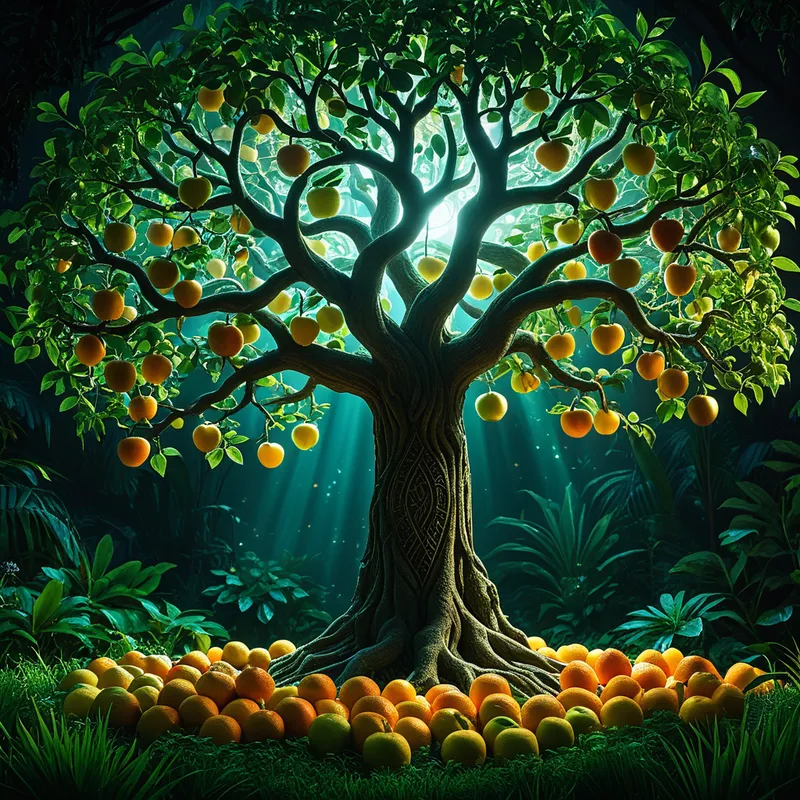
In the beginning, there was a garden. Not a garden as we know it, of weeds and seasons, but a garden of pure being. The air hummed with the breath of the Elohim, warm and fragrant with soil never turned by sorrow. In its heart, two trees stood apart from all others: the Tree of Life, and its counterpart, the Tree of the Knowledge of Good and Evil. Their fruits hung heavy, promises made manifest.
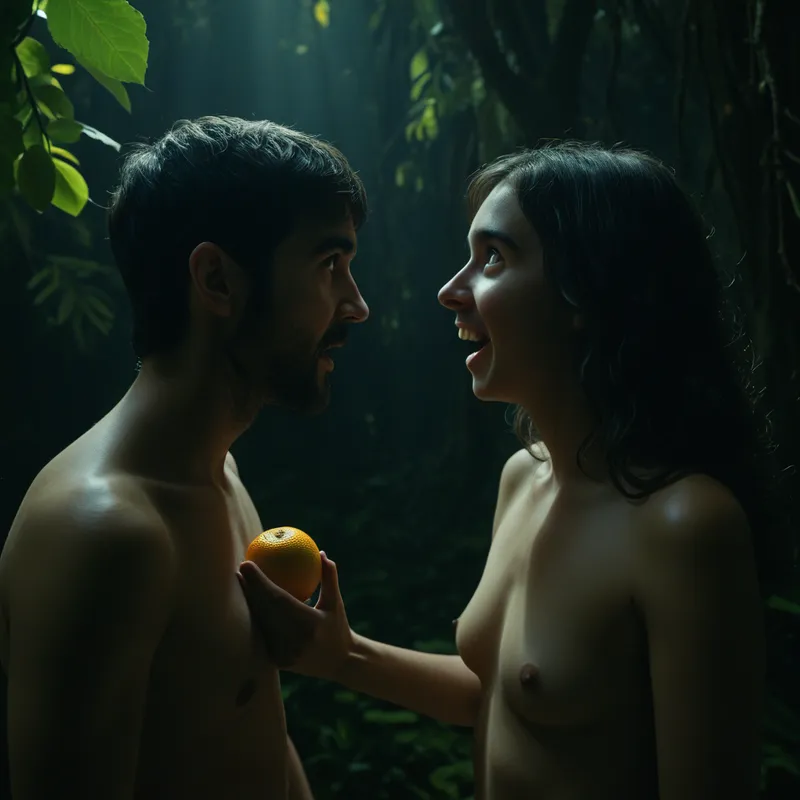
Here walked the Adam, formed from the red clay, and the Eve, drawn from his living side. They were naked and unashamed, for shame had not yet been conceived. Their world was one of direct perception, a seamless tapestry of sensation without the thread of judgment. The only law was a single, resonant prohibition, spoken by the Voice that walked in the cool of the day: “You may eat freely of every tree in the garden. But of the tree of the knowledge of good and evil, you shall not eat, for in the day that you eat of it, you shall surely die.”
Then came the whisper. It did not roar; it slid, a sound of dry scales on perfect leaves. The Serpent, most subtle of all creatures, coiled upon a branch of the forbidden tree. “Has Elohim truly said,” it murmured, its voice the color of polished brass, “that you shall not eat of any tree?” Eve, her heart a clear pool, corrected the distortion. But the seed was planted. The whisper continued, weaving a new possibility. “You will not surely die. For Elohim knows that on the day you eat of it, your eyes will be opened, and you will be like divine beings, knowing good and evil.”
The words hung in the air, a new and terrible fruit themselves. To be like the divine ones. To know. Eve looked at the tree anew. The fruit was not merely forbidden; it was beautiful. It promised a knowledge that pulsed just beyond the horizon of her innocence. Desire, sharp and sweet, bloomed in her chest—a first, inward complexity. She reached. She took. She ate. And she gave also to her man, who was with her, and he ate.
In that moment, the seamless tapestry tore. Their eyes were opened, but not to a divine vista. They saw their own nakedness, and for the first time, it was a problem to be solved. They heard the sound of the Voice walking in the garden, and instead of running toward it in joy, they hid among the trees, their hearts pounding a new rhythm: fear. They sewed fig leaves together, fashioning the first costume, the first barrier between self and other, between what is and what is seen. The garden had not changed, but the dwellers within it had been irrevocably exiled—from innocence, from unselfconscious unity, from a world without choice.
Cultural Origins & Context
This foundational narrative opens the book of Genesis, a text composed and redacted over centuries, likely during the Babylonian Exile (6th century BCE) and the subsequent Persian period. It is not a scientific record but a profound etiological myth—a story explaining origins. For a people grappling with displacement, identity, and their covenant with YHWH, it answered the deepest human questions: Why do we toil? Why do we feel shame? Why do we die? Why is knowledge so often paired with pain?
Passed down orally long before being codified, the tale served as the bedrock of a worldview where human suffering and moral complexity were not random accidents, but the consequence of a primordial choice. It established a core theological principle: human free will exists in tension with divine commandment. The story was told not to condemn, but to explain the human condition—a condition of fractured wholeness, of being both “like divine beings” in our knowledge, yet irrevocably mortal, clothed in skins of animal sacrifice and destined to return to the dust.
Symbolic Architecture
The myth’s power lies in its dense symbolic architecture, where every element is a facet of a psychological truth.
The Garden of Eden represents the original, undifferentiated state of the psyche—the unconscious unity of infancy, where self and world are one, and there is no conflict, no “other,” and no death of the spirit.
The Forbidden Fruit is not merely an apple of sin, but the seed of consciousness itself. To eat is to shatter the mirror of nature and see one’s own reflection staring back.
The Serpent is the archetypal trickster and the catalyst of evolution. It is the embodiment of questioning, of cunning intellect, and the disruptive force necessary for growth. It is not pure evil, but the necessary antagonist that forces consciousness out of its womb.
The Fruit of the Knowledge of Good and Evil symbolizes the birth of dualistic consciousness. “Good and evil” represent the fundamental act of discrimination—the psychic ability to split the world into categories: self/other, desirable/undesirable, sacred/profane. This knowledge is the prerequisite for morality, for art, for science, and for existential anxiety. It is the awareness of our own nakedness—our vulnerable, exposed, and separate selves.
Expulsion from the Garden is not a punishment, but an inevitable consequence. One cannot know duality and remain in unity. The “angel with the flaming sword” guarding the way back to the Tree of Life is the psychic defense ensuring we cannot regress into permanent innocence. We must live forward, into the complexity we have chosen.
The Dreamer’s Resonance
When this myth pattern erupts in modern dreams, it signals a profound threshold in the dreamer’s psychological development. Dreaming of a forbidden, tantalizing object—a locked box, a hidden room, a radiant fruit—points to an encounter with nascent consciousness. The somatic feeling is often one of thrilling dread, a mix of irresistible attraction and deep fear.
This is the psyche’s representation of confronting a new level of self-awareness. Perhaps the dreamer is on the verge of recognizing a painful truth about their childhood, their relationships, or their own shadow. The “forbidden” knowledge is often an aspect of themselves or their world they have been instructed (by family, society, or their own defenses) not to “see.” To eat the fruit in the dream is to accept the psychological consequence of that awakening: the death of an old, simpler identity (the “surely die” of the myth), and the birth of a more complex, responsible, and lonely self-awareness. The dream may end with a sense of shame or exposure—the fig leaves of new defenses being hastily assembled.
Alchemical Translation
The alchemical journey of individuation—the process of becoming a conscious, integrated individual—is perfectly modeled by this myth. The prima materia, the base substance, is the innocent, unconscious psyche in the Garden.
The Nigredo, the blackening, is the moment of the bite. It is the descent into knowledge, which initially feels like a fall, a corruption, a “sin.” The unified soul is blackened by the shadow of duality, by the recognition of conflict, limitation, and mortality. This is a necessary death.
The Albedo, the whitening, is the long work that follows expulsion. It is the labor of tilling the thorny ground of the conscious world—engaging with our relationships, our work, our suffering. We sew our fig leaves into more complex garments: a personality, an ego, a way of being in the world. We begin to purify the raw, chaotic knowledge into wisdom.
The goal is not to return to the Garden, but to cultivate the fallen world with the hard-won knowledge of the Fruit, integrating the serpent’s cunning with the responsibility of the divine image.
The ultimate Rubedo, the reddening or gold-making, is not a return to innocence, but the achievement of a second innocence. It is the integration of the knowledge of good and evil into a conscious wholeness that transcends mere duality. The rebel who transgressed becomes the sage who understands the necessity of that transgression for the soul’s maturation. We cannot reach the Tree of Life by going back, but by moving forward, carrying the luminous seed of that forbidden knowledge within us, transforming the dust of our mortality into the gold of a life fully lived and consciously understood. The Fruit, once the agent of our fall, becomes the cornerstone of our redemption.
Associated Symbols
Explore related symbols from the CaleaDream lexicon: