The Flower Bride Myth Meaning & Symbolism
A king must win a goddess of spring, but true sovereignty demands a sacrifice that transforms the land and the self.
The Tale of The Flower Bride
Hear now a tale from the time when [the world](/myths/the-world “Myth from Tarot culture.”/) was younger, when [the veil](/myths/the-veil “Myth from Various culture.”/) between the mortal realm and the [Sídhe](/myths/sdhe “Myth from Celtic / Irish culture.”/) was thin as morning mist. In the land of Ériu, there was a king, a man of great prowess and fair judgment, yet his kingdom lay under a subtle curse. The seasons turned, but the spring was ever brief, the summer lacked its full fire, and the harvests were meager. The people whispered that the land itself was lonely, that it missed the touch of its true sovereign.
The king, in his despair, sought the counsel of the oldest druid, whose eyes were like pools reflecting ancient stars. “The land is wed to the spirit of the growing world,” the druid said, his voice the rustle of oak leaves. “You rule the people, but the soil answers to another. You must seek the [Flower Bride](/myths/flower-bride “Myth from Celtic culture.”/). She is Brigid in her maiden aspect, she is the spirit of the [hawthorn](/myths/hawthorn “Myth from Celtic culture.”/) tree. She is the one who wears [the crown](/myths/the-crown “Myth from Various culture.”/) of blossoms and whose footsteps coax life from the clay. But know this, King: to win her is not to capture her. It is to be chosen, and the choosing demands a price deeper than blood.”
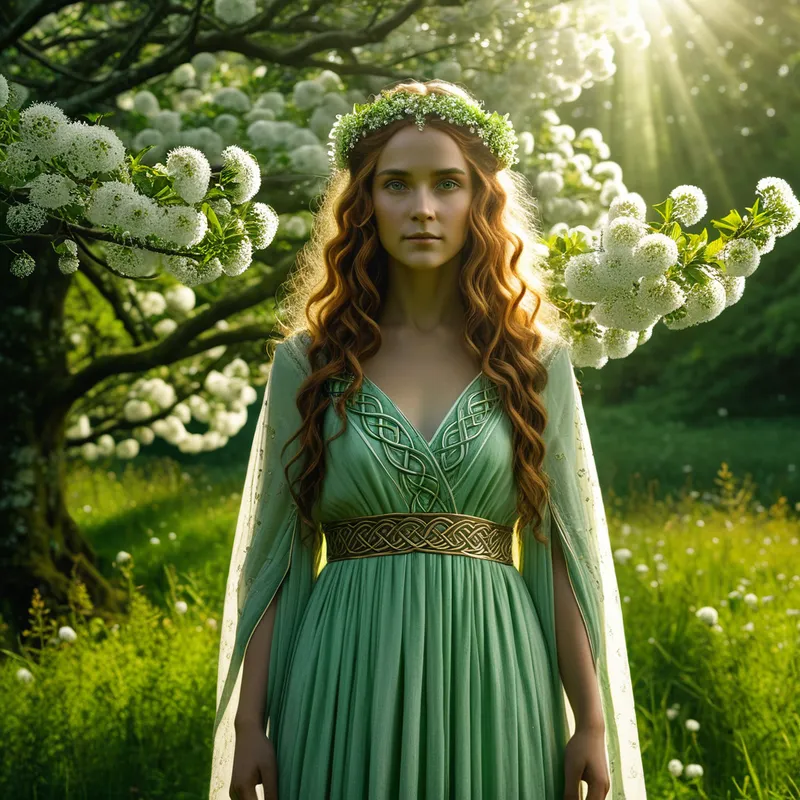
Guided by omens—a fox that ran westward at dawn, a dream of a white blossom floating on a dark stream—the king journeyed to a certain forgotten valley. And there, in a clearing where the light fell like honey, he saw her. She was neither wholly woman nor wholly spirit, but something of both. Her hair was the cascade of a waterfall, braided with hawthorn flowers. Her cloak was the deep green of the forest, and where she walked, bluebells and wood anemones sprang instantly from [the earth](/myths/the-earth “Myth from Hindu culture.”/), their scent dizzyingly sweet. She was the Flower Bride, and her eyes held the alternating warmth of summer sun and the chill of frost.
He spoke to her of his people’s hunger, of the barren fields, of his own heart that felt as fallow as the winter earth. She listened, a faint, sad smile on her lips. “I can make your land flow with milk and honey,” she said, her voice like [the wind](/myths/the-wind “Myth from Various culture.”/) through ripe barley. “I can seat you on a throne that is rooted deep in the bedrock of this island. But my love is not a prize for the swift or the strong. It is a covenant. To hold me, you must let me go. To keep me, you must give me back to myself, season by season.”
The king, his soul alight with a love he had never known, pledged himself to her. For a time, it was a [golden age](/myths/golden-age “Myth from Universal culture.”/). The Flower Bride walked the fields, and they grew heavy with grain. She laughed in the orchards, and the fruit swelled sweet. The king and his goddess-queen ruled in joy, and the land and the people were one flesh, one spirit.
But as [the wheel of the year](/myths/the-wheel-of-the-year “Myth from Celtic culture.”/) turned toward [Samhain](/myths/samhain “Myth from Celtic culture.”/), the king noticed a change. The light in his bride’s eyes dimmed. The flowers in her hair began to wilt, though it was high summer. A profound weariness settled upon her. She would stand for hours, gazing toward [the sacred grove](/myths/the-sacred-grove “Myth from Celtic culture.”/) from whence she came. “My power is not endless in your world,” she confessed one evening, her hand cold in his. “I am of the Sídhe. To remain here, to give life to this land, drains my essence. I am fading, husband.”
The king faced the crux of the druid’s warning. He could cling to her, and watch the very life he loved seep from her until she was a ghost, and the land would surely die with her. Or he could make the sacrifice. With a heart heavier than stone, he made his choice. On the eve of the harvest, he led her, now pale and faint as a moonbeam, back to the sacred hawthorn in the valley. “I cannot hold you captive, even for love,” he said, his voice breaking. “Go. Return to your own essence. Heal.”
Tears like dew fell from her eyes. As she stepped beneath the branches of the hawthorn, a radiant light enveloped her. She dissolved not into nothing, but into a thousand drifting blossoms, a sigh of fragrance on the air. The king fell to his knees, certain he had lost everything.
But with the dawn, he saw it. The hawthorn tree, which had bloomed only in May, was now covered in a second, miraculous flowering. And from that day, the kingdom knew a new rhythm. The Flower Bride would come to him each spring, vibrant and whole, and depart each autumn, her strength preserved. The land flourished in a balance more profound than any constant summer, for it was a land loved, not possessed. The true sovereignty was not in holding, but in the sacred, cyclical release.
Cultural Origins & Context
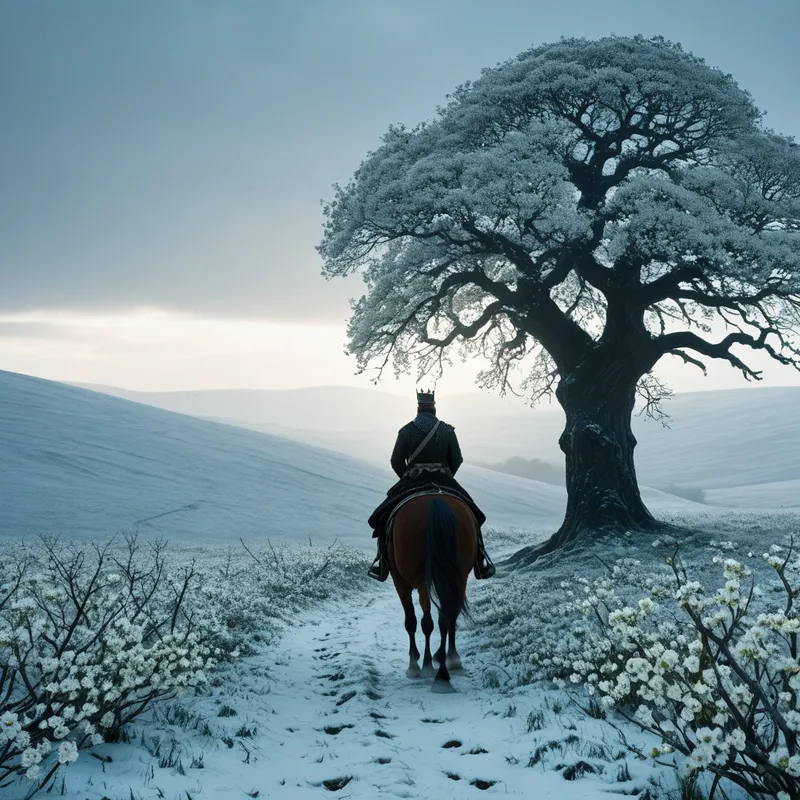
The motif of the Flower Bride is woven from several threads in the Celtic mythological tapestry, primarily Irish and Welsh. It is less a single, standardized myth than a powerful narrative pattern reflecting core druidic and societal principles. This story pattern echoes in the tales of deities like Brigid (whose feast day, Imbolc, heralds spring), in the concept of the Sovereignty Goddess who often appears as a hag transformed into a beauty by the rightful king’s kiss or union, and in the deep reverence for trees like the hawthorn, considered a gateway to [the Otherworld](/myths/the-otherworld “Myth from Celtic culture.”/).
These stories were the province of the filid, the poet-seers, who preserved them not as mere entertainment but as sacred lore. Their function was didactic and cosmological. They taught the nature of true kingship—fír flathemon—which held that a king’s personal morality and his correct relationship with the feminine spirit of the land directly caused prosperity or blight. The myth encoded a fundamental law: life is cyclical, not linear; sovereignty is a partnership with forces beyond human control; and the greatest power often lies in respectful release, not possessive domination.
Symbolic Architecture
At its [heart](/symbols/heart “Symbol: The heart symbolizes love, emotion, and the core of one’s existence, representing deep connections with others and self.”/), the myth is a profound map of [relationship](/symbols/relationship “Symbol: A representation of connections we have with others in our lives, often reflecting our emotional state.”/)—between humanity and [nature](/symbols/nature “Symbol: Nature symbolizes growth, connectivity, and the primal forces of existence.”/), the conscious ego and the animating [soul](/symbols/soul “Symbol: The soul represents the essence of a person, encompassing their spirit, identity, and connection to the universe.”/), the ruler and the [realm](/symbols/realm “Symbol: The symbol of ‘Realm’ often signifies the boundaries of one’s consciousness, experiences, or emotional states, suggesting aspects of reality that are either explored or ignored.”/).
The Flower Bride is the soul of the world, the anima mundi, and the inner anima of the individual. She is the vital, creative, and instinctual life force that cannot be owned.
The [king](/symbols/king “Symbol: A symbol of ultimate authority, leadership, and societal order, often representing the dreamer’s inner power or external control figures.”/) represents the conscious mind, [the ego](/myths/the-ego “Myth from Jungian culture.”/), and the [human](/symbols/human “Symbol: The symbol of a human represents individuality, complexity of emotions, and social relationships.”/) will. His initial desire is noble—to heal [the wasteland](/myths/the-wasteland “Myth from Arthurian culture.”/)—but it is still a desire to take, to acquire the [solution](/symbols/solution “Symbol: A solution symbolizes resolution, clarity, and the overcoming of obstacles, often representing a sense of accomplishment.”/) (the [bride](/symbols/bride “Symbol: A bride symbolizes new beginnings, commitment, and the transition into a partnership or a new phase in life.”/)) for his [kingdom](/symbols/kingdom “Symbol: A kingdom symbolizes authority, belonging, and a sense of identity within a larger context or community.”/). The barren land is a [symbol](/symbols/symbol “Symbol: A symbol can represent an idea, concept, or belief, serving as a powerful tool for communication and understanding.”/) of a [life](/symbols/life “Symbol: The symbol of ‘Life’ represents a journey of growth, interconnectedness, and existential meaning, encompassing both the joys and challenges that define human experience.”/) lived from [the ego](/myths/the-ego “Myth from Jungian culture.”/) alone, disconnected from the deep, nourishing waters of the unconscious and the natural cycles of being.
The critical transformation is not in the winning, but in the letting go. The king’s sacrifice is the ego’s ultimate submission to a larger law. He must relinquish possessive, personal love for a sacred, cyclical relationship. The hawthorn [tree](/symbols/tree “Symbol: In dreams, the tree often symbolizes growth, stability, and the interconnectedness of life.”/) is the [axis](/symbols/axis “Symbol: A central line or principle around which things revolve, representing stability, orientation, and the fundamental structure of reality or consciousness.”/) of this transformation—a symbol of guarded boundaries, sacred union, and the painful, necessary threshold between worlds.
The second flowering of the hawthorn is the alchemical sign of the conjunctio, the sacred marriage achieved not through fusion, but through rhythmic, respectful dialogue between opposites.
The Dreamer’s Resonance
When this myth stirs in the modern [psyche](/myths/psyche “Myth from Greek culture.”/), it often surfaces in dreams of profound relationship dilemmas or cycles of creativity and depletion. One might dream of a luminous, captivating partner who begins to sicken the closer they are held; of a project or talent that blooms brilliantly then withers under too much focused pressure; or of a beautiful, walled garden that one is forbidden to enter, yet is responsible for tending.
Somatically, this can feel like a clutching in the chest, a tension between the desire to merge and a deep, instinctual need for autonomy. Psychologically, the dreamer is encountering the anima or animus not as a fantasy to be acquired, but as a sovereign entity with its own laws. The process is one of recognizing where one’s love has become a cage, where one’s ambition is draining the very source it seeks to harness. It is the psyche’s plea for a shift from a psychology of possession to a psychology of covenant.
Alchemical Translation
The journey of the king is a perfect model for the individuation process. The “wasteland” is the initial state of neurosis or meaninglessness, where the conscious attitude is bankrupt. The quest for the Flower Bride is the ego’s turn toward the unconscious, seeking the lost vitality of the soul.
The first union represents a thrilling inflation—the ego has “found” the soul, and life becomes magically productive. But this is the [nigredo](/myths/nigredo “Myth from Alchemical culture.”/), the darkening, for inflation is always followed by a crisis. The clinging ego risks killing the very soul-image it depends on, leading to a deeper barrenness.
The sacrifice is the pivotal mortificatio—the death of the ego’s possessive attitude. This is not self-annihilation, but the death of a childish way of relating.
By releasing his claim, the king does not lose the Flower Bride; he establishes a correct, living relationship with her principle. This is the albedo, the whitening, symbolized by the miraculous hawthorn blossoms. The cyclical nature of their subsequent union reflects the achieved state of individuation: a conscious personality no longer identified with the unconscious, nor divorced from it, but in a dynamic, rhythmic exchange. The ego learns to rule the inner kingdom not as a tyrant, but as a steward who honors the seasons of the soul—times for expression and times for withdrawal, times for work and times for essential, sacred rest. The final sovereignty is self-sovereignty, won through the courageous, loving release of what one holds most dear.
Associated Symbols
Explore related symbols from the CaleaDream lexicon: