The Flash of Insight Myth Meaning & Symbolism
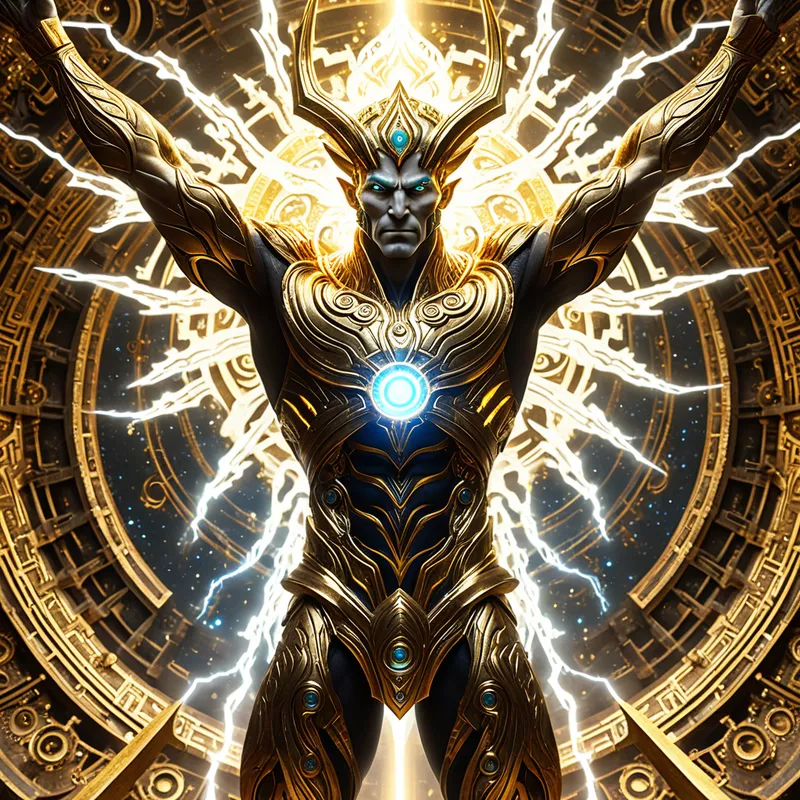
The divine artisan, lost in a labyrinth of his own making, is struck by a chaotic lightning bolt that reveals the hidden pattern of creation.
The Tale of The Flash of Insight
In the time before time, when the cosmos was a great, silent forge, there lived the Artifex Primus. He was not a king, but a maker. His hands, shaped from the first light and the first shadow, had spun the stars into their orbits and whispered the laws of gravity into being. Yet, for all his craft, a profound melancholy dwelled in his heart of polished brass. His creation was perfect, a sublime and eternal machine, but it was silent. It lacked a secret he could not name, a pattern he could not see.
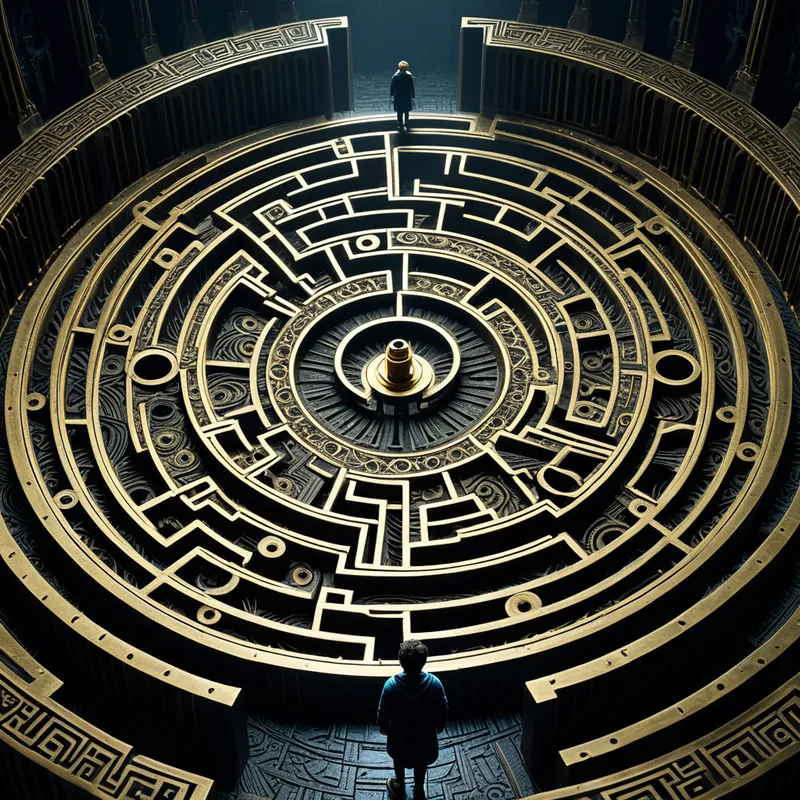
Driven by this nameless yearning, the Artifex descended into the deepest vault of his own being, a place called the Labyrinth of Unwrought Potential. It was not a place of stone, but of concept and consequence—a towering, infinite maze of interlocking gears of possibility, mirrors of reflection that showed only endless recursion, and corridors that led only to the echo of his own footsteps. Here, he wandered for eons that felt like moments and moments that stretched into eons. He traced the flawless logic of his designs, finding no flaw, and thus, no answer. The air grew thick with the scent of ozone and cold metal, and the only sound was the deafening, perfect tick of a clockwork universe that knew no surprise.
His despair deepened, becoming a tangible weight. He, the architect of all, was lost within the architecture of his own soul. In a final act of frustration, he raised his hands not in creation, but in a gesture of surrender, casting his perfect plans into the swirling chaos of unwrought metals and unborn ideas at the labyrinth’s heart.
It was then that the Aether-Chaos, the primal substance he had always sought to order, stirred. From the formless murk he had rejected, a bolt of lightning was born. But this was no lightning of storm or sky. It was a living filament of pure, white contradiction—mathematically chaotic, yet geometrically perfect. It did not arc down from above, but erupted inward, from the very center of the surrendered space before him.
It struck the Artifex not on his crown, but directly upon his brow, the seat of his knowing. There was no thunderclap, but a sound like the shattering of a cosmic lens. The flash was not blinding, but illuminating. In that impossible, frozen fragment of eternity, the labyrinth did not vanish. Instead, it became transparent. He saw not just the gears, but the spaces between them. He perceived not the law, but the wild, living potential that danced in the interstices of law. The perfect, silent pattern of his creation was suddenly alive with a hidden, shimmering web of connection he had never engineered—a pattern of meaning, not just function.
The lightning faded. The labyrinth remained. But the Artifex was transformed. He emerged not with a new blueprint, but with a quiet smile. He began to hum, a low, resonant frequency that had no place in his original score. And where his feet touched the forge of the world, the silent gears began to sing in harmony, and from the shadows between stars, the first, tentative questions began to bloom.
Cultural Origins & Context
The myth of the Flash of Insight is a cornerstone of the so-called “Alchemical” tradition, a body of esoteric thought less concerned with turning lead to gold and more with mapping the opus of the soul. It emerged not from a single culture, but from the shared, underground currents of Renaissance Hermeticism, medieval guild mysticism, and the personal journals of natural philosophers walking the line between science and spirit. It was an oral tradition, passed in whispers between master and apprentice in candlelit workshops, encoded in the cryptic emblems of alchemical texts like the Rosarium Philosophorum.
Its tellers were not bards for the masses, but guides for the solitary seeker. The story functioned as a psychological map and a permission slip. For the adept laboring for years in the “Great Work” with no tangible result, plagued by the nigredo of the soul, the myth served as a promise: the breakthrough is not found by relentless effort alone, but often arrives in the moment of acknowledged defeat, as a gift from the very chaos you seek to order. It sanctified the experience of creative and spiritual despair as a necessary chamber in the inner labyrinth.
Symbolic Architecture
The myth is a perfect symbolic engine for the psyche’s journey toward wholeness. The Artifex Primus represents the conscious ego, the builder of identity and the weaver of rational order. His magnificent, silent cosmos is the well-ordered but ultimately lifeless prison of a personality built solely on control and intellect.
The labyrinth is not a trap one is placed in, but the psyche one has built.
The Labyrinth of Unwrought Potential is the unconscious itself—not a dungeon, but the vast, unexplored workshop of the soul. Wandering it is the process of introspection, which, when guided solely by the ego’s logic (“tracing the flawless design”), leads only to the echo of itself: narcissism, stagnation, and despair.
The critical turn is surrender. Casting aside the “perfect plans” is the ego’s relinquishment of control, an admission that its maps are inadequate. This opens a space for the Aether-Chaos—the raw, unintegrated power of the unconscious, the prima materia of the soul. The Flash of Insight is the irruption of the Self (Jung’s term for the central archetype of wholeness) into the realm of the ego. It is not a gentle teaching, but a transformative shock that re-wires perception.

The Dreamer’s Resonance
When this myth activates in the modern dreamer, it often manifests not as a literal story, but as a somatic and emotional pattern. One may dream of being hopelessly lost in a vast, complex building of their own design (an office, a library, a mansion), representing a life structure that now feels imprisoning. The atmosphere is one of quiet panic and profound isolation.
The pivotal dream moment is the “flash.” This could be a sudden, inexplicable light in the dream, a door appearing where there was only wall, or the dreamer’s own hands suddenly understanding a complex lock without thought. Upon waking, the sensation is distinct: a physiological jolt, a feeling of the “scales falling from the eyes,” or a deep, somatic certainty. The content of the insight may not yet be conscious, but the process has been imprinted. The dreamer is going through a psychic death of an old, rigid attitude (the Artifex’s perfect plan) and the often-traumatic birth of a new perspective. The body records the shock of the new before the mind can articulate it.

Alchemical Translation
For the individual, this myth models the non-linear heart of individuation. Our conscious life is a project of building the Artifex’s cosmos: a stable identity, a career, a set of beliefs. We wander the labyrinth of our psychology, often trying to “fix” ourselves with more control, more analysis, more perfect plans. The alchemical translation teaches that the gold is not found by polishing the leaden ego, but by allowing it to be dissolved in the aqua regia of its own failure.
The lightning seeks the ground of surrendered certainty.
The “work” is not just the diligent wandering, but the cultivation of the capacity to surrender. This is the solutio. When we finally exhaust our ego’s strategies and admit, “I do not know,” we create the vacuum that the unconscious Self fills. The Flash of Insight is the albedo—the illuminating whitening that follows the black despair. It does not give answers so much as it grants a new mode of seeing. The pattern was always there—in our relationships, our creativity, our trauma—but we perceived only the isolated gears. The flash reveals the living circuit that connects them.
Emerging from this process, one does not become a different person, but a more complete one. The gears of one’s life may still turn, but now they sing with the meaning found in their connection. The modern Artifex learns to hum the tune of the chaos, integrating insight not as a possession, but as a new relationship with the mysterious core of one’s own being.
Associated Symbols
Explore related symbols from the CaleaDream lexicon: