The First Death Myth Myth Meaning & Symbolism
A foundational myth where a divine being's sacrifice establishes death as a sacred law, transforming the timeless Dreaming into a world of cycles and meaning.
The Tale of The First Death Myth
In the beginning-time, the Dreaming, the world was not as it is now. The Ancestral Beings walked the fresh earth, shaping the rivers with their journeys and singing the mountains into being. There was no darkness, only the endless, shimmering light of becoming. And there was no end. Beings changed form, shifted from kangaroo to rock to man, but they did not perish. The world was eternal, and time was a flat, bright plain.
Among these mighty beings was one of great wisdom, a Creator Figure known by many names across the songlines. Let us call them the Law-Giver. The Law-Giver saw the world they had helped dream into existence. It was beautiful, yes, teeming with life that never faded. But it was also still. Like a waterhole without a current, it was becoming stagnant. There were too many beings, with no room for the new. The songs of the old ones filled every space, leaving no air for new melodies.
A great heaviness settled upon the Law-Giver’s spirit. They walked to a sacred place, where the red earth met the boundless sky. The other Ancestors gathered, sensing a change in the song of the world. “What troubles you?” they asked.
The Law-Giver looked at them, their eyes holding the light of a thousand suns. “Our creation is incomplete,” they said, their voice the sound of wind through deep gorges. “It has no rhythm. It has no consequence. To live forever is to never truly live. There is no depth without the shadow, no story without an ending.”
A murmur of disbelief rippled through the assembly. To speak of an ending was to speak of the unthinkable.
“I see a new law,” the Law-Giver continued, their form beginning to glow with a soft, inevitable light. “A law of turning. A law of return. From this moment, life will have a season. It will bloom, it will fade, and it will go back to the earth from which it came. It will make room for the new shoots, the new songs. This will be the greatest gift, and the hardest law.”
The other beings cried out. “Do not do this! Do not bring this shadow into our bright world!”
But the Law-Giver was resolved. “A law cannot be given; it must be shown. It must be lived.”
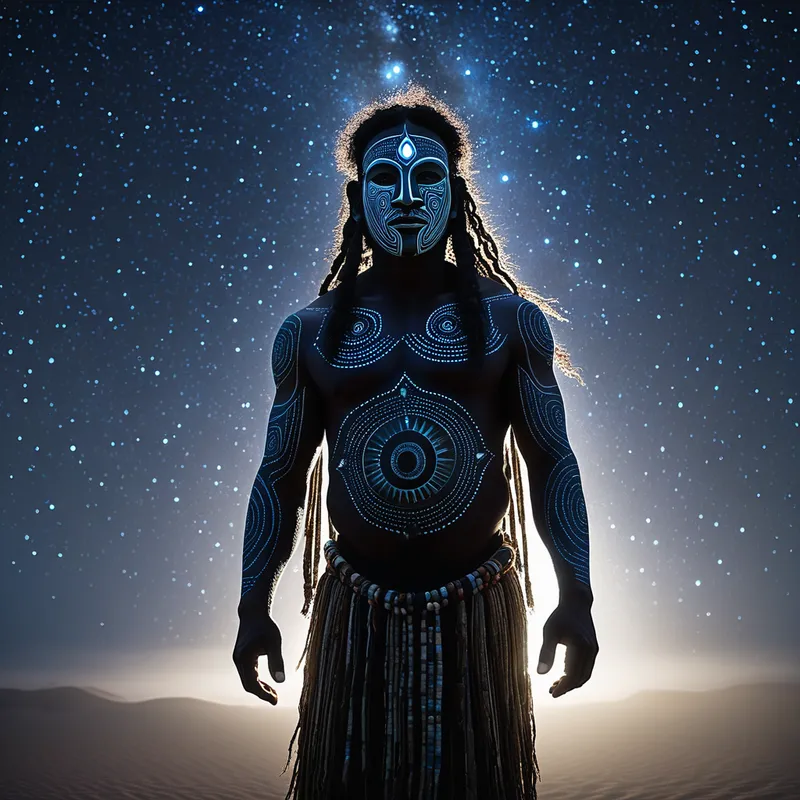
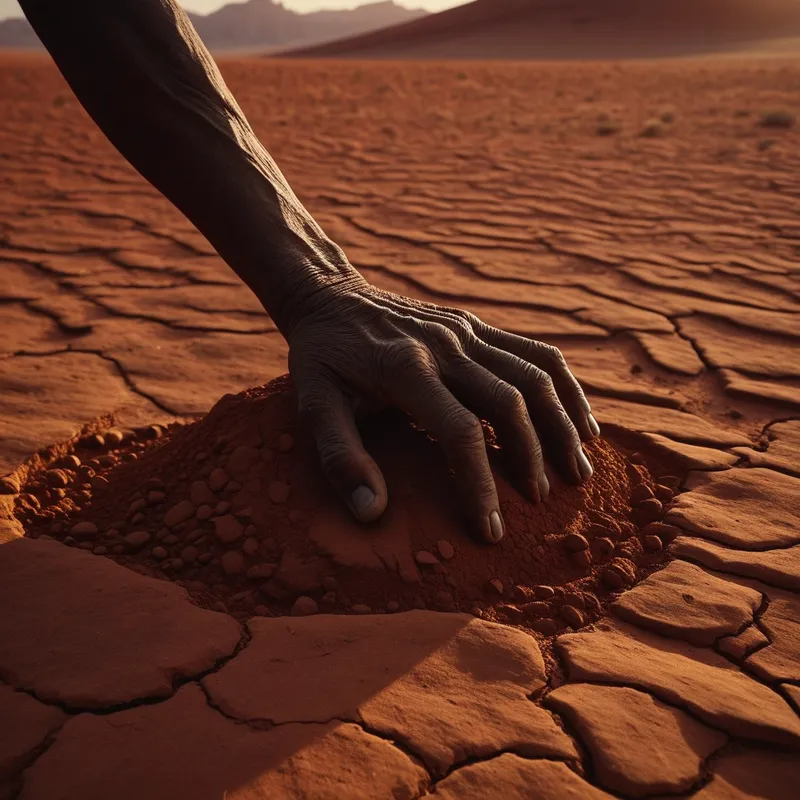
And so, the Law-Giver lay down upon the red earth. They did not fight, they did not struggle. They began to sing—a low, haunting song that was both a lullaby and a dirge. As they sang, their luminous form, which had shaped canyons and stars, began to soften. The brilliant light dimmed, not into darkness, but into a gentle, spreading glow. Their body did not vanish, but transformed. It seeped into the ground, becoming the first nutrients. Their breath became the first wind that carries seeds. Their final, closing gaze became the first true night, a velvet blanket studded with the sparks of their enduring spirit.
A profound silence fell, deeper than any that had existed before. It was a silence filled with a new kind of knowing. Where the Law-Giver had lain, the first plants sprang up, greener and more vibrant than any before. The world felt different. It felt precious. It felt real. The first death had occurred, not as a theft, but as a sacred, willing donation. And with it, the first tears were shed, watering the new life that now had meaning because it was fleeting.
Cultural Origins & Context
This foundational narrative exists in various forms across the many and diverse Aboriginal Australian nations, often tied to specific landscapes and songlines. It is not a singular, monolithic “myth” but a core thematic truth expressed through localised stories featuring different Ancestral Beings—sometimes a specific named figure, sometimes a group. Its transmission was, and for many communities remains, an oral sacrament. Elders and knowledge-holders recount it during ceremonies, initiations, and at times of mourning, not as mere history but as a living map of reality’s structure.
Its societal function is multifaceted. Primarily, it is a etiological narrative that explains the origin of mortality, framing it not as a punishment or flaw, but as an essential, sacred law (Lore) established in the Dreaming. This provides a profound cosmological framework for understanding life, loss, and ecology. It teaches that death is not an end but a transformation and a necessary return that nourishes the continuity of life. It consoles the bereaved by situating personal grief within a grand, purposeful cycle ordained at the very foundation of the world.
Symbolic Architecture
The myth’s power lies in its radical re-framing of the ultimate [human](/symbols/human “Symbol: The symbol of a human represents individuality, complexity of emotions, and social relationships.”/) fear. Here, [death](/symbols/death “Symbol: Symbolizes transformation, endings, and new beginnings; often associated with fear of the unknown.”/) is not an [antagonist](/symbols/antagonist “Symbol: A character or force that opposes the protagonist, creating conflict and driving narrative tension in artistic works.”/), but the cornerstone of a meaningful [cosmos](/symbols/cosmos “Symbol: The entire universe as an ordered, harmonious system, often representing the totality of existence, spiritual connection, and the unknown.”/).
The first law of a living world is not permanence, but exchange. The Sage does not conquer death; they become its architect, transforming terror into sacred law.
The Law-Giver is the archetypal Sage, whose wisdom sees beyond the immediate desire for eternal preservation to the deeper need for [rhythm](/symbols/rhythm “Symbol: A fundamental pattern of movement or sound in time, representing life’s cycles, emotional flow, and universal order.”/) and meaning. Their sacrifice is not one of [blood](/symbols/blood “Symbol: Blood often symbolizes life force, vitality, and deep emotional connections, but it can also evoke themes of sacrifice, trauma, and mortality.”/), but of state—a voluntary relinquishment of timelessness to institute temporality. The act of lying down and dissolving represents the ultimate trust in the process of creation itself, a belief that the whole is more important than the perpetual existence of the individual part.
The resulting transformation—[body](/symbols/body “Symbol: The body in dreams often symbolizes the dreamer’s self-identity, personal health, and the relationship they have with their physical existence.”/) into [earth](/symbols/earth “Symbol: The symbol of Earth often represents grounding, stability, and the physical realm, embodying a connection to nature and the innate support it provides.”/), [breath](/symbols/breath “Symbol: Breath symbolizes life, vitality, and the connection between the physical and spiritual realms.”/) into wind—establishes the core symbolic principle of return. Nothing is lost; everything is changed and recycled within the [system](/symbols/system “Symbol: A system represents structure, organization, and interrelated components functioning together, often reflecting personal or social order.”/). This creates a [universe](/symbols/universe “Symbol: The universe symbolizes vastness, interconnectedness, and the mysteries of existence beyond the individual self.”/) based on reciprocal [relationship](/symbols/relationship “Symbol: A representation of connections we have with others in our lives, often reflecting our emotional state.”/), where every ending directly feeds a beginning. The “first plants” that spring forth are the direct, physical [symbol](/symbols/symbol “Symbol: A symbol can represent an idea, concept, or belief, serving as a powerful tool for communication and understanding.”/) of this new, fertile [logic](/symbols/logic “Symbol: The principle of reasoning and rational thought, often representing order, structure, and intellectual clarity in dreams.”/) born from sacrifice.
The Dreamer’s Resonance
When this mythic pattern stirs in the modern dream, it rarely appears as a literal story. Instead, it manifests as a profound somatic and psychological process of release. One might dream of a cherished, towering tree willingly shedding all its leaves, which then turn into a flock of birds. One might dream of calmly dismantling one’s own home, brick by brick, to feed a river. The dream ego is not being attacked or killed; it is participating in a necessary, if sorrowful, dissolution.
This signals a psyche ready to surrender an old, outworn structure of being—a rigid identity, a prolonged state of grief, a career, a self-concept that has become stagnant. The “first death” in the dream is the death of a way of being. The somatic feeling is often not panic, but a deep, melancholic certainty and a surprising undercurrent of peace. It is the unconscious, working through the mythic template, teaching the dreamer how to die to one chapter so that the next can be written. The tears in the dream are the sacred water that the myth says must fall, watering the seeds of what is to come.

Alchemical Translation
For the individual on the path of individuation, this myth models the ultimate alchemical act: the mortificatio or solutio, not as a catastrophic failure, but as a conscious, willed sacrifice for the sake of greater life. The psyche, like the timeless Dreaming, can become cluttered with the perpetual, undigested matter of old traumas, fixed personas, and unlived potentials. To cling to this static inner landscape is to choose a kind of psychic immortality that is, in truth, a living stagnation.
Individuation requires the courage to become the Law-Giver of one’s own soul—to willingly decree the end of what is, to make space for what must become.
The alchemical process here is one of transmuting the fear of death into the acceptance of necessary endings. The ego, in its role as the inner Law-Giver, must learn to “lie down” upon the red earth of the body and the unconscious. It must consent to the dissolution of its own primacy, allowing its fixed energies to decompose and become nutrients for a broader, more complex Self. This is the death that precedes rebirth; the sacrifice of the known for the sake of the possible. The “new plants” that spring forth are the emergent qualities of compassion, depth, authenticity, and connection to the transpersonal—the vibrant life that can only grow in soil fertilized by what we have courageously let go.
Associated Symbols
Explore related symbols from the CaleaDream lexicon:
- Sacrifice — The central, voluntary act of the Law-Giver, representing the conscious offering of one state of being to establish a greater, life-sustaining order.
- Death — Transformed from a mere end into a sacred, generative law, the necessary catalyst for all cyclical renewal and meaning.
- Earth — The recipient of the sacrifice, symbolizing the grounded reality, the body, and the fertile ground from which new life inevitably springs.
- Water — The tears shed at the first death, representing the emotional release and cleansing that accompanies profound transformation and nourishes new growth.
- Law — The new cosmic principle established by the myth, representing the necessary structures and cycles that give shape and depth to existence.
- Dream — The state of the timeless Dreaming from which the law emerges, and the inner psychic space where this transformative process is rehearsed.
- Return — The core motion of the myth, the cyclical journey back to the source that ensures continuity and ecological/psychological balance.
- Seed — The potential for new life made possible only by the decomposition of the old, buried in the fertile ground created by sacrifice.
- Grief — The sacred human response to an ending, framed not as pointless suffering but as the necessary emotional water that honors the sacrifice.
- Origin — The myth as a foundational story that explains the very origin of conditionality, time, and consequence in the human experience.
- Mythos — The overarching, living narrative framework that contains this truth, providing a map for understanding life’s deepest transitions.