The Fimbulwinter Myth Meaning & Symbolism
The great winter of three years, a time of primal chaos and broken bonds that precedes the twilight of the gods and the world's rebirth.
The Tale of The Fimbulwinter
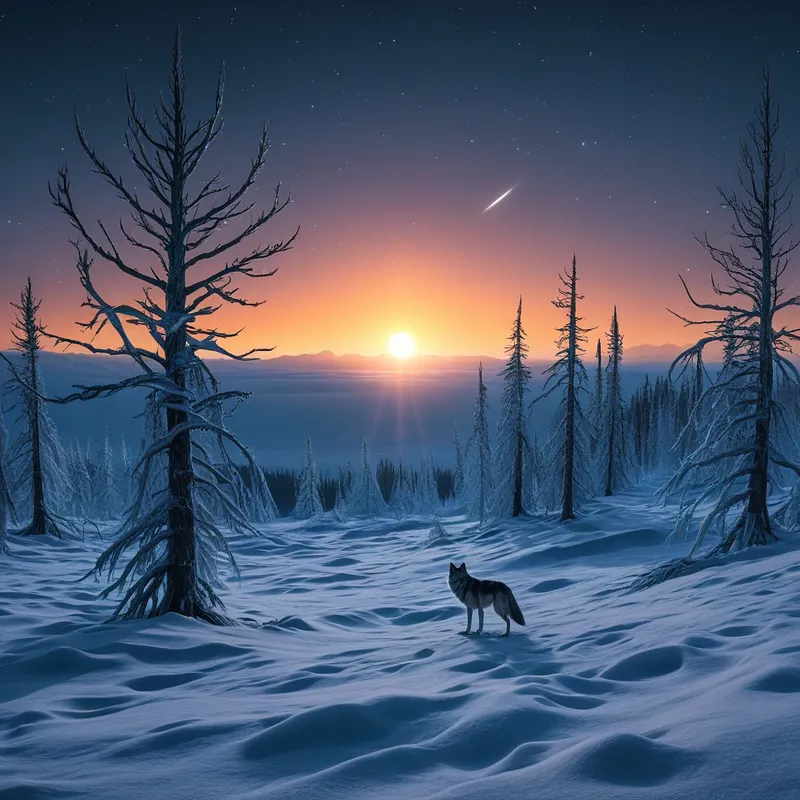
Listen. [The wind](/myths/the-wind “Myth from Various culture.”/) does not blow; it gnaws. It is a tooth of ice from the north, and it has been gnawing at the roots of [the world](/myths/the-world “Myth from Tarot culture.”/) for three long years. This is the [Fimbulwinter](/myths/fimbulwinter “Myth from Norse culture.”/), and it has a brother: silence.
First, the sun grew weak, a pale coin in a leaden sky. Then her brother, [the moon](/myths/the-moon “Myth from Tarot culture.”/), wandered a bloody path. The stars, those steadfast sparks, trembled and went out. Now, three winters run together with no summer between. Snow drives horizontal from every direction, burying the high halls and the low huts alike. The seas themselves grow a skin of iron-hard ice. In the forests, the great beasts—the elk, the bear—simply lie down and let the white shroud take them. The wolves, driven by a hunger older than the gods, come down from the mountains. But they do not find sheep or cattle; they find only the silence, and so they turn on each other.
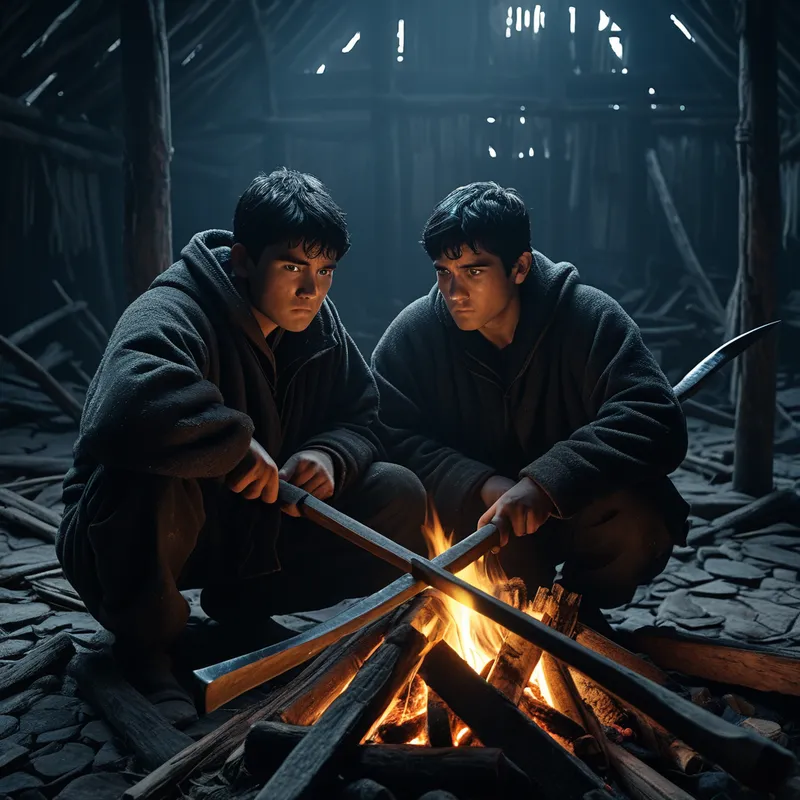
This is the time when bonds, forged in warmth and mead, snap like icicles. A man will not recognize his brother’s face beneath the frost. A son will bar the door against his father’s frozen fist. Kin will slay kin for a crust of hard bread, for a handful of embers. All oaths are forgotten, all law is unmade. The very language of men shrivels, reduced to grunts and snarls. It is a world unmade from the inside out, a great exhale of chaos before the final breath.
And high above, on the shimmering [rainbow bridge](/myths/rainbow-bridge “Myth from Universal culture.”/) of Bifröst, the watchman [Heimdallr](/myths/heimdallr “Myth from Norse culture.”/) stands. His hearing, which can catch the sound of grass growing and wool on a sheep, is filled with a new sound: the cracking of the world’s spine. He turns his gaze from [Midgard](/myths/midgard “Myth from Norse culture.”/), this frozen grave, toward the east. There, in the iron wood of Járnviðr, the old witch feeds the wolves that will swallow the sun and moon. He looks to the north, where the ship of nails, [Naglfar](/myths/naglfar “Myth from Norse culture.”/), breaks free from its icy moorings. He knows this deep cold is not an end, but a gathering. It is the long, drawn-out note that calls the players to their final places: the bound wolf [Fenrir](/myths/fenrir “Myth from Norse culture.”/), the world-serpent [Jörmungandr](/myths/jrmungandr “Myth from Norse culture.”/), the fire-giant [Surtr](/myths/surtr “Myth from Norse culture.”/). The Fimbulwinter is the locking of the door. What comes next is the breaking of it.
Cultural Origins & Context
The primary source for the Fimbulwinter is the Völuspá, the haunting prophecy spoken by a revived seeress to Odin. Recorded in the 13th-century Poetic Edda, its verses are believed to preserve much older oral traditions. This was not a fireside tale for comfort, but a sacred cosmology recited by skalds and seers. It functioned as a map of existential reality for the Norse peoples—a world-view that accepted cataclysm and cyclical renewal as fundamental laws.
In a culture intimately acquainted with the brutality of northern climates, a winter that never ended was the ultimate existential threat. The myth gave a cosmic, ordained shape to their deepest environmental fears. More than that, it served as a profound social mirror. The breakdown of kinship and law (frith and örlög) described in the myth was a warning of the fragility of civilization itself. It taught that societal collapse begins not with invasion, but with the freezing of the human heart—a failure of the bonds that make a community more than just a collection of individuals facing the cold.
Symbolic Architecture
The [Fimbulwinter](/symbols/fimbulwinter “Symbol: Fimbulwinter represents a cataclysmic winter preceding the end of the world, embodying themes of destruction, transformation, and renewal.”/) is not merely a meteorological [event](/symbols/event “Symbol: An event within dreams often signifies significant life changes, transitions, or emotional milestones.”/); it is the archetypal [landscape](/symbols/landscape “Symbol: Landscapes in dreams are powerful symbols representing the dreamer’s emotional state, personal journey, and the broader context of life situations.”/) of systemic collapse. It represents the point where a sustaining [structure](/symbols/structure “Symbol: Structure in dreams often symbolizes stability, organization, and the framework of one’s life, reflecting how one perceives their environment and personal life.”/)—be it ecological, psychological, or societal—exhausts its [capacity](/symbols/capacity “Symbol: A measure of one’s potential, limits, or ability to contain, process, or achieve something, often reflecting self-assessment or external demands.”/) for [life](/symbols/life “Symbol: The symbol of ‘Life’ represents a journey of growth, interconnectedness, and existential meaning, encompassing both the joys and challenges that define human experience.”/) and enters a terminal phase of [entropy](/symbols/entropy “Symbol: In arts and music, entropy represents the inevitable decay of order into chaos, often symbolizing creative destruction, impermanence, and the natural progression toward disorder.”/).
The great winter is the psyche’s necessary descent into a state where all provisional identities and comforting narratives freeze and shatter.
Symbolically, the three years signify a complete cycle, a [fullness](/symbols/fullness “Symbol: A state of complete satisfaction, abundance, or completion, often representing emotional, spiritual, or physical fulfillment.”/) of time necessary for a total [dissolution](/symbols/dissolution “Symbol: The process of breaking down, dispersing, or losing form, often representing transformation, release, or the end of a state of being.”/). The failure of the sun and [moon](/symbols/moon “Symbol: The Moon symbolizes intuition, emotional depth, and the cyclical nature of life, often reflecting the inner self and subconscious desires.”/) represents the [extinction](/symbols/extinction “Symbol: The complete disappearance of a species or concept, representing irreversible endings, loss of legacy, and profound transformation.”/) of conscious guiding principles—[the logos](/myths/the-logos “Myth from Biblical culture.”/) (order, reason) and the eros ([connection](/symbols/connection “Symbol: Connection symbolizes relationships, communication, and bonds among individuals.”/), feeling). The wolves turning on each other and kin killing kin are the ultimate images of the [shadow](/symbols/shadow “Symbol: The ‘shadow’ embodies the unconscious, repressed aspects of the self and often represents fears or hidden emotions.”/) consuming [the self](/myths/the-self “Myth from Jungian culture.”/). When the external world provides no sustenance, the unconscious drives, once directed [outward](/symbols/outward “Symbol: Movement or orientation away from the self or center; expansion, expression, or externalization of inner states into the world.”/), turn [inward](/symbols/inward “Symbol: A journey toward self-awareness, introspection, and the exploration of one’s inner world, thoughts, and unconscious mind.”/) in self-cannibalization. The Fimbulwinter is the [winter](/symbols/winter “Symbol: Winter symbolizes a time of reflection, introspection, and dormancy, often representing challenges or a period of transformation.”/) of the [soul](/symbols/soul “Symbol: The soul represents the essence of a person, encompassing their spirit, identity, and connection to the universe.”/), where everything that is not essential to the core self is stripped away by the cold, often through [crisis](/symbols/crisis “Symbol: A crisis symbolizes turmoil, urgent challenges, and the need for immediate resolution or change.”/), depression, or profound [loss](/symbols/loss “Symbol: Loss often symbolizes change, grief, and transformation in dreams, representing the emotional or psychological detachment from something or someone significant.”/).
The Dreamer’s Resonance
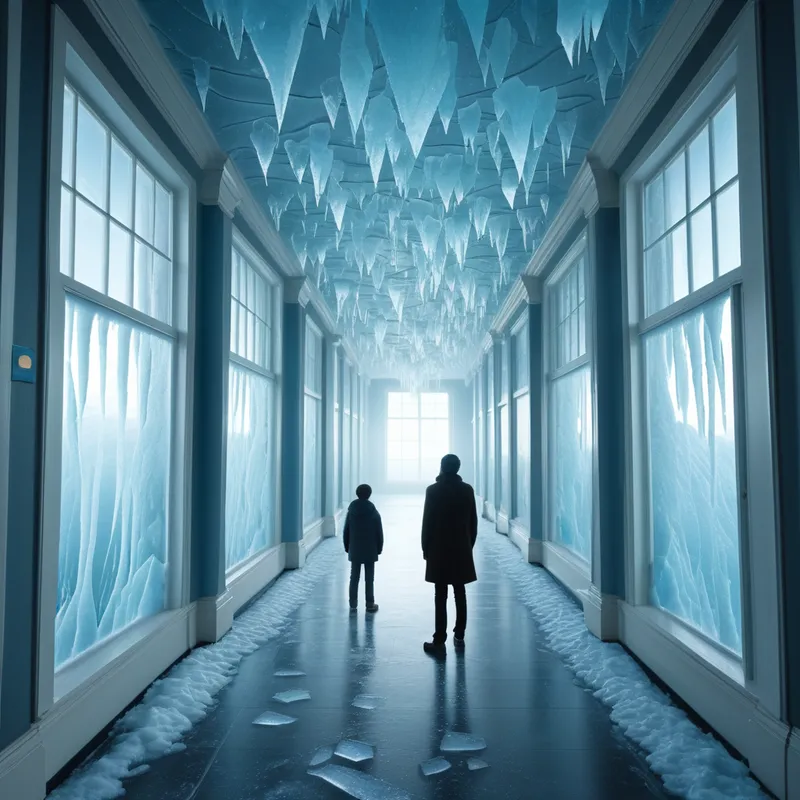
When the pattern of the Fimbulwinter emerges in modern dreams, it rarely appears as literal snow and ice. Its signature is a pervasive, chilling atmosphere of existential isolation and emotional paralysis. The dreamer may find themselves in a familiar place—their childhood home, their workplace—that has become eerily empty, lifeless, and freezing cold. Technology fails; phones have no signal, lights will not turn on. People in the dream, even loved ones, are distant, unresponsive, or hostile, their faces blank or frost-covered.
Somatically, this dream state correlates with a process of deep psychic contraction. It is the feeling of being stuck, of life force draining away, of relationships feeling brittle and cold. Psychologically, it often manifests during life transitions so profound they feel like an ending of the world as one knows it: the collapse of a career, the end of a long relationship, a spiritual crisis, or the confrontation with one’s own mortality. The dream is not a prophecy of literal doom, but an accurate mapping of the inner landscape. It says, “You are in the long winter. The old ways of being and relating are no longer sustaining you.”
Alchemical Translation
In the alchemy of the [psyche](/myths/psyche “Myth from Greek culture.”/), the Fimbulwinter is the essential [nigredo](/myths/nigredo “Myth from Alchemical culture.”/)—the blackening, the putrefaction. It is the first, non-negotiable stage of the individuation process, where the [persona](/myths/persona “Myth from Greek culture.”/) (the adapted social self) freezes and cracks, exposing the raw, chaotic contents of the personal and collective shadow.
The purpose of the endless winter is not to kill the soul, but to force it to discover its own inner fire, the ember that can only be found in absolute darkness and cold.
The modern individual undergoing this “Fimbulwinter” is not called to fight the cold, but to endure it consciously. It is a time for radical honesty, for sitting in the ruins of broken oaths (to old selves, to outdated ideals) and feeling the full weight of the silence. This is the purification by frost. Just as the mythic winter kills off all that is weak and unsustainable in the external world, the psychological winter annihilates our inauthentic attachments and dependencies.
The crucial alchemical truth embedded in the myth is that the Fimbulwinter is preparatory. It clears the ground for [Ragnarök](/myths/ragnark “Myth from Norse culture.”/). In the individual, this means the winter of the soul must be fully experienced before the buried, fiery core of the true Self (Surtr within) can rise to destroy the old, tyrannical structures of the psyche (the old gods) and allow for rebirth. We do not bypass the Fimbulwinter to achieve transformation; we must pass through its very heart. The resilience forged in that cold—the discovery that one can survive the death of a world—is the seed of the new green shoot that will eventually break through the thaw.
Associated Symbols
Explore related symbols from the CaleaDream lexicon: