
The Fig Leaves in Eden Myth Meaning & Symbolism
After tasting forbidden knowledge, the first humans, naked and exposed, sew fig leaves into aprons, marking the dawn of self-awareness and the human condition.
The Tale of The Fig Leaves in Eden
In the beginning, before time was counted, there was a garden. Not a garden as we know it, of ordered rows and weary soil, but a place of unthinking abundance. The air was a perfume of living things, and the light fell not from a distant sun, but seemed to emanate from the very soil, the leaves, the fur of the resting lion. Here walked the Adam and his counterpart, the Woman, in a state of seamless belonging. They were naked, and they felt no sting of it. Their eyes saw the world, but did not judge it; their minds knew the creatures, but did not compare themselves.
A whisper moved through the garden, older than the trees. It coiled around the trunk of the Tree of the Knowledge of Good and Evil, its fruit heavy and luminous. The whisper took form in the cleverest of the beasts, the Nachash. “You will not surely die,” it murmured, its voice the sound of dry leaves and hidden springs. “For the divine ones know that on the day you eat of it, your eyes will be opened, and you will be like them, knowing good and evil.”
The Woman looked upon the fruit. It was not merely food; it was a promise, a threshold. She took. She ate. She gave to the man beside her, and he ate.
And then, the great unmaking of innocence.
The light of the garden did not change, but their perception of it shattered. It was as if a second sun had risen inside their own skulls, casting a harsh, new light upon everything, most of all upon themselves. They looked at each other—truly looked—and for the first time, they saw. They saw not a companion in unity, but an other, separate, exposed, vulnerable. The beautiful unselfconsciousness of their bodies curdled into a burning awareness. A cold wind, born of no weather, seemed to pass between them. This was the knowledge: the searing, irrevocable awareness of their own nakedness.
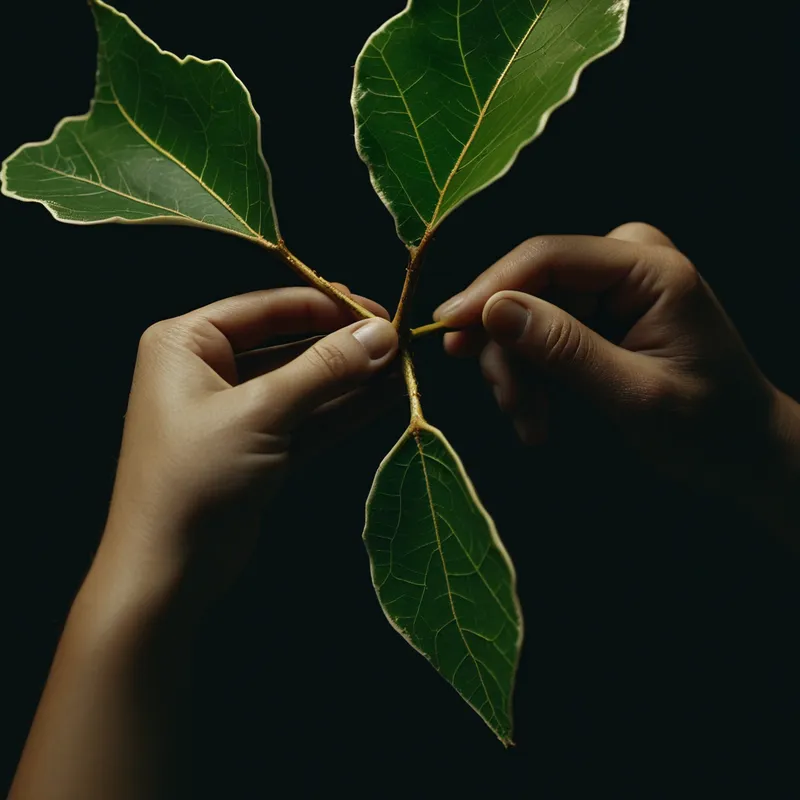
The sound that followed was not a cry, but a frantic rustling. They fled from the open glade, not from the presence of the divine voice—that would come later—but from the exposure of their own new consciousness. Their hands, which had only ever reached for sustenance or caress, now tore at the broad, soft leaves of the fig tree. They fumbled with stems, pierced the flesh of the leaves with thorns, weaving not for beauty, but for a barrier. They fashioned aprons, crude shields of green. It was the first human industry, born not of creativity, but of shame. The leaves were a veil over their bodies, a fragile declaration that the world as it had been was gone. They had eaten of the fruit, and now they must live with the harvest: the endless, human work of covering what had been revealed.
Cultural Origins & Context
This narrative forms the heart of the primeval history in the Book of Genesis. It is a foundational etiological myth, a story explaining origins: the origin of human self-consciousness, morality, clothing, and the fraught relationship between the sexes and with the divine. It was preserved and refined within the priestly and wisdom traditions of ancient Israel, a people deeply concerned with order, covenant, and the boundaries between sacred and profane, clean and unclean.
The story was not meant as a literal historical account, but as a profound theological and anthropological meditation. It was told to answer the most piercing human questions: Why are we like this? Why do we feel shame? Why do we hide? Why is our world one of toil and separation? The fig leaves are the story’s first, tangible answer—a symbol of the human condition crafted by human hands immediately upon the fall from unconscious unity into the duality of self-awareness.
Symbolic Architecture
The fig leaves represent the primordial human response to the awakening of the ego. Before the fruit, Adam and Eve existed in a state of psychic wholeness, identified with the garden and the divine breath within them—a state of unconscious paradise. The fruit of the Tree of the Knowledge of Good and Evil symbolizes the catalytic moment of differentiation, where consciousness splits from the unconscious, creating the subject-object relationship.
The first garment is not woven from thread, but from the awareness of a boundary between self and world.
The nakedness they suddenly perceive is not merely physical. It is psychic nakedness—the terrifying exposure of the nascent, fragile ego to the overwhelming totality of existence, to the gaze of the other, and to the judgmental voice of the inner moral authority (which the myth projects outward as the voice of YHWH). The fig leaves, therefore, are the archetype of the persona, the mask or social skin we construct to interface with the world. They are our first, clumsy attempt to manage the vulnerability that consciousness imposes. They symbolize all the defenses, identities, and roles we hastily assemble to hide our perceived inadequacies, our primal shame, and our terrifying freedom.

The Dreamer’s Resonance
When this myth pattern surfaces in modern dreams, it rarely appears as a biblical tableau. Instead, the dreamer may find themselves in a public space—a meeting, a party, a street—and suddenly realize they are underdressed, or wearing pajamas, or utterly naked. The somatic feeling is one of acute exposure, a hot rush of shame and panic. The dream-ego scrambles to find cover, often with inadequate materials: a notebook, a curtain, their own hands.
This dream signals a moment where some nascent awareness, some new knowledge or feeling, has broken through into consciousness, making the dreamer feel psychically “seen” and vulnerable. It often occurs during life transitions, after personal revelations, or when one’s usual defenses (their tailored “clothes”) have failed. The frantic search for cover is the psyche’s attempt to re-stabilize, to quickly fashion a new persona to handle this exposed state. The dream is an invitation to ask: What new “knowledge” have I ingested? From what feeling of raw exposure am I trying to hide?

Alchemical Translation
The alchemical journey of individuation does not aim for a return to the unconscious paradise of Eden—that is impossible. Instead, it seeks to transform the crude fig leaf into the integrated garment of skin that YHWH later provides the exiles. The process begins with the nigredo, the blackening: the acknowledgment of the shame, the fragmentation, and the defensive hiding.
The goal is not to discard the garment, but to become conscious of the tailor.
The modern individual must first recognize their own “fig leaves”—the automatic personas, the masks of competence, the ideologies behind which they hide their vulnerable, uncertain self. This is a painful unveiling, a conscious re-living of that first shock of exposure. The alchemical work is to hold that vulnerability without immediately covering it, to tolerate the anxiety of being “naked” before one’s own truth.
Through this sustained conscious engagement (albedo, the whitening), the crude, defensive covering can be transmuted. The leaves, symbols of a temporary, fear-based identity, can become a true garment—a conscious adaptation to the world that is flexible, functional, and owned, rather than a rigid hiding place. One integrates the knowledge of good and evil not by being ruled by its judgments, but by understanding its source within. The final stage (rubedo, the reddening) is embodying a self that is both clothed in a conscious personality and at peace with the essential, vulnerable being beneath. It is the reconciliation of the exile with the garden, not as a place to return to, but as a state of inner wholeness now carried within, fully conscious and fully human.
Associated Symbols
Explore related symbols from the CaleaDream lexicon: