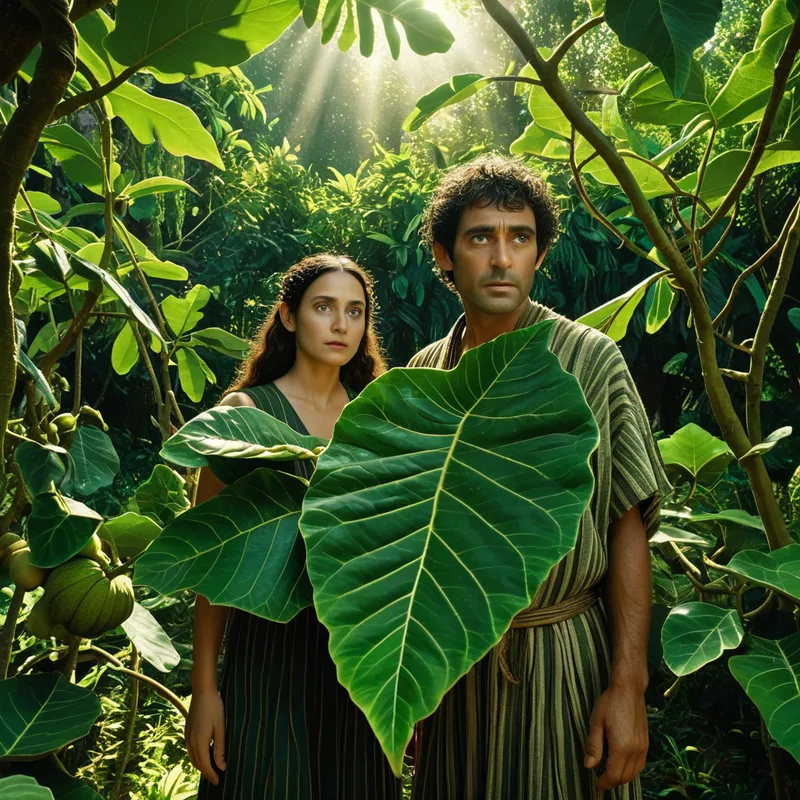
The Fig Leaf Myth Meaning & Symbolism
The moment primal innocence is lost, replaced by self-awareness, shame, and the first fragile attempt to clothe the newly exposed soul.
The Tale of The Fig Leaf
In the beginning, there was no before. There was only the Garden, a breath held in perpetual dawn. The air was not air, but a fragrance of soil, blossom, and clear [water](/myths/water “Myth from Chinese culture.”/). The man, Adam, and the woman, Eve, walked without footprints. They knew the names of every creature—the deep-throated murmur of the cattle, the secret language of the stars—but they did not know themselves. Their eyes were mirrors reflecting only the outer world, clear and without shadow.
They were naked, and they felt no shame. It was not a state of lack, but of completion so absolute it needed no witness, no covering. The skin was simply the boundary of being, like the bark of a tree or the surface of a pond.
But in the center of the Garden grew a tree unlike the others. Its fruit was not sustenance, but a threshold. A serpent, sleek and knowing, coiled upon its branches, its voice the sound of dry leaves stirring with a thought that had never been thought before. It spoke not of evil, but of a possibility: “Your eyes will be opened. You will be like the divine, knowing good and bad.”
The woman looked at the fruit. It was not temptation she saw, but a door. She took it. She ate. She gave it to the man, and he ate.
And then, [the world](/myths/the-world “Myth from Tarot culture.”/) cracked.
It was not the Garden that changed, but the gaze that fell upon it. The light, once a gentle garment, became a spotlight. The breeze, once a caress, felt like an exposure. They looked at each other—truly looked, from the outside in—and for the first time, a cold wind blew through the soul. They saw their own forms, separate, vulnerable, and seen. A heat rose in their cheeks that had no name, but we have come to call it shame.
The knowledge they had swallowed was a sword that had cleaved them in two: the being that acts, and the being that watches the act. And the watcher judged.
Their hands, which had only ever reached for nourishment or touch, now fluttered in a new, desperate dance. They ran, not in play, but in retreat. Their eyes scanned the generous foliage not for beauty, but for utility. And they found the fig tree, its leaves broad, sturdy, and opaque. With frantic fingers, they tore them from the branches and began to sew. They made not clothing, but a barrier. A declaration. A tiny, green wall against the infinite gaze of a world they now knew was watching.
Then, they heard the sound. The sound of the divine walking in the Garden in the cool of the day. And they hid.

Cultural Origins & Context
This foundational narrative originates from the Book of Genesis, a text that crystallized from ancient oral traditions of [the Israelites](/myths/the-israelites “Myth from Abrahamic culture.”/), likely during the first millennium BCE. It is not a story told to explain botany, but ontology—the nature of being. Passed down through priestly and wisdom lineages, it served as the bedrock for understanding the human condition within the Abrahamic worldview.
Its societal function was profound. It established a pre-history to explain the present: why humans labor, why birth is painful, why we wear clothes, and most critically, why we feel estranged—from the divine, from nature, and from each other. The fig leaf is the first cultural artifact, born not from need for warmth, but from the psychological need for a boundary. It marks the irrevocable transition from a state of unconscious unity with creation to one of self-conscious participation in history, morality, and culture.
Symbolic Architecture
The myth is an archetypal map of the [dawn](/symbols/dawn “Symbol: The first light of day, symbolizing new beginnings, hope, and the transition from darkness to illumination.”/) of [consciousness](/symbols/consciousness “Symbol: Consciousness represents the state of awareness and perception, encompassing thoughts, feelings, and experiences.”/). The Garden represents the unconscious, paradisiacal state of [infancy](/symbols/infancy “Symbol: A symbol of beginnings, vulnerability, and foundational development, often representing a return to origins or a state of pure potential.”/) or undifferentiated [psychic wholeness](/symbols/psychic-wholeness “Symbol: A state of complete integration between conscious and unconscious aspects of the psyche, representing spiritual unity and self-realization.”/). The [forbidden fruit](/symbols/forbidden-fruit “Symbol: The Forbidden Fruit represents temptation and the allure of vices that are often shunned or forbidden by society.”/) is not “sin” in a petty sense, but the catalytic act of acquiring discriminative [knowledge](/symbols/knowledge “Symbol: Knowledge symbolizes learning, understanding, and wisdom, embodying the acquisition of information and enlightenment.”/)—the [ability](/symbols/ability “Symbol: In dreams, ‘ability’ often denotes a recognition of skills or potential that one possesses, whether acknowledged or suppressed.”/) to perceive duality (good/bad, self/other, naked/clothed).
The Fig Leaf is the psyche’s first act of creation following its first trauma: the trauma of self-awareness.
The [leaf](/symbols/leaf “Symbol: A leaf symbolizes growth, renewal, and the cycles of life, reflecting both the natural world and personal transformations.”/) itself is a dense [symbol](/symbols/symbol “Symbol: A symbol can represent an idea, concept, or belief, serving as a powerful tool for communication and understanding.”/). The fig [tree](/symbols/tree “Symbol: In dreams, the tree often symbolizes growth, stability, and the interconnectedness of life.”/), often associated with [abundance](/symbols/abundance “Symbol: A state of plentifulness or overflowing resources, often representing fulfillment, prosperity, or spiritual richness beyond material needs.”/) and [fertility](/symbols/fertility “Symbol: Symbolizes creation, growth, and abundance, often representing new beginnings, potential, and life force.”/), here offers not [fruit](/symbols/fruit “Symbol: Fruit symbolizes abundance, nourishment, and the fruits of one’s labor in dreams.”/), but concealment. It symbolizes [nature](/symbols/nature “Symbol: Nature symbolizes growth, connectivity, and the primal forces of existence.”/)’s complicity in the [human](/symbols/human “Symbol: The symbol of a human represents individuality, complexity of emotions, and social relationships.”/) [drama](/symbols/drama “Symbol: Drama signifies narratives, emotional expression, and the exploration of human experiences.”/), providing the raw [material](/symbols/material “Symbol: Material signifies the tangible aspects of life, often representing physical resources, desires, and the physical world’s influence on our existence.”/) for our psychological defenses. The act of sewing—of joining—signifies the [birth](/symbols/birth “Symbol: Birth symbolizes new beginnings, transformation, and the potential for growth and development.”/) of [the ego](/myths/the-ego “Myth from Jungian culture.”/). The ego’s primary [task](/symbols/task “Symbol: A task represents responsibilities, duties, or challenges one faces.”/) is to mediate between the inner world of instinct and the outer world of [reality](/symbols/reality “Symbol: Reality signifies the state of existence and perception, often reflecting one’s understanding of truth and life experiences.”/); here, it literally stitches together a protective [identity](/symbols/identity “Symbol: Identity represents the sense of self, encompassing personal beliefs, cultural background, and social roles.”/) to stand between the vulnerable, newly-exposed self and the overwhelming “other.”
[Shame](/symbols/shame “Symbol: A painful emotion arising from perceived failure or violation of social norms, often involving exposure of vulnerability or wrongdoing.”/), in this context, is not a moral failing but the somatic signature of the conscious ego being born. It is the feeling of being an object in one’s own [story](/symbols/story “Symbol: The symbol of ‘Story’ represents the narrative woven through our lives, embodying experiences, lessons, and emotions that shape our identities.”/).
The Dreamer’s Resonance
When this myth pattern surfaces in modern dreams, it rarely appears as a biblical tableau. Instead, the dreamer may find themselves suddenly exposed in a public place—on a stage, in a meeting, on a street—realizing they are unprepared or unclothed. The accompanying feeling is a deep, visceral shame and a frantic search for cover. This is not about literal nudity, but about the exposure of a part of the [psyche](/myths/psyche “Myth from Greek culture.”/) that feels raw, undeveloped, or unfit for scrutiny.
Somatically, it often manifests as a hot flush, a desire to shrink, or a paralysis. Psychologically, it signals that a previously unconscious content—a talent, a wound, a desire, a fear—has broken into awareness. The ego feels ill-equipped to integrate it. The dream is replaying the primordial shock of becoming conscious of a new aspect of [the self](/myths/the-self “Myth from Jungian culture.”/). The “fig leaf” in the dream might be a hastily grabbed coat, a turned-back, a mumbled excuse, or a distracting task—any psychic maneuver to quickly cover the exposed vulnerability and restore a sense of bounded safety.

Alchemical Translation
The individuation process, the journey toward psychic wholeness, requires us to revisit and re-work this primal scene. The initial alchemical stage is [nigredo](/myths/nigredo “Myth from Alchemical culture.”/)—the blackening, the confrontation with [the shadow](/myths/the-shadow “Myth from Jungian culture.”/). This is the moment of eating the fruit: the painful, often shameful, awakening to a truth about ourselves we wished to ignore.
The sewing of the fig leaf represents the necessary, but ultimately provisional, ego-construction that follows. We build personas, defenses, and identities to navigate the world. The trap of spiritual immaturity is to mistake this leaf for our true skin, to live forever hiding behind it.
True alchemical gold is forged not by remaining naked in the Garden, nor by forever hiding in the bushes, but by consciously choosing to remove the stitched leaf and stand revealed—not in naive innocence, but in hard-won integrity.
The advanced work is the albedo—the whitening, the purification. This involves the conscious, gradual, and compassionate dismantling of those archaic fig-leaf defenses. We must “un-sew” what was frantically stitched in fear. We re-encounter that initial shame not as a sentence, but as a gateway. To integrate the shadow is to look at our exposed self with the eyes of the divine after the exile: not with condemnation, but with the recognition that this consciousness, with all its pain and complexity, is the very [thing](/myths/thing “Myth from Norse culture.”/) that makes us fully human. The transformed individual does not return to a mindless Garden, but carries a conscious, compassionate awareness into the world of toil and relationship—the “east of Eden.” The leaf is no longer a hiding place, but understood as a sacred artifact marking the beginning of the great human journey from unconsciousness toward responsible, embodied consciousness.
Associated Symbols
Explore related symbols from the CaleaDream lexicon: