The Fatesin Greek my Myth Meaning & Symbolism
The story of the three primordial sisters who spin, measure, and cut the thread of every mortal and divine life, weaving destiny itself.
The Tale of The Fatesin Greek my
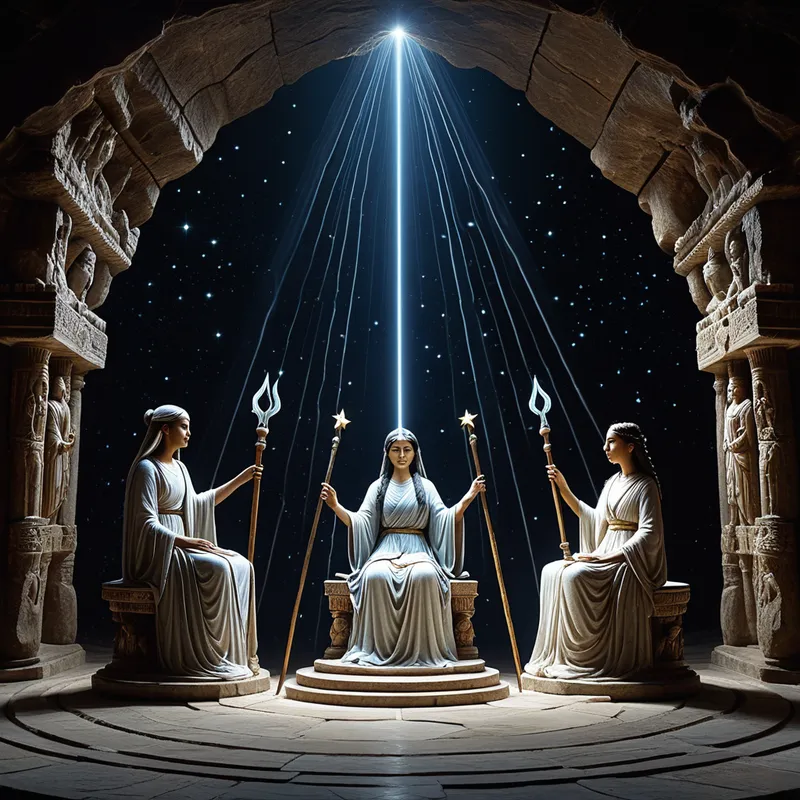
Before the first name was spoken, before the first city cast a shadow, there was the hum. It was not a sound for ears, but a vibration in the marrow of the world, the deep, rhythmic breath of necessity. In the darkest chamber at the root of Mount Olympus, where time drips like water from stone, they sat. Three sisters, older than memory, older than the gods themselves.
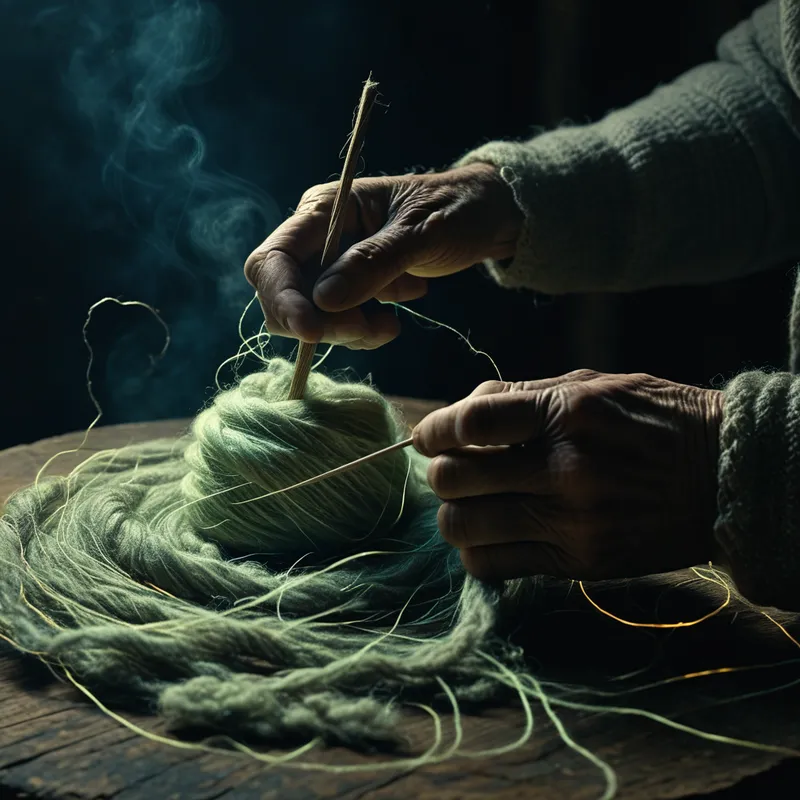
Clotho was the youngest in form, her fingers eternally busy. From a basket of raw, cloud-like wool—the unformed stuff of possibility—she drew forth strands. With a touch, she set her spindle whirling, a silver hum in the gloom. From nothing, she spun something: a fine, glowing thread. Each twist of her wrist was a first breath, a birth cry swallowed by the cavern’s silence. The thread pulsed with a soft light, containing all that might be—laughter, sorrow, triumph, love—in its nascent twist.
The thread passed to Lachesis, she of the solemn eyes and the unerring hand. Without a word, she took the glowing filament and, with a rod carved from the bone of the earth, she measured. Her gaze saw down the length of the thread, perceiving the knots of crisis, the smooth runs of peace, the sudden, sharp bends of fate. She allocated the lot, the portion of joy and suffering, of length and brevity. Her decree was silent, absolute. The thread now had its shape, its ordained course through the loom of the world.
Finally, it came to Atropos, the eldest and most inflexible. In her lap lay shears of adamant, their blades darker than the space between stars. She examined the measured thread, her expression one of ancient, impersonal resolve. There was no malice in her, only the final, terrible truth of end. When the appointed moment arrived in the thread’s shimmering tale, her shears would snip. The light would vanish. The hum would cease for that one story. And the Spinner would already be drawing forth new wool from the basket, the great work forever continuing.
Even the mighty Zeus was said to bow his thunderous head before them. He might hurl bolts and shake the earth, but the thread of his own reign, like all things, was wound upon their spindles, measured by their rod, and subject to their shears. Their law was the first law, the framework upon which all other stories—of heroes, monsters, and gods—were hung. They were the quiet, relentless heartbeat beneath the epic music of the world.
Cultural Origins & Context
The Moirai, or Fates, are not Olympian inventions but pre-Olympian powers, chthonic deities whose origins sink into the deepest strata of Indo-European and Mediterranean belief. They represent an ancient, primordial understanding of cosmic order—Ananke (Necessity) personified. In Hesiod’s Theogony, they are born of Nyx (Night) alone, placing them among the first forces of the universe, older and more fundamental than the Titans or the Olympians.
Their myth was not merely told; it was a foundational pillar of the Greek worldview, recited by poets and referenced in tragedies. They served a crucial societal function: they provided a metaphysical explanation for the limits of life and the apparent randomness of fortune and misfortune. Why did the brave hero die young, while the coward lived to old age? The Moirai had measured his thread. This was not a comfort, but a rationale—a way to integrate the harsh realities of mortality, injustice, and capricious luck into a coherent, if stern, cosmic framework. They were the ultimate answer to “why,” an answer that not even the gods could override.
Symbolic Architecture
The Fates are the ultimate archetype of process, the tripartite structure of any life, story, or psychic event. They are not death, but the architecture of time-bound existence itself.
The Spinner, the Measurer, and the Cutter represent the three irrevocable phases of every phenomenon: its emergence from potential, its unfolding through form, and its necessary dissolution.
Psychologically, they map onto the human confrontation with limits. Clotho symbolizes the raw potential of the psyche, the unconscious wellspring from which our impulses, talents, and nascent selves emerge. Lachesis represents the process of living—the choices made, the circumstances encountered, the unique path that is our life. She is the embodiment of destiny not as a fixed script, but as the unfolding narrative shaped by character and chance within a bounded frame. Atropos is the symbol of the ultimate limit: death, yes, but also the end of all phases, relationships, and identities. She is the “inevitable” that gives shape and preciousness to the measured length.
Together, they represent a psychic truth: the ego (the heroic, god-like part of us) is not all-powerful. It exists within a larger, older, and more deterministic system—the Self, or the totality of the psyche, which has its own necessities and timelines.
The Dreamer’s Resonance
To dream of the Fates is to dream of the bedrock of one’s own psyche. It often surfaces during life transitions—births, deaths, career changes, the end of relationships—when the individual feels caught in larger, impersonal forces.
Dreaming of the Spinner may indicate a somatic sense of new beginnings, a creative urge, or an anxiety about an unformed potential struggling to take shape. The dreamer might feel a buzzing energy with no clear outlet. Dreaming of the Measurer often accompanies a period of assessment or mid-life evaluation. The dreamer may be unconsciously measuring their life’s path, feeling the weight of past choices, or sensing a crossroads. The image can bring feelings of being judged or of trying to see the “length” of a current endeavor.
An encounter with the Cutter in dreams is the most potent. It rarely signifies literal death, but rather the necessary end of a psychological state: the death of an old identity, the severing of a toxic attachment, or the closing of a major life chapter. The somatic experience can be one of chilling finality, deep relief, or profound terror—the body reacting to a psychic surgery that is both traumatic and essential.
Alchemical Translation
The individuation process, the alchemical journey toward psychic wholeness, requires a conscious relationship with these inner Fates. The modern individual’s struggle is often a rebellion against Lachesis and Atropos—an attempt to live in the infinite potential of Clotho without accepting measure or end. The myth models the transmutation: from being passive threads in their tapestry to becoming conscious participants in the weaving.
The alchemical work is to take up one’s own spindle, measuring rod, and shears—to become, in part, the author of one’s own fate.
This begins with Acknowledgment: recognizing the inner Moirai—the innate talents (Clotho), the life circumstances and inherent limits (Lachesis), and the mortality that defines our time (Atropos). The next stage is Dialogue: instead of railing against fate, one learns its language. What is the thread I am currently spinning? How am I measuring my days? What needs to be cut away to allow for new growth? Finally, there is Integration: wielding the shears oneself. This is the most difficult alchemical act—consciously choosing to end outworn patterns, relationships, or self-concepts. It is performing the work of Atropos with the awareness of Lachesis and the creative hope of Clotho.
In this translation, the Fates cease to be external persecutors and become internal governors of a profound self-knowledge. To honor them is not to submit to despair, but to live with clarity within the beautiful, terrible, and finite tapestry of a single, measured, and utterly unique life.
Associated Symbols
Explore related symbols from the CaleaDream lexicon: