The Fates Myth Meaning & Symbolism
Three primordial goddesses spin, measure, and cut the thread of every mortal and divine life, embodying the inescapable law of destiny.
The Tale of The Fates
Listen. Before the gods of Olympus drew their first breath, before the Titans wrestled in the dark, there was a law. And the law had three faces.
In a place that is not a place, a grove older than time, they sit. The air hums with the sound of the turning of the world. Here, at the foot of a great, nebulous tree whose roots drink from forgotten springs, the three sisters work. They are the Moirai, and their hands are never still.
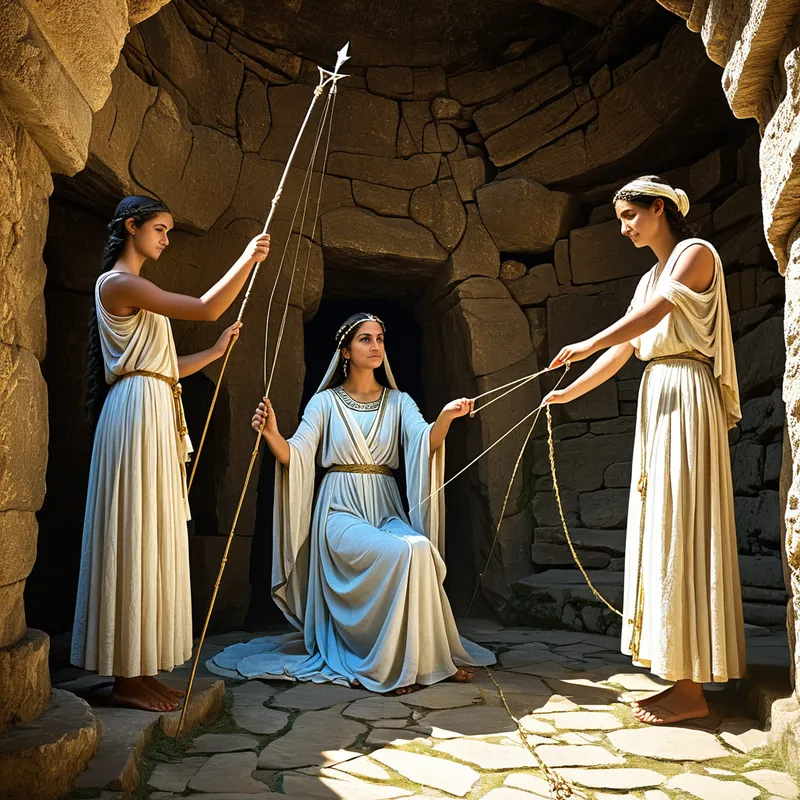
The first is Clotho. She is youth incarnate, her fingers nimble and sure. From a silver distaff she draws the raw stuff of being—a shimmering, nebulous cloud of potential. With a twist of her wrist, she spins. The whorl hums, and from the void emerges a single, luminous thread. It is fragile, brilliant, and utterly new. This is the moment of birth, the first cry drawn into being from the formless all.
The thread passes to the second sister, Lachesis. She is the woman in the fullness of her power, her eyes seeing what is and what will be. She does not look at the thread with her eyes, but with her soul. Her fingers, adorned with simple rings, measure its length against a solemn rod marked with no scale mortals can read. As she measures, she sings—a low, complex chant. With each note, the thread thickens, gains color and texture. The joys are woven in as golden filaments, the sorrows as dark, resilient twists. She allots the portion: the loves, the battles, the triumphs, the losses. The thread becomes a biography written in fiber.
Then, it lies across the lap of the third. Atropos. She is ancient, her face a map of all endings. Her gaze is not cruel, but absolute. In her hand are shears of adamant, cold and sharp enough to sever light itself. She waits. She observes the thread as it pulses with the life it represents. She feels its vibrations—the final heartbeat, the last breath held, the concluding word. When the measure is full, when the song Lachesis sang reaches its final, inevitable note, Atropos moves. There is no hesitation, only the clean, silent snick of the shears.
The thread goes slack. The light within it fades, returning to the mist from which it was spun. The sisters do not pause. Clotho’s spindle has already turned, and another glimmering strand is born from the nothing. The hum continues. The law endures. Not even Zeus, who shakes the heavens with his thunder, dares to question their decree. For they are older than prayer, and their work is the foundation upon which all stories—of gods, heroes, and mortals—are told, and must finally end.
Cultural Origins & Context
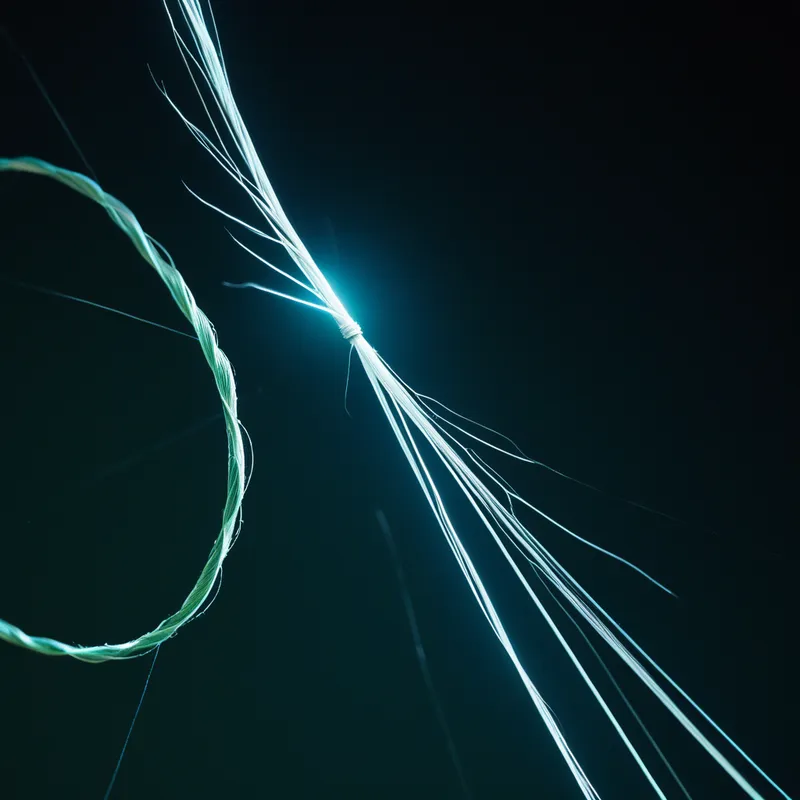
The myth of the Fates is not a story told for mere entertainment around a fire. It is a foundational cosmological principle, a deep-seated explanation for the most perplexing human experience: the interplay of agency and inevitability. In Hesiod’s Theogony, they are born of Nyx (Night) alone, placing them among the most ancient, pre-Olympian forces. This genealogy is critical—they are not subject to the later, more anthropomorphic pantheon but are part of the world’s original, impersonal order.
Their worship was diffuse but profound. They lacked the grand temples of Zeus or Athena, but were honored in household rites and at critical life passages: birth, marriage, and death. To invoke them was to acknowledge the limits of one’s own power. In literature, from the epics of Homer to the tragedies of Aeschylus and Sophocles, they are the ultimate backdrop against which heroic striving occurs. Oedipus runs headlong into the fate they spun for him; Achilles chooses a short, glorious thread over a long, obscure one. The Fates provided the ancient Greeks with a framework to hold the terrifying randomness of life—plague, shipwreck, sudden fortune—within a narrative of cosmic order. Even chaos had its place in the pattern.
Symbolic Architecture
The Fates represent the archetypal structure of time and consciousness itself. They are not random witches but a precise triadic system governing becoming, being, and ceasing.
Clotho, the Spinner, symbolizes pure potential, the moment of inception. She is the creative impulse, the initial spark of an idea, the birth of a feeling or a life. Psychologically, she is the unconscious from which the ego-consciousness is first spun into existence. Lachesis, the Measurer, embodies the unfolding of that potential in the realm of lived experience. She is destiny, not as a fixed script, but as the allotment of possibilities, challenges, and gifts that give a life its unique shape and texture. She represents the middle, where we live, choose, and experience.
Atropos, the Cutter, is the necessary end. She is the principle of limitation that gives form and meaning. Without an end, a story has no shape; a life has no definition.
The thread is not the prison; the cut is not the crime. They are the loom and the frame that make the tapestry possible.
Together, they form a complete psychological model: the emergence of consciousness from the unconscious (Clotho), its navigation through the complexes and patterns of personal and collective life (Lachesis), and its final reintegration, the dissolution of the ego necessary for any true transformation (Atropos). They are the ultimate Ananke (Necessity), reminding us that freedom is only meaningful within a framework of limits.
The Dreamer’s Resonance
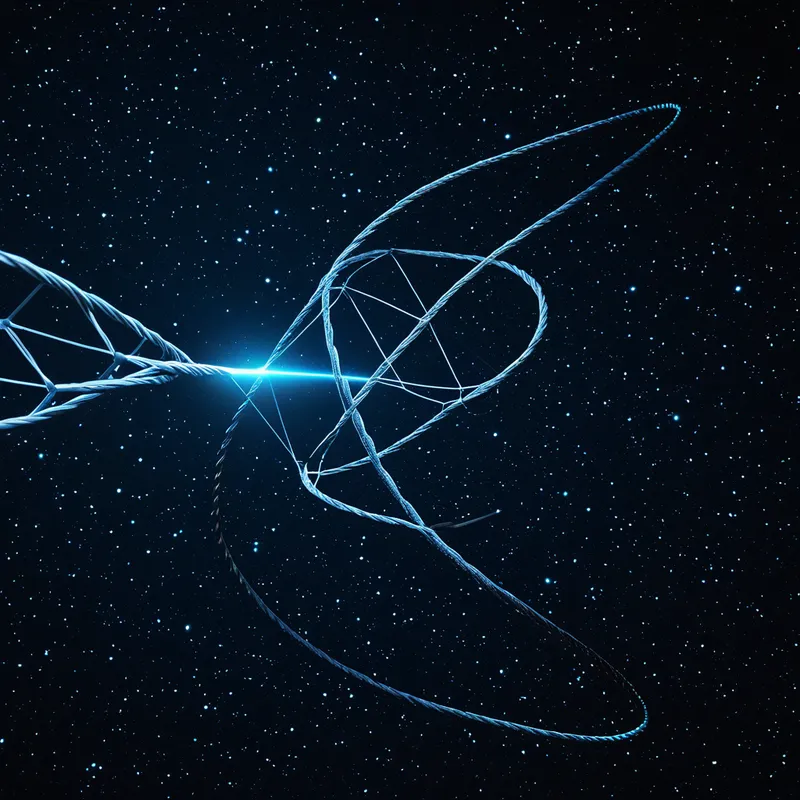
When the pattern of the Fates emerges in modern dreams, it signals a profound encounter with the psyche’s own laws of destiny. This is not about literal fortune-telling, but a somatic and psychological reckoning with one’s own “thread.”
Dreaming of tangled, knotted yarn or thread may point to a feeling of life being stuck, of potential snarled by indecision or past trauma (a dysfunction in Clotho’s domain). Dreams of measuring—endless tape measures, being judged against an impossible standard—often arise when one is acutely assessing their life’s path, questioning choices and direction (Lachesis at work). The most potent and often alarming dreams involve cutting: scissors snapping, strings breaking, sudden severance. These can accompany life transitions so profound they feel like a death—the end of a career, a relationship, an identity. This is the psyche’s enactment of Atropos, forcing an ending so a new beginning, orchestrated by Clotho, can be spun.
The dreamer undergoing this is in a process of confronting their own necessary limits and the inherent design of their life. It is a deeply somatic experience, often accompanied by feelings of awe, dread, or a chilling, serene acceptance. The psyche is rehearsing its own mortality and the boundaries that give individual existence its poignant, singular beauty.

Alchemical Translation
The individuation process, the alchemical journey of becoming whole, is mirrored perfectly in the myth of the Fates. The modern individual must become, in turn, all three sisters.
First, we must become Clotho. This is the stage of Nigredo, where we return to the raw material of the self. We spin a new thread of awareness from the dark, unformed parts of our psyche—our unlived life, our buried potentials. It requires surrendering the old, worn-out identity to the primal creative source within.
Then, we take up the role of Lachesis. This is Albedo and Citrinitas. We consciously measure our thread. We examine the patterns, the golden joys and dark sorrows woven into us by family, culture, and experience. We own our story, our “allotment,” not as a curse but as the unique material we have to work with. This is active, conscious living, making meaning from the measured length.
Finally, and most crucially, we must integrate Atropos. This is the ultimate stage of Rubedo. It is the psychological capacity to “cut the thread” of outmoded attachments, dying identities, and compulsive behaviors. It is the ego’s courageous consent to its own necessary transformations and final limit.
To individuate is to hold the shears in your own hand, not to avoid the cut, but to understand it as the sacred act that completes the pattern.
The triumph is not in cheating the Fates, but in realizing you are their living embodiment. The struggle for free will occurs not against destiny, but within its grand, terrible, and beautiful design. When we consciously spin, measure, and finally release our own form, we cease to be victims of fate and become co-authors of a destiny that includes, and ultimately transcends, the final, merciful cut.
Associated Symbols
Explore related symbols from the CaleaDream lexicon:
- Railroad
- Menu
- Sewing Needle
- Pulling Strings
- Weaving Threads
- Storm Clouds
- Tram
- Tangled Roots
- Woven Tapestry
- Tailor’s Measuring Tape
- Hairdresser’s Scissors
- Guillotine
- Cinematic Frame
- Antique Singer Sewing Machine
- Sifter
- Woven Jewelry
- Address Book
- Whirring Spinner
- Wool Spindle
- Kimono Sleeves
- Gravitational Waves
- Complex Systems
- Cellular Automata
- Imperative
- Referential
- Pulse
- Motif
- Syndrome
- Converging
- Divisor
- Dread
- Spin
- Department
- Common
- Involved
- Cause
- Needle
- Congregation
- Caused
- Deadline
- Victorian
- Communal
- Cultural Robes
- Woven Dreams
- Seagrass Meadow
- Fitness Tracker
- Embroidery Thread
- Crochet Hook
- Family Gathering
- Fantasy Tapestry
- Silken Fabric Collage
- Woven Fable
- Handcrafted Scissors
- Embroidery Frame
- Cotton Wristband
- Clipboard Dream
- To-Do List
- Cigarette Smoke
- Interwoven Pattern
- Interweaving Threads
- Seamless Textiles
- Loom for Weaving
- Net Weaving
- Woven Cord
- Braided Rope
- Loomed Fiber Rope
- Braided Leather
- Plant Fiber Rope
- Tapestry
- The Algorithm
- Cadence
- Quantum Entanglement
- Nonlinear Dynamics
- The Tradition
- Countdown
- Budget
- Metric
- Spinning