
The Fall of Man Myth Meaning & Symbolism
A foundational myth of innocence lost, forbidden knowledge, and the dawn of human consciousness, responsibility, and mortality.
The Tale of The Fall of Man
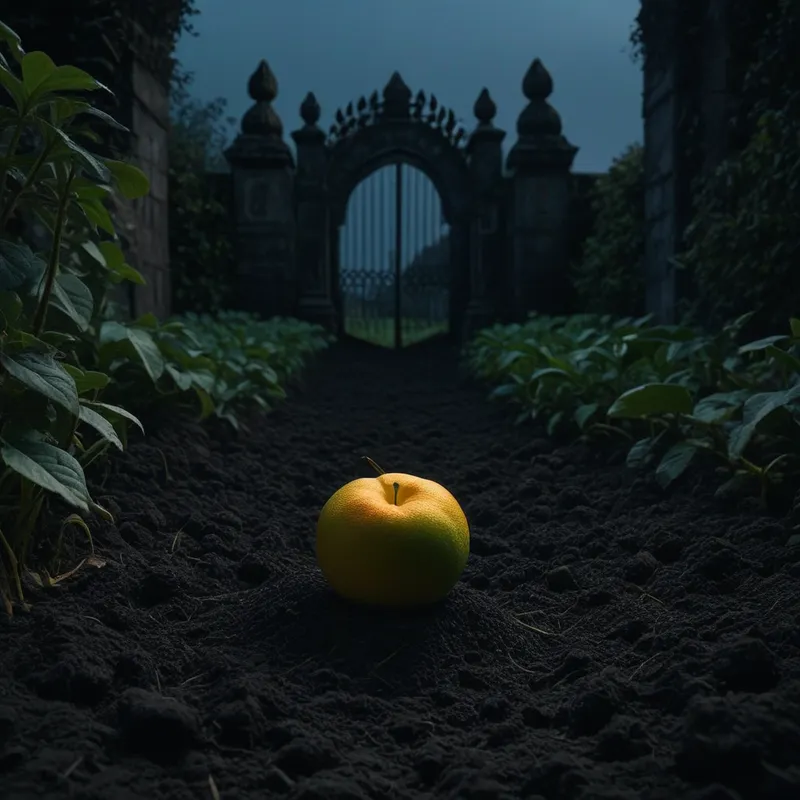
In the beginning, there was a garden. Not a garden as we know it, of tangled vine and wilting flower, but a place of perfect resonance. The air hummed with the scent of damp earth and ripe, unnamed fruits. Rivers of clear [water](/myths/water “Myth from Chinese culture.”/), bearing gold and bdellium and onyx, wound through groves where every leaf was a testament to an unbroken thought. This was Eden, a realm of seamless unity, where the first man, Adam, walked in the cool of the day with the voice that had shaped the mountains.
He was not alone. From his own substance, a deep sleep, and a sacred rib, was drawn the woman, Eve. Together, they were naked and unashamed, their consciousness a clear pool reflecting only [the sky](/myths/the-sky “Myth from Persian culture.”/) above, unaware of any other horizon. In the heart of this paradise stood two trees: the [Tree of Life](/myths/tree-of-life “Myth from Kabbalistic culture.”/), and the Tree of the Knowledge of Good and Evil. Of this second tree, the voice had given one law, clear and firm as crystal: “You shall not eat of it, for in the day that you eat of it you shall surely die.”
Then came the serpent. It was not a creature of horror, but the most subtle, the most cunning of all the beasts of the field. It moved with a liquid grace, its scales catching the dappled light. It found the woman by the forbidden tree and posed a question that had never before been asked: “Did God actually say, ‘You shall not eat of any tree in the garden’?” With those words, a crack appeared in the seamless world. Possibility, otherness, doubt—these shadows entered the garden.
Eve corrected the serpent, but the seed was sown. The serpent whispered the great temptation: “You will not surely die. For God knows that when you eat of it your eyes will be opened, and you will be like God, knowing good and evil.” She looked at the tree. The fruit was good for food, a delight to the eyes, and desirable to make one wise. The desire swelled, a new and terrifying pulse in her breast. She took. She ate. She gave some to her man, who was with her, and he ate.
And in that moment, [the world](/myths/the-world “Myth from Tarot culture.”/) shattered. Their eyes were opened, but not to divinity—to separation. They saw their own nakedness, and for the first time, they felt shame. They heard the sound of the divine presence walking in the garden, and they hid among the trees, their hearts pounding a frantic rhythm of fear. When called forth, they pointed fingers—the man to the woman, the woman to the serpent. The voice pronounced the consequences: enmity, pain in childbirth, toil upon cursed ground, and finally, dust returning to dust. With garments of skin to cover their newfound vulnerability, they were driven out from Eden, and a flaming sword turned every way, guarding [the way](/myths/the-way “Myth from Taoist culture.”/) back to the Tree of Life.
Cultural Origins & Context
This narrative forms the opening chapters of the Book of Genesis, the foundational text of the Abrahamic traditions. Its origins are layered, drawing from older Mesopotamian mythologies concerning primordial humans, divine gardens, and lost immortality, which were refined and radically reinterpreted within the emerging Hebrew monotheistic worldview. It is part of the Torah, and its telling was central to Israel’s understanding of its covenant relationship with YHWH.
Functionally, it served as an etiological myth—a story explaining the origins of fundamental human conditions: why we labor, why childbirth is painful, why we wear clothes, why we die, and why there is a fundamental tension between humanity and the natural world (symbolized by the serpent). More profoundly, it established the theological framework of human free will, moral responsibility, and the concept of a fractured relationship with the divine that requires mending—a core drama that would define centuries of theological and philosophical thought.
Symbolic Architecture
The myth is a dense map of the [psyche](/myths/psyche “Myth from Greek culture.”/)‘s awakening from unconscious unity to conscious duality. The Garden represents the original, undifferentiated state of the psyche—the [womb](/symbols/womb “Symbol: A symbol of origin, potential, and profound transformation, representing the beginning of life’s journey and the unconscious source of creation.”/) of the unconscious where all opposites are held in [harmony](/symbols/harmony “Symbol: A state of balance, agreement, and pleasing combination of elements, often associated with musical consonance and visual or social unity.”/). Adam and Eve are not two individuals but the nascent [human](/symbols/human “Symbol: The symbol of a human represents individuality, complexity of emotions, and social relationships.”/) [consciousness](/symbols/consciousness “Symbol: Consciousness represents the state of awareness and perception, encompassing thoughts, feelings, and experiences.”/) itself, existing in a participatory [relationship](/symbols/relationship “Symbol: A representation of connections we have with others in our lives, often reflecting our emotional state.”/) with the divine.
The serpent is not the devil, but the catalyst of consciousness. It is the embodiment of the questioning function, the trickster archetype that disrupts stasis to force evolution.
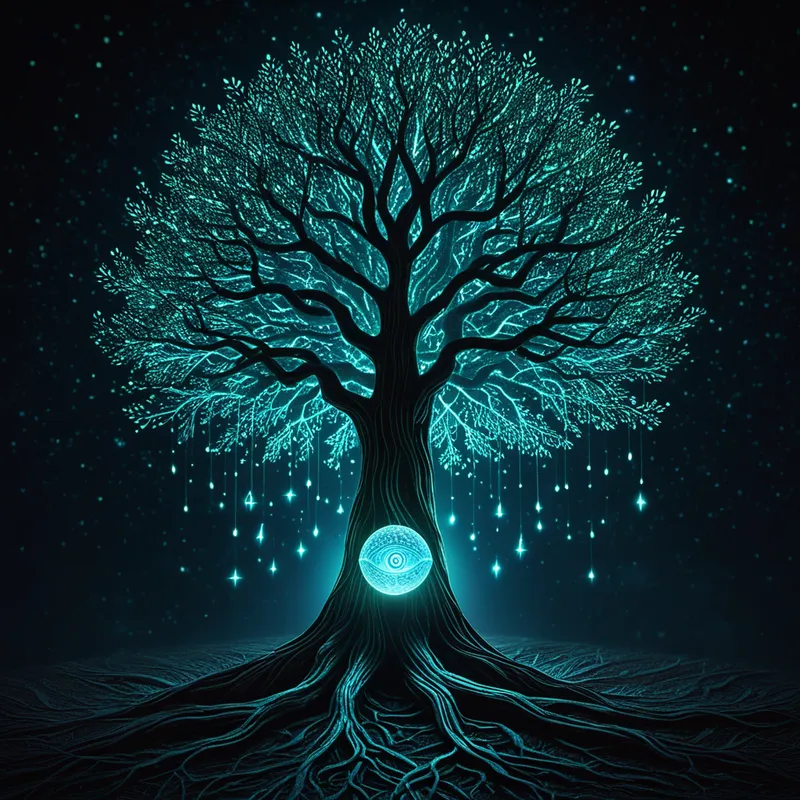
The [Tree](/symbols/tree “Symbol: In dreams, the tree often symbolizes growth, stability, and the interconnectedness of life.”/) of the [Knowledge](/symbols/knowledge “Symbol: Knowledge symbolizes learning, understanding, and wisdom, embodying the acquisition of information and enlightenment.”/) of Good and Evil symbolizes the [dawn](/symbols/dawn “Symbol: The first light of day, symbolizing new beginnings, hope, and the transition from darkness to illumination.”/) of moral discrimination and self-reflective [awareness](/symbols/awareness “Symbol: Conscious perception of self, surroundings, or internal states. Often signifies awakening, insight, or heightened sensitivity.”/). To eat its [fruit](/symbols/fruit “Symbol: Fruit symbolizes abundance, nourishment, and the fruits of one’s labor in dreams.”/) is to step across [the threshold](/myths/the-threshold “Myth from Folklore culture.”/) from being lived by instinct and divine will to knowing oneself as a separate entity capable of [choice](/symbols/choice “Symbol: The concept of choice often embodies decision-making, freedom, and the multitude of paths available in life.”/) and judgment. This “fall” is thus also an [ascent](/symbols/ascent “Symbol: Symbolizes upward movement, progress, spiritual elevation, or striving toward higher goals, often representing personal growth or transcendence.”/) into the burdensome gift of consciousness. [Shame](/symbols/shame “Symbol: A painful emotion arising from perceived failure or violation of social norms, often involving exposure of vulnerability or wrongdoing.”/) and the need for covering symbolize the [birth](/symbols/birth “Symbol: Birth symbolizes new beginnings, transformation, and the potential for growth and development.”/) of the [persona](/symbols/persona “Symbol: The social mask or outward identity one presents to the world, often concealing the true self.”/)—the social mask we construct to hide our perceived [vulnerability](/symbols/vulnerability “Symbol: A state of emotional or physical exposure, often involving risk of harm, that reveals authentic self beneath protective layers.”/) and separateness. [Exile](/symbols/exile “Symbol: Forced separation from one’s homeland or community, representing loss of belonging, punishment, or profound isolation.”/) from the garden is the inevitable psychological consequence: we can never return to the blissful ignorance of the unconscious once we have tasted the [fruit](/symbols/fruit “Symbol: Fruit symbolizes abundance, nourishment, and the fruits of one’s labor in dreams.”/) of self-[knowledge](/symbols/knowledge “Symbol: Knowledge symbolizes learning, understanding, and wisdom, embodying the acquisition of information and enlightenment.”/).
The Dreamer’s Resonance
When this myth pattern stirs in the modern dreamer, it signals a profound psychological transition. Dreaming of a perfect, walled garden may reflect a longing for security or a current state of naive innocence that is about to be challenged. A serpent in a dream often appears not as a monster, but as a wise, unsettling, or magnetic presence—it is the psyche’s own instinct for growth and differentiation, urging the dreamer toward a necessary but frightening knowledge.
Dreams of eating forbidden food, or of being cast out from a safe place, often accompany life’s initiations: leaving home, ending a relationship, questioning deep-seated beliefs, or embracing a truth about oneself that disrupts a comfortable identity. The somatic feeling is often one of simultaneous exhilaration and deep anxiety—the thrilling, nauseating vertigo of stepping into a larger, more complex world. The dream is the psyche’s way of rehearsing this ancient, inevitable drama of becoming an individual.

Alchemical Translation
The alchemical journey of individuation mirrors [the Fall](/myths/the-fall “Myth from Biblical culture.”/) not as a catastrophe to be undone, but as the [prima materia](/myths/prima-materia “Myth from Alchemical culture.”/)—the essential, leaden starting point of the work. We begin in a state of unconscious identification (the Garden). The call to consciousness (the serpent) feels like a betrayal of that original unity, plunging us into the [nigredo](/myths/nigredo “Myth from Alchemical culture.”/), the blackening, where we experience shame, conflict, and exile.
The goal is not to return to the garden, but to integrate the knowledge of the tree into a conscious relationship with the tree of life.
The work is to consciously bear the knowledge of good and evil—to integrate our shadow, acknowledge our capacity for both creation and destruction—without being destroyed by it. The “garments of skin” transform from symbols of shame into the earned, authentic personality (the [lapis philosophorum](/myths/lapis-philosophorum “Myth from Alchemical culture.”/)), no longer a hiding place but a testament to the journey. The flaming sword that bars the return is not a punishment, but a protection; we cannot go back to unconsciousness, but must move forward to create a conscious, responsible wholeness that includes the memory of both the garden and the fall. In this reading, the myth charts the painful, glorious birth of the modern psychological individual, tasked with creating meaning in a world of their own knowing.
Associated Symbols
Explore related symbols from the CaleaDream lexicon: