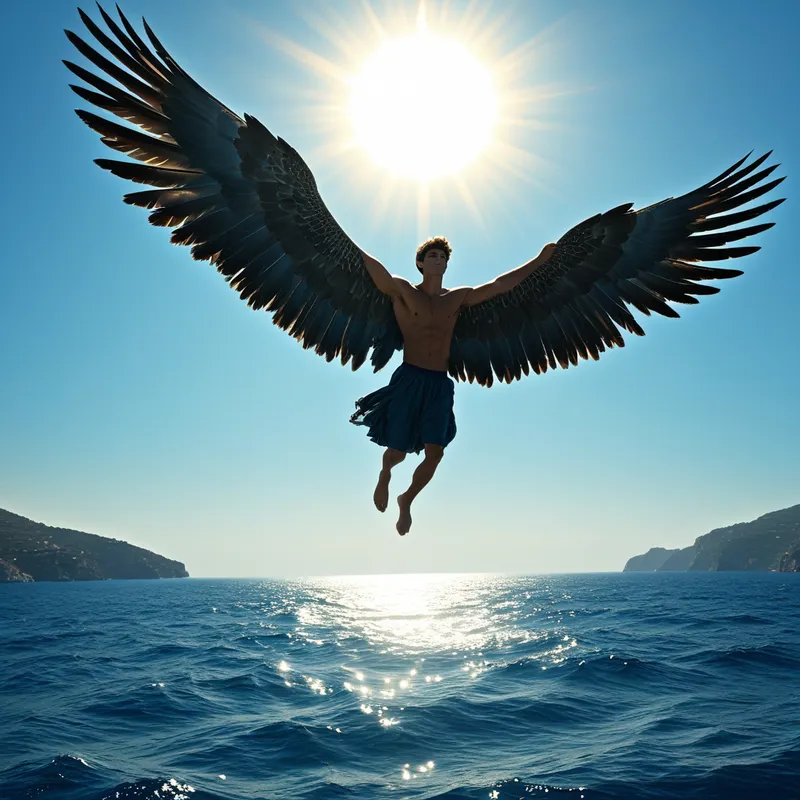
The Fall of Icarus Myth Meaning & Symbolism
The son of Daedalus, Icarus ignores warnings and flies too close to the sun, melting his wings and falling into the sea—a timeless parable of soaring ambition and its limits.
The Tale of The Fall of Icarus
Hear now the tale of a flight that shook the heavens and a fall that still echoes in the salt of our tears. It begins not in the open sky, but in a labyrinth of stone—the Cretan Labyrinth, a twisting prison of King Minos’s making. Within its shadowed corridors paced the monstrous Minotaur, and within its heart, trapped by his own genius, was the architect Daedalus.
Daedalus, whose mind could conjure wonders, saw no escape through the maze’s confounding paths. So he looked up. The sky, ruled by Helios, was the only door the king had not thought to lock. With the patience of a craftsman and the desperation of a father, he gathered feathers—discarded quills from gulls, hawks, and eagles. He bound them with thread and fixed them with wax, crafting two pairs of wings: one large and steady for himself, and one, lighter, for his beloved son, Icarus.
On the dawn of their flight, Daedalus fastened the wings to his son’s shoulders, his hands trembling not from fear of the height, but from the weight of his warning. “My boy,” he said, his voice low as the sea’s murmur far below the cliff, “follow my path. Fly the middle course. If you sink too low, the damp sea spray will clog your wings and drag you down. But if you soar too high…” He looked up, where the sun’s chariot was beginning its blazing ascent. “The sun’s fire will melt the wax. Remember this. The middle way is the way of life.”
Icarus, his heart a wild bird in his chest, nodded. But the words were already lost to the wind as they leapt from the cliff. The first rush of air, the incredible lift, the world shrinking beneath them—it was a birth into a new element. They flew over the Cretan Sea, leaving the labyrinth a tiny, puzzling scratch on the earth. Daedalus flew on, grim and focused. But Icarus…
Icarus was seized by an ecstasy. The caution of his father became a distant whisper. The sun, Helios, called to him. It was not just light; it was a sublime, golden pull, a promise of apotheosis. He beat his wings, climbing higher, leaving his father’s sensible middle course. The air grew thin and pure. He felt invincible, a god challenging the heavens. He did not notice the first droplet of wax, warm as a tear, tracing a path down a feather. He did not heed the loosening of the careful bonds.
Then, a feather spun free. Then another. The structure of the wing began to unravel. The ecstasy turned to terror in a single, silent gasp. The sun’s embrace became a furnace. The wax surrendered, and the glorious wings disintegrated into a shower of feathers. Icarus, now just a boy, flailed against the empty air. His cry was swallowed by the vastness as he tumbled, a falling star in reverse, down, down into the waiting, wine-dark sea. Daedalus, turning at the sudden silence, saw only a few scattered feathers floating on the waves. He named the land where he buried his son Icaria, and the sea around it the Icarian Sea, and flew on, a man forever winged with grief.
Cultural Origins & Context
This haunting story comes to us from the Roman poet Ovid, in his epic Metamorphoses. While Ovid was Roman, he drew upon the rich tapestry of earlier Greek myth and storytelling tradition. The tale is fundamentally Greek in its ethos, a classic aition (a story explaining the origin of a place name—here, the Icarian Sea). It was not a religious hymn but a moral and philosophical narrative, passed down by poets and storytellers.
In the competitive, honor-based society of ancient Greece, the myth served as a powerful cultural check. It dramatized the concept of hubris—the dangerous overstepping of human limits. For the Greeks, the universe had a divine order (dike). To challenge that order, to seek to equal the gods (as Icarus does in his flight toward the sun), inevitably summoned Nemesis. The story was a warning to the ambitious, the brilliant, and the young: genius and passion must be tempered by wisdom, moderation (sophrosyne), and respect for the boundaries set by nature and the divine.
Symbolic Architecture
The myth of Icarus is a perfect, tragic geometry of symbols. The Labyrinth represents the complex, entrapping problems of the human condition—be they political, psychological, or personal. Daedalus is the intellect, the cunning, problem-solving aspect of consciousness that can devise astonishing escapes. His invention is pure human ingenuity.
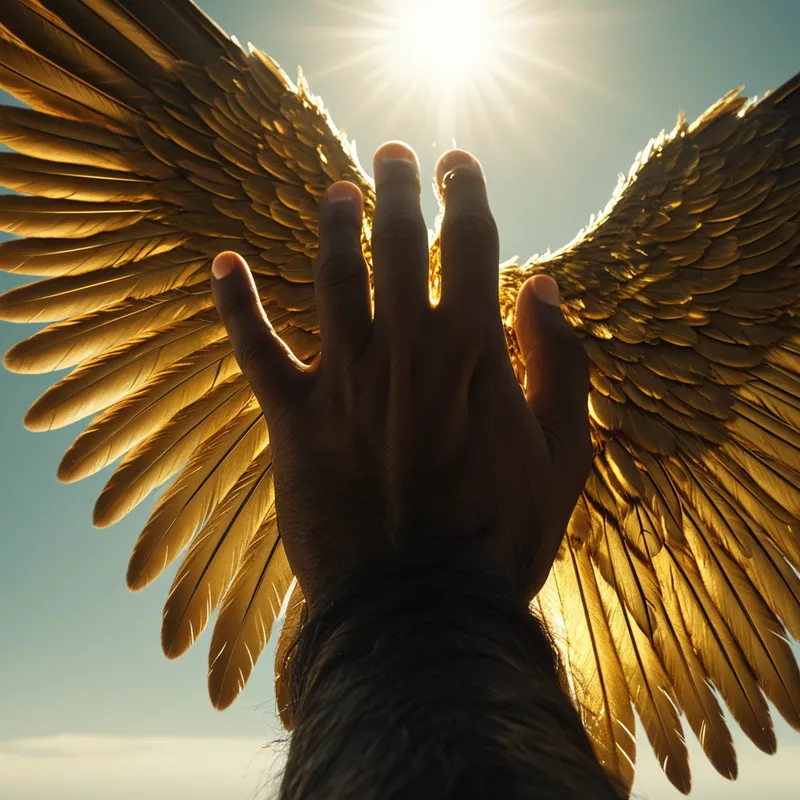
The wax and feather wings are the sublime, fragile marriage of inspiration (the feathers, lifting us upward) and material reality (the wax, binding it to earth). They are any human creation—art, technology, ambition—that allows us to transcend our natural state.
Icarus is the spirit, the youthful pneuma, the unbounded desire for transcendence. His flight is the intoxicating rush of liberation, of potential realized. The Sun is the ultimate symbol of the divine, of pure consciousness, of the source of life and truth. It is the goal of all mystical and ambitious yearning. But it is also an absolute, and absolutes consume.
The fall is not a punishment, but a thermodynamic law of the soul. The substance that binds our earthly aspirations cannot withstand the pure fire of the absolute. To touch the sun is to cease to be human.
The Sea that receives Icarus is the unconscious, the primal, maternal womb from which life emerged and to which individual consciousness returns. It is not evil, but neutral and vast. The tragedy is in the separation of intellect (Daedalus, who survives) and spirit (Icarus, who is lost).

The Dreamer’s Resonance
When this myth stirs in the modern dreamer, it signals a critical juncture in a process of ambitious expansion or spiritual awakening. To dream of flying with makeshift wings speaks to a newfound sense of capability, a creative or professional breakthrough that feels liberating. The dreamer is in the “ascending phase,” feeling the thrill of leaving old limitations (the labyrinth) behind.
The pivotal moment in the dream—the melting, the unraveling, the fall—manifests somatically as a sudden lurch, a gasp, or a feeling of dread amidst the euphoria. Psychologically, it marks the confrontation with a personal hubris. Perhaps the dreamer has over-identified with a success, neglected crucial practical details (the wax), or is pursuing a goal with a fanaticism that burns away all other aspects of life. The dream is the psyche’s urgent correction, a catastrophic simulation to prevent a catastrophic reality. It asks: What are you using to bind your ambitions? Is it melting? Are you heeding the warnings of your inner, experienced Daedalus, or are you drunk on the altitude?

Alchemical Translation
In the alchemical journey of individuation—the process of becoming a whole, integrated Self—the Icarus myth models the peril and necessity of the sublimatio stage. This is the phase where psychic material is volatilized, lifted from its base, earthly state (the labyrinth of complex personal history) toward a higher, spiritual principle.
Daedalus represents the guiding, conscious ego that structures the process. It knows the recipe, gathers the materials (skills, therapy, discipline), and intends the transformation. Icarus is the awakened spirit, the libido or life-force that must actually make the flight. The danger lies in the dissociation of these two. If the ego is too rigid and earthbound (Daedalus flying only the safe, middle course), no transcendence occurs. If the spirit breaks free without the ego’s binding wisdom, it is annihilated.
The alchemical goal is not for Daedalus to restrain Icarus, nor for Icarus to abandon Daedalus. It is for the two to fly as one integrated being—where the daring of the spirit is perfectly tempered by the knowing craftsmanship of the conscious mind.
The true “gold” produced is not reaching the sun, but achieving a sustainable altitude. It is the capacity for inspired flight within human limits. The fall, when it happens in our lives, is a solve—a dissolution of an inflated identity. The sea that receives us is the prima materia once more, the raw psychic material from which a wiser, more humble, and more authentic self can be reconstituted. We must, like Daedalus, mourn the lost, pure spirit of unbound ambition, but we must also learn to fly on, carrying both the memory of the fall and the indelible knowledge of what it is to soar.
Associated Symbols
Explore related symbols from the CaleaDream lexicon: