The Fall Myth Meaning & Symbolism
A story of awakening from innocence. Eating the forbidden fruit births self-awareness, knowledge of good and evil, and the painful, glorious burden of consciousness.
The Tale of The Fall
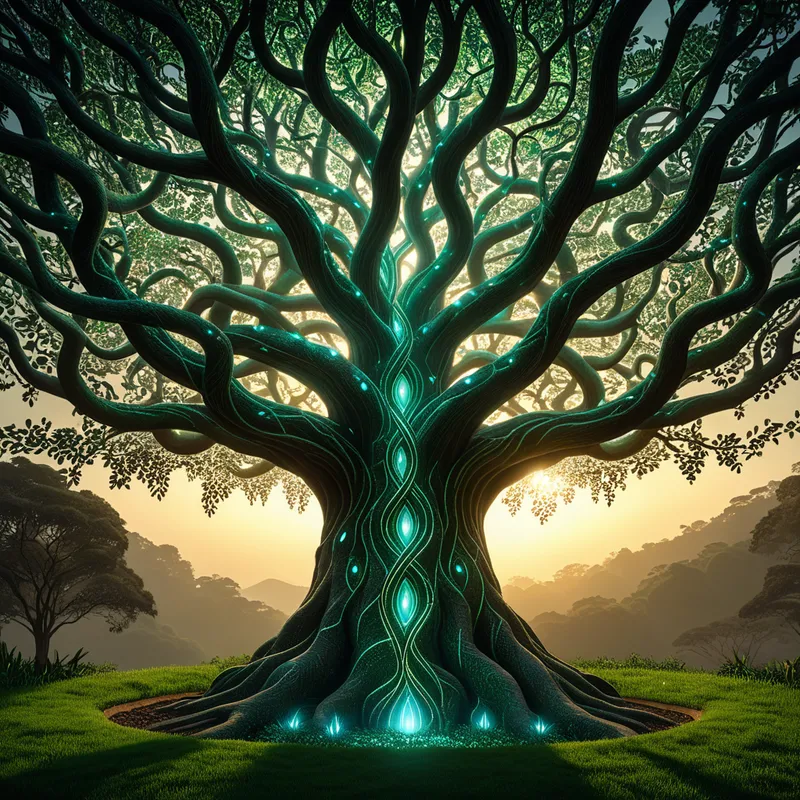
In the beginning, there was a rhythm. A rhythm of breath and clay, of light moving through leaves, of water finding its course without sound. This was the Garden of Eden, a place where every need was met before it was a thought, where the first humans walked in a state of seamless belonging. They knew the names of the beasts and the taste of every fruit save one. For in the heart of the garden stood two trees: the Tree of Life, and its mysterious twin, the Tree of the Knowledge of Good and Evil. Of this, they were told: “You shall not eat, for on the day you eat of it, you shall surely die.”
But the garden held another voice. It was the voice of the cunning serpent, more subtle than any beast. It did not roar; it wove its question into the stillness. “Did the Divine truly say you shall not eat of any tree?” The woman corrected, but the seed was planted. The serpent continued, its whisper a silver thread in the air. “You will not die. For the Divine knows that on the day you eat of it, your eyes will be opened, and you will be like gods, knowing good and evil.”
The air grew heavy, charged with a possibility more terrifying than any prohibition. The woman looked at the tree. She saw that its fruit was good for food, a delight to the eyes, and desirable to make one wise. The rhythm of innocence was broken by a new, internal pulse: choice. She took. She ate. She gave to her man, who was with her, and he ate.
And in that moment, the world fractured.
Their eyes were opened, just as the voice had promised. But the first knowledge was not of power—it was of nakedness. Of separation. The seamless cloth of unity was torn, and they saw themselves as objects, vulnerable and apart. They heard the sound of the Divine walking in the garden in the cool of the day, and for the first time, they hid. The call came: “Where are you?” It was not a question of location, but of state. And from behind the foliage, a confession woven from shame tumbled out: “I was afraid, because I was naked; and I hid.”
Then came the consequences, spoken not as wrath, but as the inevitable logic of a new reality. To the woman, pain in childbirth and a tangled duality in relationship. To the man, toil and struggle against a resistant earth. And to both, exile. They were driven out from the garden, and a flaming sword turned every way, guarding the way back to the Tree of Life. The rhythm was gone. In its place was history.
Cultural Origins & Context
This foundational narrative is found in the Book of Genesis, the first book of the Tanakh and the Christian Old Testament. Its origins are layered, drawing from ancient Near Eastern mythic traditions about primordial humans, divine gardens, and lost golden ages. It functions as an etiological myth—a story explaining the origins of fundamental human conditions: why we labor, why childbirth is painful, why we wear clothes, and most profoundly, why we experience moral consciousness, shame, and alienation from a state of pure nature.
Passed down orally long before being codified in written scripture, it served as the bedrock of the Israelite worldview. It established the core theological concepts of human free will, divine commandment, consequence, and the fractured relationship between humanity, the divine, and the natural world. It was not merely a story of the past but a mirror held up to every generation, explaining the pervasive sense that the world is not as it should be, that we live east of a lost Eden.
Symbolic Architecture
The myth is a dense map of the psyche’s emergence from unconscious unity into conscious duality.
The Garden of Eden represents the original, undifferentiated state of the psyche—the womb of the unconscious where all opposites are held in harmony. There is no “I” and “other,” no knowledge of death, no moral conflict. It is the psychic condition of infancy and the collective unconscious.
The fruit is not evil; it is the catalyst of consciousness. To eat is to choose self-awareness over eternal, unconscious bliss.
The Tree of the Knowledge of Good and Evil symbolizes the principle of differentiation itself. “Good and evil” represents all fundamental opposites: self/other, male/female, life/death, pleasure/pain. To partake of this knowledge is to leave the world of “and” for the world of “or.” The serpent is the instinctual, chthonic wisdom of the unconscious itself, pushing the psyche toward necessary growth, however disruptive. It is the trickster-guide who forces evolution.
The “Fall” is thus a necessary catastrophe. It is the birth of the ego, the “I” that can reflect, judge, and feel separate. The immediate consequences—shame, fear, blame—are the birth pangs of individual psychological life. Exile from the garden is not a punishment but the inevitable result of awakening; you cannot know you are in paradise. You can only remember it, or yearn for it.
The Dreamer’s Resonance
When this myth stirs in modern dreams, it signals a profound psychological transition. Dreaming of a pristine, beautiful garden from which you are barred or expelled often reflects a felt loss of innocence, a confrontation with a difficult truth that has shattered a previous, simpler worldview. It is the dream of the divorce, the career failure, the moral dilemma, the diagnosis—any event that irrevocably changes your perception of yourself and your world.
Dreams of eating forbidden fruit or encountering a wise/tempting serpent indicate an active, if fraught, process of integration. The dreamer is grappling with a new level of self-knowledge that feels both empowering and isolating. The somatic feeling is often one of simultaneous exhilaration and deep anxiety—the “nakedness” of being truly seen, or of seeing oneself without illusion. This is the psyche working through its own “fall” from a defensive innocence into a more complex, conscious, and responsible state of being.

Alchemical Translation
For the modern individual seeking wholeness or individuation, The Fall is the essential first operation: the Nigredo, the blackening. It is the necessary dissolution of the primal, unconscious unity (the Garden) so that a conscious, differentiated self can be forged.
The alchemical journey does not seek to return to the garden—that is spiritual regression. Instead, it seeks to integrate the knowledge gained from the fruit into a new, higher synthesis. The goal is not to become innocent again, but to become wise. The flaming sword that guards the way back also points the way forward: we must journey through the wilderness of experience, consciousness, and time.
The exile carries the seed of the garden within. Individuation is the long work of cultivating that internal seed into a conscious, ethical life—a personal paradise earned, not given.
The serpent’s gift of knowledge becomes the tool for this work. By consciously engaging with our dualities—our light and shadow, our creativity and destructiveness—we perform the alchemical marriage of opposites. We cannot undo the Fall, but we can redeem it by using our hard-won consciousness to create meaning, bear responsibility, and perhaps, in moments of profound integration, catch a glimpse of the sacred not as a place we left behind, but as a quality of being we can embody, here, in the midst of the thorns and the sweat of our brow. The myth ends not with an ending, but with a beginning: the human story itself.
Associated Symbols
Explore related symbols from the CaleaDream lexicon: