
The Fading Lotus Myth Meaning & Symbolism
A celestial lotus blooms for a single night, teaching a bodhisattva that true enlightenment is found not in permanence, but in the beauty of letting go.
The Tale of The Fading Lotus
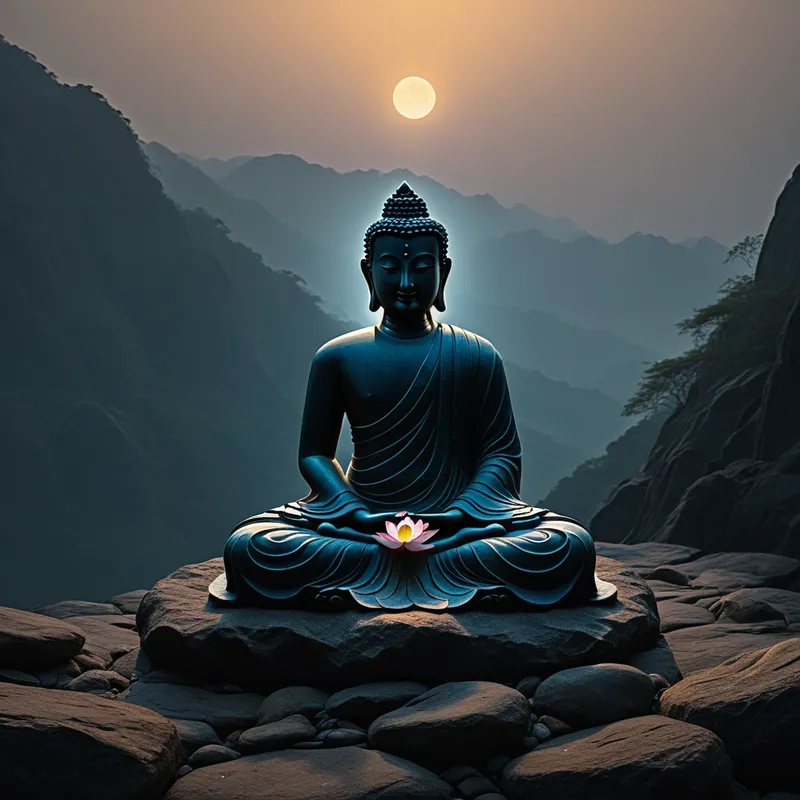
Listen, then, to a whisper from the Akaniṣṭha. In a time before time was measured, when the cosmos breathed in a single, silent rhythm, there existed a lake of perfect stillness. Its waters were not of this earth, but a mirror to [the void](/myths/the-void “Myth from Buddhist culture.”/), reflecting not images, but the essence of all potential. In its center grew a [lotus](/myths/lotus “Myth from Hindu culture.”/), but no ordinary bloom. This was the Ādi-Kamala, the First [Lotus](/myths/lotus “Myth from Hindu culture.”/). Its roots drank from [the abyss](/myths/the-abyss “Myth from Kabbalistic culture.”/), its stem was the axis of worlds, and its bud, tightly furled, held a light so profound it was said to be the condensed compassion of all the Bodhisattvas.
For eons uncounted, it remained a promise, a closed secret. The Apsarās would circle its waters, their songs willing it to open. The Dharmapālas stood vigilant on the shores, guarding its silence. All awaited the moment of its unveiling, believing that when its petals unfurled, they would reveal the ultimate, unchanging truth, a permanent answer to the great mystery of suffering and release.
And then, it began. Not with a sound, but with a sigh that trembled through the fabric of reality. A single, outermost petal loosened its hold. A light, softer than dawn and more ancient than the stars, spilled forth. The celestial hosts fell silent. [The bodhisattva](/myths/the-bodhisattva “Myth from Buddhist culture.”/) Samantabhadra, who had meditated upon its shore for lifetimes, opened his eyes. The blooming was an excruciatingly slow symphony. Each petal that curved back revealed not a static truth, but a living, pulsing galaxy of understanding—the interconnectedness of all things, the emptiness of inherent existence, the boundless nature of compassion. The light was not a beacon to be grasped, but a wisdom to be witnessed.
For one entire night of the cosmos, [the lotus](/myths/the-lotus “Myth from Hindu culture.”/) blazed in its full glory. It was the heart of existence laid bare. Samantabhadra felt his own consciousness expand, touching infinity. He understood the Four Noble Truths not as concepts, but as the very rhythm of [the lotus](/myths/the-lotus “Myth from Hindu culture.”/)’s light. In that moment, he stood at [the threshold](/myths/the-threshold “Myth from Folklore culture.”/) of perfect, permanent enlightenment.
But as the cosmic night began to wane, a new movement commenced. The very petals that had unfurled with such majestic slowness began to fade. Not to wither, but to gently dissolve. Their substance turned translucent, then became like mist, then like memory, merging back into the starlight from which they came. The magnificent, complete form was returning to the formless. A murmur of dismay arose among some celestial beings. “It is lost!” they cried. “The truth is departing!”
Samantabhadra felt a profound tension—the instinct to cling to this perfection, to freeze this moment of supreme understanding forever. But as he watched, his gaze softened. In the fading, he saw something he had not seen in the full bloom: grace. The lotus was not being taken; it was giving itself back. It was demonstrating the final, most elusive truth not in its presence, but in its absence. As the last fragment of petal-light dissolved into the now-glimmering waters, leaving the lake perfectly still and empty once more, Samantabhadra did not despair. A smile, deep and peaceful, touched his lips. The lesson was complete. The lotus had not shown him a truth to hold, but the truth of holding itself.
Cultural Origins & Context
The narrative of The Fading Lotus is not found in a single, canonical [sutra](/myths/sutra “Myth from Hindu culture.”/) but is a Jātaka-like tale that emerged from the Mahayana Buddhist tradition, particularly within the <abbr title=“The “Great Perfection” or “Great Completion,” a central teaching in the Nyingma school of Tibetan Buddhism”>Dzogchen and <abbr title=“The “Great Seal,” a central meditation practice in Tibetan Buddhism”>Mahāmudrā lineages that emphasize the direct realization of the nature of mind. It was transmitted orally by masters to their disciples, often as a “pointing-out instruction” during meditation retreats near high mountain lakes, where the natural cycle of lotus blooms could be observed.
Its societal function was deeply pedagogical, aimed at advanced practitioners who risked “sticking” to profound meditative experiences. In a culture that venerates the lotus as the ultimate symbol of purity and enlightenment (Nirvāṇa), rising unsullied from the mud, this myth served as a crucial corrective. It taught that even the most sublime states of consciousness, the “blooms” of spiritual achievement, are subject to Anicca ([impermanence](/myths/impermanence “Myth from Buddhist culture.”/)). To seek to possess enlightenment as a permanent state was, according to this story, to misunderstand its very nature. It was a narrative safeguard against spiritual materialism.
Symbolic Architecture
The myth is a masterclass in non-dual [symbolism](/symbols/symbolism “Symbol: The use of symbols to represent ideas or qualities, often conveying deeper meanings beyond literal interpretation. In dreams, it’s the language of the unconscious.”/). The Ādi-Kamala represents the primordial, unconditioned [nature](/symbols/nature “Symbol: Nature symbolizes growth, connectivity, and the primal forces of existence.”/) of [reality](/symbols/reality “Symbol: Reality signifies the state of existence and perception, often reflecting one’s understanding of truth and life experiences.”/) and mind—often called <abbr title=“Suchness” or “thusness,” the ultimate nature of reality as it is”>Tathatā. Its long gestation symbolizes the arduous path of practice, the Aṣṭāṅgika-Mārga. The glorious, single-night bloom is the peak experience: satori, mystical union, the dazzling insight that seems to explain everything.
The lotus does not fear the mud, for it knows its origin. Its true test is not in blooming, but in releasing its own perfection.
The fading, therefore, is the core of the teaching. It symbolizes the necessary [dissolution](/symbols/dissolution “Symbol: The process of breaking down, dispersing, or losing form, often representing transformation, release, or the end of a state of being.”/) of the experience itself, the letting go of the “attainment” of enlightenment. This is the embodiment of Dāna-pāramitā applied to one’s own spiritual gains. Samantabhadra’s shift from clinging to serene [acceptance](/symbols/acceptance “Symbol: The experience of being welcomed, approved, or integrated into a group or situation, often involving validation of one’s identity or actions.”/) models the transition from experiencing wisdom to embodying it. The empty [lake](/symbols/lake “Symbol: A lake often symbolizes a place of reflection, emotional depth, and the subconscious mind, representing both tranquility and potential turmoil.”/) at the end is not a void of [loss](/symbols/loss “Symbol: Loss often symbolizes change, grief, and transformation in dreams, representing the emotional or psychological detachment from something or someone significant.”/), but the <abbr title=“The “sky-like” or “empty” nature of reality, free from inherent existence”>Śūnyatā ([emptiness](/symbols/emptiness “Symbol: Emptiness signifies a profound sense of void or lack in one’s life, often related to existential fears, loss, or spiritual quest.”/)) that is simultaneously [fullness](/symbols/fullness “Symbol: A state of complete satisfaction, abundance, or completion, often representing emotional, spiritual, or physical fulfillment.”/)—the mind in its natural, uncontrived state, free from the grasping even at [bliss](/symbols/bliss “Symbol: A state of profound happiness and spiritual contentment, often representing fulfillment of desires or alignment with one’s true self.”/) or understanding.

The Dreamer’s Resonance
When this myth stirs in the modern unconscious, it rarely appears as a literal Buddhist parable. Instead, it manifests in dreams of profound but fleeting beauty or success: a breathtaking piece of art the dreamer creates then loses, a perfect moment of connection that cannot be sustained, a career peak that immediately passes, or a loved one in radiant health who then fades from view.
The somatic experience is key. There is often an intense feeling of expansion and luminous joy (the blooming), followed by a crushing, anxious contraction—a desperate desire to “save” or “record” the experience (the instinct to cling). The dream ego is cast in the role of Samantabhadra, witnessing its own heartbreak. This dream pattern signals a profound psychological process: [the ego](/myths/the-ego “Myth from Jungian culture.”/)‘s confrontation with [the law](/myths/the-law “Myth from Biblical culture.”/) of impermanence in its own inner kingdom. The [psyche](/myths/psyche “Myth from Greek culture.”/) is working to metabolize a truth that the conscious mind resists: that all states, even the most valued and identity-defining ones—being in love, being successful, being inspired—are transient. The dream is an initiatory ordeal, preparing the dreamer to relate to their own experiences not as possessions, but as visitations.

Alchemical Translation
For the modern individual on the path of individuation, The Fading Lotus models the alchemical stage of [Solutio](/myths/solutio “Myth from Alchemical culture.”/) (dissolution) applied to the highest spiritual or psychological achievements. Our culture prizes peak experiences, breakthroughs, and “finding yourself.” This myth suggests the more profound work begins after the discovery.
The initial “bloom” is the emergence of the Self archetype—a moment of profound integration, where life makes sense and one feels aligned with destiny. The ego, naturally, wishes to claim this state as a permanent acquisition, a final “enlightenment” or “fixed” personality. This is the spiritual ego’s last and most subtle fortress.
Individuation is not the curation of perfect states, but the cultivation of a relationship with the process that gives them birth and receives them back in death.
The alchemical work is the conscious, willing participation in the “fading.” It is the active letting be of the very wholeness one has sought. This is not regression, but a surrender into a deeper ground of being. It translates as: not identifying as “the healed one,” “the awakened one,” or “the successful one,” but remaining fluid. It is the ability to hold one’s talents, insights, and hard-won peace lightly, ready for them to be dissolved and reconfigured by life’s next unknown. The [triumph](/myths/triumph “Myth from Roman culture.”/) is not in the permanent radiance of the lotus, but in developing the serene clarity of the lake—which can reflect the bloom, the fade, and the empty sky with equal, unwavering depth. This is the move from possessing consciousness to being consciousness itself, forever open, forever complete in its incompleteness.
Associated Symbols
Explore related symbols from the CaleaDream lexicon: