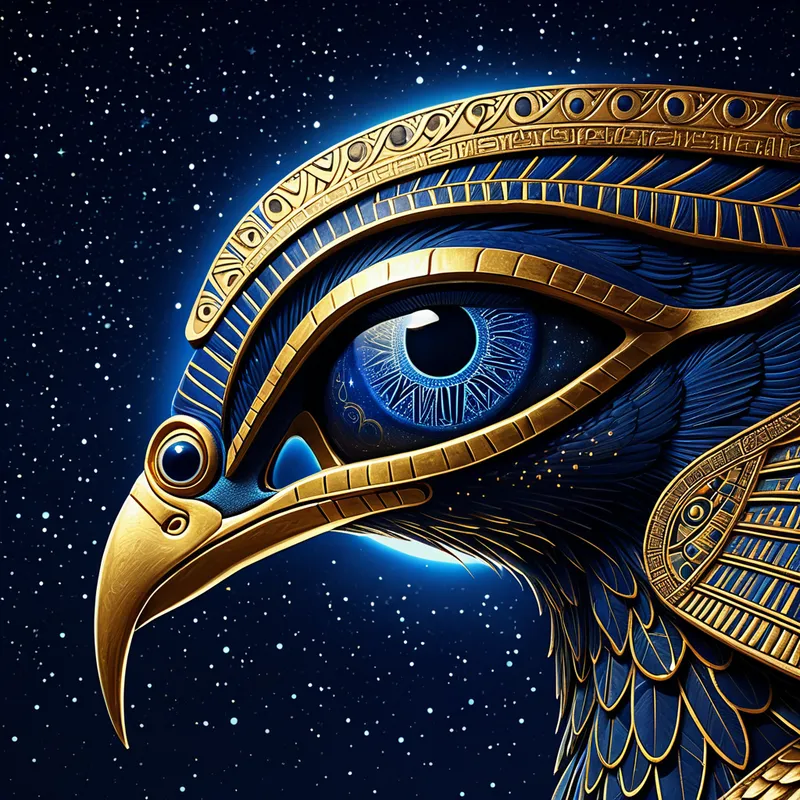
The Eye of Horus from Egyptian Myth Meaning & Symbolism
A myth of divine conflict where a lost eye is restored, becoming a symbol of sacrifice, wholeness, and the price of cosmic order.
The Tale of The Eye of Horus from Egyptian
Hear now the tale whispered on the hot winds of the desert, a story etched in starlight and blood. The world was young, and the air crackled with the aftermath of a primal crime. The great god Horus, his feathers still matted with the dust of battle, bore the fresh, searing agony of his left eye. It was gone, torn from him in the ferocious, churning conflict with his uncle, Set. The struggle was not for mere land, but for the very throne of the Two Lands, for the right to heal a world fractured by Set’s murder of Horus’s father, Osiris.
In that void where his eye had been, Horus knew a darkness deeper than the Nun. It was a darkness of usurpation, of a rightful order overturned. Yet, the cosmos itself seemed to grieve the loss. The moon, that great silver eye of the night, began to wane, its light dimming in sympathy. Without the eye of the sky god, balance itself was threatened.
But the gods are not idle. From the silent depths of his cosmic knowledge emerged Thoth, the measurer, the scribe. His was not the power of the storm or the fist, but the quiet, relentless power of the word and the number. He descended to the scorched sands where the fragments of the eye lay scattered—each piece a glimmering tear of divine substance. With hands steady as the pillars of heaven, Thoth began the work. He did not simply find the pieces; he called them. He sang to the shards with the language of mathematics and magic, the very language he used to order the stars.
One by one, the luminous fragments responded, drifting from the shadows of canyons and the beds of dry rivers. Thoth fitted them together, not as a mere physical organ, but as a vessel of restored function and potent magic. As the final piece clicked into place, a sound like a crystal chime resonated across the desert. The eye was whole again—but it was transformed. It now pulsed with a compounded power, a wisdom forged in loss and repair.
Horus, his strength returning, did not greedily reclaim his eye. Instead, in a gesture that stilled the heavens, he offered it to his father, Osiris, who dwelt in the silent, green halls of the Duat. This gift was no simple token. As the restored eye touched Osiris, a surge of vital, lunar energy flowed into the lord of the dead, fortifying him, completing his resurrection, and granting him eternal sovereignty over the afterlife. The sacrificed eye became the sustenance of renewal itself. And in that moment, the moon in our sky began to wax once more, a silent, eternal testament to the offering.

Cultural Origins & Context
This myth, central to the Egyptian understanding of cosmic and political order, is not a single, fixed story but a constellation of related narratives and rituals spanning millennia. It is found in the Pyramid Texts, the Coffin Texts, and most extensively in the Book of the Dead. It was recited by priests in temple rites and invoked in the most intimate of spaces: the burial chamber.
The myth functioned on multiple levels. Politically, it legitimized the pharaoh (the living Horus-on-Earth) by linking his right to rule to this divine victory and restorative sacrifice. Societally, it modeled the imperative of ma’at—cosmic order, truth, and justice—over isfet, or chaos. On a personal, funerary level, the restored Eye of Horus, known as the Wedjat, was the ultimate protective amulet. It was painted on coffin lids, carved into stone, and worn in life and death to ensure physical integrity, healing, and safe passage. The myth was a lived technology for navigating the greatest transitions: from chaos to order, from injury to healing, from death to afterlife.
Symbolic Architecture
The Eye of Horus is a profound symbol of fragmentation and active reintegration. It is not a symbol of passive wholeness, but of wholeness achieved. The eye itself represents perception, consciousness, and the sovereign self. Its loss is the shattering of that self through trauma, conflict, or profound betrayal.
The true self is not born whole; it is assembled, piece by painful piece, from the aftermath of its own breaking.
The act of shattering by Set represents the inevitable, chaotic forces that disrupt our inner order. Thoth’s restoration is the archetypal function of the intellect, wisdom, and meticulous care in the healing process. He does not fight chaos with more chaos; he opposes it with measurement, reason, and sacred formula. Crucially, the restored eye is then given away. This is the myth’s alchemical heart: the healed fragment is not re-absorbed narcissistically but is transmuted into an offering that nourishes a greater, ancestral wholeness (Osiris). The eye becomes a vehicle of sacrifice that completes a cosmic circuit of renewal.
The Dreamer’s Resonance
When this myth stirs in the modern dreamer, it often signals a profound process of psychic retrieval. To dream of a lost or damaged eye, of searching for pieces of a broken mirror or vessel, or of a benevolent, non-human figure (an ibis, a wise animal) assisting in a repair, is to dream the Wedjat.
Somatically, this may coincide with feelings of fragmentation, disorientation, or a specific sense of lack—a “blind spot” in one’s life. The psychological process is one of gathering scattered parts of the self that were lost to past trauma, shame, or conflict. The dream is not merely diagnosing the fracture; it is activating the inner Thoth, the cognitive and spiritual capacity to patiently locate, honor, and reassemble those parts. The dreamwork is the slow, nightly piecing-together, where each recovered fragment—a forgotten talent, a buried emotion, a reclaimed boundary—brings a increment of light and lunar cohesion back to the dreaming psyche.

Alchemical Translation
For the individual on the path of individuation, the myth of the Eye models the complete arc of psychic transmutation. The initial conflict (Horus vs. Set) is the necessary, often brutal, engagement with one’s own shadow—the internalized Set that seeks to usurp conscious control through destructive patterns. This battle inevitably results in a wounding, a loss of a naive, previously “whole” perspective.
Individuation is the restoration of the eye, not to see a perfect world, but to see the world perfectly—with all its fractures included in your vision.
The alchemical work is in the Thoth-phase: the conscious, patient, and scholarly inner work. This is therapy, journaling, active imagination, art—any practice that “measures” and names the shattered parts. The final, crucial stage is the offering. The healed insight, the regained power, must not be hoarded. It must be sacrificed—given to the “Osiris within,” the deeper, perhaps dormant, layer of the soul that connects us to our ancestors and the collective unconscious. This offering fertilizes the soul’s afterlife, its future potential. Thus, the personal healing becomes transpersonal. The individual’s restored vision becomes a lens through which a more profound, nourishing wisdom flows into their life and, by extension, into their world. The Wedjat you wear is the wholeness you have forged and then given away, which in turn makes you truly whole.
Associated Symbols
Explore related symbols from the CaleaDream lexicon: