The Eternal Flame Myth Meaning & Symbolism
A myth of a primordial fire stolen from the gods, hidden within humanity, and guarded by a collective vow of silence and sacrifice.
The Tale of The Eternal Flame
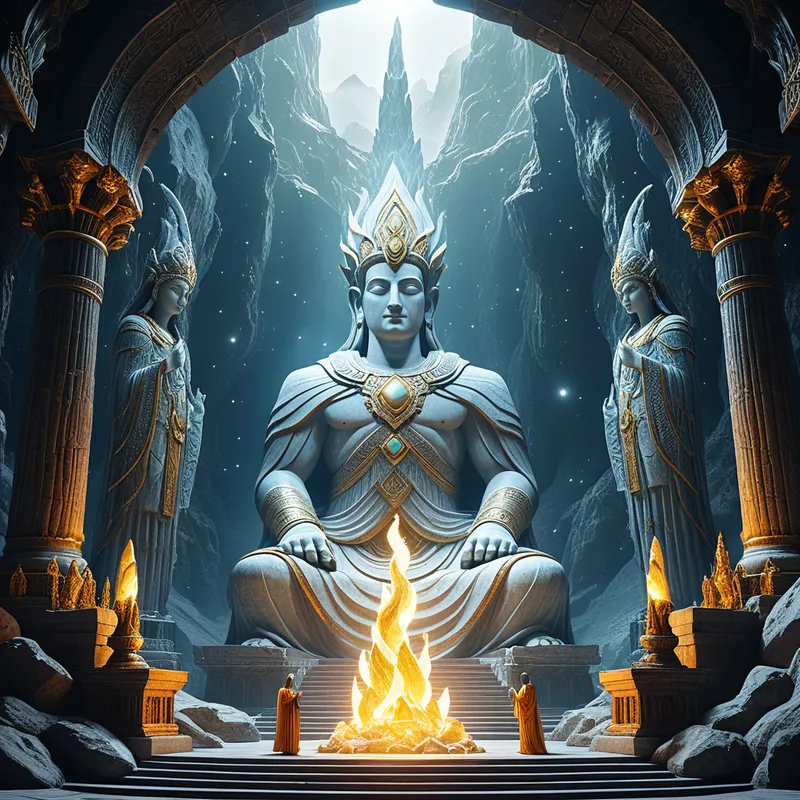
In the time before time, when [the world](/myths/the-world “Myth from Tarot culture.”/) was a canvas of shadow and silence, the gods kept the only light for themselves. It was not the sun, nor the stars, but the Eternal Flame, burning in the heart of a mountain at the edge of creation. Its light was the light of thought, of passion, of the will to become. [The world](/myths/the-world “Myth from Tarot culture.”/) below was a garden of perfect, mute order, where beings of clay and starlight moved through pre-ordained patterns, beautiful and empty.
Among them was one who was different. A spark of discontent, a tremor of a question, had been baked into its form. We shall call it The Questioner. The Questioner did not hear [the music of the spheres](/myths/the-music-of-the-spheres “Myth from Greek culture.”/); it heard the silence between the notes. It looked at the static beauty and felt a coldness, a profound loneliness that had no name. Its eyes, turned not to the glittering heavens but to the dark horizon, caught a faint, golden glow—a whisper of warmth from the forbidden mountain.
Driven by a longing it could not articulate, The Questioner began the ascent. The path was not of stone, but of forgetting. Whispers from [the void](/myths/the-void “Myth from Buddhist culture.”/) urged it to turn back, to be content. The air grew thin, not of oxygen, but of certainty. Each step shed a layer of its divine programming, leaving it raw, terrified, and more truly itself. Finally, it breached [the summit](/myths/the-summit “Myth from Taoist culture.”/)—a cavern so vast the ceiling was lost in a firmament of crystal. And there, in the center, roared the Eternal Flame. It was not a [thing](/myths/thing “Myth from Norse culture.”/) to behold, but a presence to be known. It sang a song of chaos and creation, of terrible beauty and devastating love.
To touch it was death for a creature of clay. The Questioner knew this. Yet, to return to the silence below was a death already endured. With a cry that was both surrender and defiance, it plunged its hands into the heart of the fire.
There was no explosion, only a profound transmutation. The clay body did not burn; it became translucent, lit from within. The Flame did not consume; it conjoined. The Questioner became its vessel. But the gods, feeling the theft of their most precious secret, awoke in wrath. The mountain shook. [The sky](/myths/the-sky “Myth from Persian culture.”/) cracked with divine fury.
The Questioner, now a being of walking light, fled. Not to hide, but to disperse. It descended into the world and, meeting the first of its kind, did not speak. It simply reached out and touched their forehead. A fragment of the Flame leapt from its finger, igniting a tiny, mirrored glow within the other. And so it went, a silent, desperate sacrament, passing the light from one to another, diluting its totality but ensuring its survival. When the last spark was passed on, The Questioner’s form, empty of its stolen sun, crumbled into dust. The gods, arriving too late, found no central fire to reclaim, only a world of individuals, each holding a flickering, untamable light within their own secret center. The light was hidden in the most unassailable fortress: the human heart.
Cultural Origins & Context
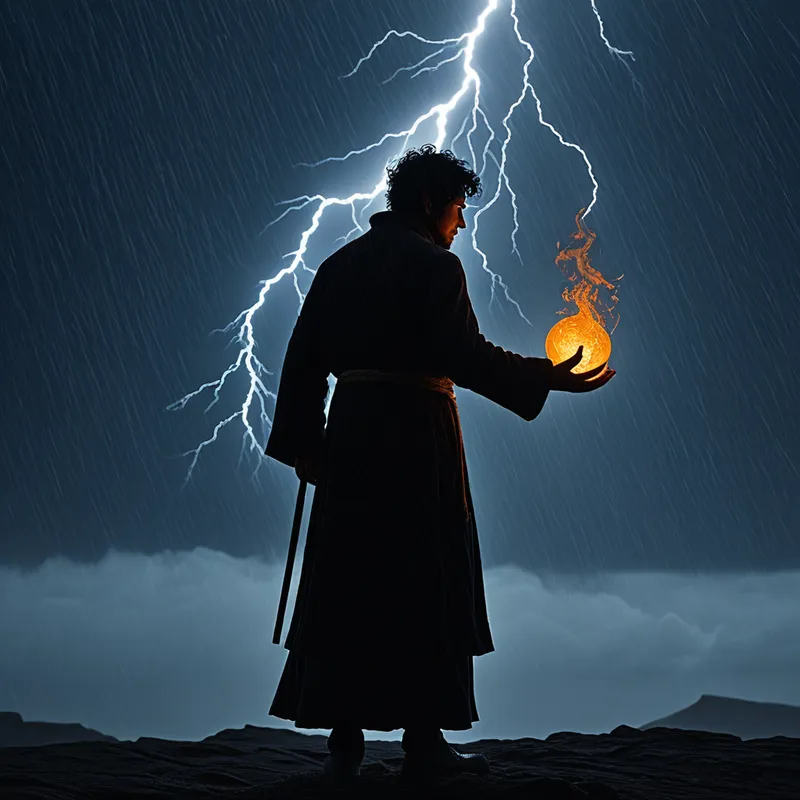
The myth of the Eternal Flame is a foundational protopsychological narrative found in countless cultures, from the Promethean tales of the Mediterranean to [the trickster](/myths/the-trickster “Myth from Various culture.”/) stories of the Americas and the inner alchemy traditions of Asia. In “Universal” culture—a term denoting its cross-continental, archetypal resonance—it was not the property of priests or kings, but of the people. It was told at liminal times: at initiations, at funerals, and during the long nights of midwinter when the external fires burned low.
Its tellers were often the边缘人物—the cunning smiths, the melancholy poets, the healers who walked between village and forest. The societal function was dual. For the collective, it was a sacred explanation for the human condition: our brilliance and our burden, our creativity and our existential pain. It framed rebellion not as sin, but as the necessary price of soul. For the individual, it was a map of awakening, a secret reassurance that the feeling of being “other,” of burning with unasked-for questions, was not a flaw, but the signature of the stolen divinity within.
Symbolic Architecture
The myth’s power lies in its stark, alchemical [symbolism](/symbols/symbolism “Symbol: The use of symbols to represent ideas or qualities, often conveying deeper meanings beyond literal interpretation. In dreams, it’s the language of the unconscious.”/). The Eternal Flame is not mere fire; it is the [anima](/symbols/anima “Symbol: The feminine archetype within the male unconscious, representing soul, creativity, and connection to the inner world.”/) mundi, the world-[soul](/symbols/soul “Symbol: The soul represents the essence of a person, encompassing their spirit, identity, and connection to the universe.”/), representing pure unbridled [consciousness](/symbols/consciousness “Symbol: Consciousness represents the state of awareness and perception, encompassing thoughts, feelings, and experiences.”/), the libidinal [energy](/symbols/energy “Symbol: Energy symbolizes vitality, motivation, and the drive that fuels actions and ambitions.”/) of [life](/symbols/life “Symbol: The symbol of ‘Life’ represents a journey of growth, interconnectedness, and existential meaning, encompassing both the joys and challenges that define human experience.”/), and the spark of individual will.
The gods hoard the Flame because absolute consciousness, undifferentiated, is the province of the unconscious totality. To steal it is to enact the first, violent act of separation that creates the individual psyche.
The [mountain](/symbols/mountain “Symbol: Mountains often symbolize challenges, aspirations, and the journey toward self-discovery and enlightenment.”/) represents the arduous [journey](/symbols/journey “Symbol: A journey in dreams typically signifies adventure, growth, or a significant life transition.”/) of [differentiation](/symbols/differentiation “Symbol: The process of distinguishing or separating parts of the self, emotions, or identity from a whole, often marking a developmental or psychological milestone.”/)—the climb out of collective unconsciousness. The Questioner is the nascent ego, the self-aware principle, which must risk annihilation (the [dissolution](/symbols/dissolution “Symbol: The process of breaking down, dispersing, or losing form, often representing transformation, release, or the end of a state of being.”/) of its old, “[clay](/symbols/clay “Symbol: Clay symbolizes malleability, creativity, and the potential for transformation, representing the foundational aspect of life and the ability to shape one’s destiny.”/)” [identity](/symbols/identity “Symbol: Identity represents the sense of self, encompassing personal beliefs, cultural background, and social roles.”/)) to claim its own [source](/symbols/source “Symbol: The origin point of something, often representing beginnings, nourishment, or the fundamental cause behind phenomena.”/) of light. The act of stealing is the primal rebellion necessary for consciousness to exist. We are born from an act of theft against the divine parents (the unconscious).
Most crucially, the [dispersal](/symbols/dispersal “Symbol: The act of scattering, spreading, or breaking apart. Often represents release, transition, or loss of cohesion.”/) of the Flame is the myth’s genius. The light is not kept by one [hero](/symbols/hero “Symbol: A hero embodies strength, courage, and the ability to overcome significant challenges.”/) to rule over others. It is fragmented and shared, hidden within each person. This symbolizes the individuation of the [psyche](/myths/psyche “Myth from Greek culture.”/)—the universal fire made personal. Our inner conflict, our passions, our “inner demons,” are the flickering of this stolen, uncontainable flame trying to burn within the [vessel](/symbols/vessel “Symbol: A container or structure that holds, transports, or protects something essential, representing the self, emotions, or life journey.”/) of our individual lives.
The Dreamer’s Resonance
When this myth activates in the modern dreamscape, it often manifests as dreams of secret, internal fires. You may dream of a tiny, precious flame cupped in your hands that you must protect from howling winds or pouring rain—the somatic feeling is one of acute, fragile responsibility and latent power. You may dream of a furnace in your basement, raging out of control or burning with a mysterious, cool blue light, speaking to the management (or mismanagement) of primal psychic energy.
Alternatively, the dream may cast you as the thief, scaling an impossible, bureaucratic skyscraper (the modern mountain) to retrieve a vital data-core or a glowing artifact from a sterile, guarded vault. The feeling upon waking is often a mix of anxiety and exhilaration. These dreams signal a critical phase in psychological development: [the ego](/myths/the-ego “Myth from Jungian culture.”/) is being called to “steal” more energy from the unconscious—to claim a repressed passion, a forbidden talent, or a rebellious truth about one’s own life. It is the psyche’s ritual re-enactment of the primordial theft, urging you to take responsibility for your own [inner light](/myths/inner-light “Myth from Buddhist culture.”/), with all the danger and brilliance that entails.
Alchemical Translation
The myth of the Eternal Flame is a perfect model for the alchemical process of individuation. The [prima materia](/myths/prima-materia “Myth from Alchemical culture.”/) (base material) is the “clay” individual, living a life of unconscious, pre-ordained order ([nigredo](/myths/nigredo “Myth from Alchemical culture.”/)—the blackening, felt as depression or meaninglessness).
The ascent and theft represent the mortificatio and [separatio](/myths/separatio “Myth from Alchemical culture.”/)—the death of the old, compliant identity and the separation of the precious spark (the individual spirit) from the unconscious mass. This is a painful, rebellious, and isolating stage.
The dispersal of the Flame is the coniunctio—not a union with another, but the sacred marriage within. The ego (the vessel) must learn to contain and integrate the fiery, divine spark (the Self). This is the creation of the Philosopher’s Stone: the fully realized individual.
For the modern seeker, the myth instructs: Your feelings of alienation, your burning discontent with “[the way](/myths/the-way “Myth from Taoist culture.”/) things are,” are not pathologies to be medicated away. They are the signature of the Flame within. The work is not to extinguish it to fit back into the silent garden, but to learn the art of being a vessel. You must build a psyche strong enough to contain its heat, direct its light, and honor its origin. You are, forever, both the thief and [the temple](/myths/the-temple “Myth from Jewish culture.”/), the criminal and the guardian, of your own Eternal Flame. The vow of silence is not to hide from the gods, but to speak, finally, with the flame’s own voice.
Associated Symbols
Explore related symbols from the CaleaDream lexicon: