The Elysian Fields Myth Meaning & Symbolism
A blessed realm for heroes and the virtuous, a promise of eternal spring beyond the shadowy underworld, where the soul finds its final, peaceful harbor.
The Tale of The Elysian Fields
Listen, and let your spirit travel west, beyond the setting sun, beyond the known maps of [the world](/myths/the-world “Myth from Tarot culture.”/). There, where the great river [Oceanus](/myths/oceanus “Myth from Greek culture.”/) encircles [the earth](/myths/the-earth “Myth from Hindu culture.”/), lies a shore untouched by sorrow. This is not the realm of [Hades](/myths/hades “Myth from Greek culture.”/), that sunless kingdom of murmuring shades. No, this is a secret within the great mystery, a hidden fold in the fabric of death itself.
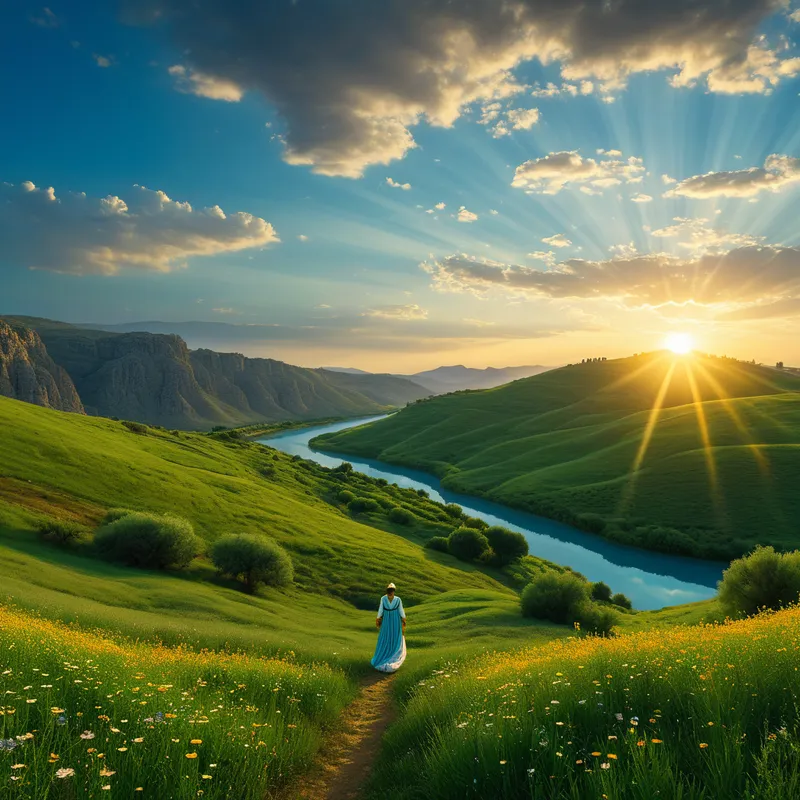
The poets call it the Elysian Fields, or the Isles of the Blessed. Here, the air is not still and heavy, but sweet and gentle, carrying the scent of perpetual spring. The sun shines with a kinder light, and soft breezes whisper through meadows of asphodel and crocus. No snow, no scorching heat, no storm ever bruises this land. Gentle rivers, clear as thought, meander through fields where the grass is eternally tender underfoot.
Who earns this grace? It is not for every soul. [The ferryman](/myths/the-ferryman “Myth from Various culture.”/) Charon does not bring them here. Their passage is guided by a different decree. It is for those touched by the gods’ own favor. For heroes like Achilles and [Odysseus](/myths/odysseus “Myth from Greek culture.”/), whose blood was half-divine and whose deeds shook the world. For the righteous, like the king Menelaus, whom [the sea](/myths/the-sea “Myth from Greek culture.”/)-god <abbr title=“An early sea-god, known as the “Old Man of the Sea"">[Proteus](/myths/proteus “Myth from Greek culture.”/) promised a fate apart from common men: “You shall not die in horse-pasturing Argos, but the deathless gods will convey you to the world’s end, to the Elysian Field.”
Here, conflict is a memory. The rising action of a mortal life—the striving, the war, the longing—finds its final resolution in perfect stasis, not of stillness, but of effortless being. The heroes who once clashed on the plains of Troy now wrestle only in friendly sport upon the green. Their wounds are gone, their grievances dissolved like morning mist. They run, they feast, they sing songs of their own glory, which now feels like a story about someone else. Time does not gnaw at them. It flows around them like the gentle rivers, a cycle without end, a day without night. This is the resolution [the Fates](/myths/the-fates “Myth from Greek culture.”/) weave only for a few: not an end, but a seamless blending into a blessed, eternal present.
Cultural Origins & Context
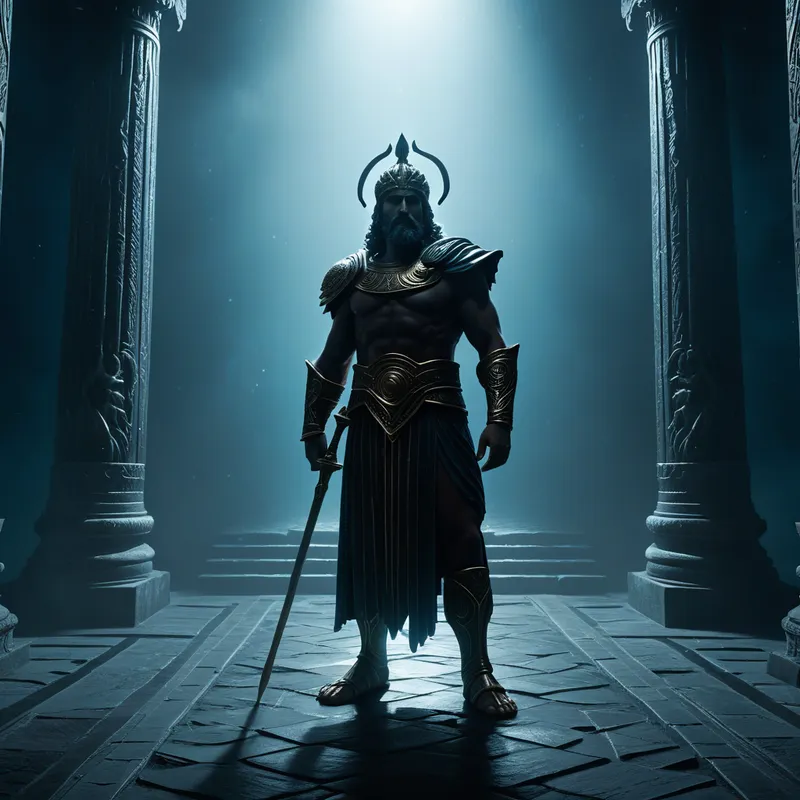
The vision of Elysium is not a single, dogmatic doctrine from ancient Greece, but a evolving dream woven through centuries of poetry and belief. Its earliest threads appear in the epic verses of [Homer](/myths/homer “Myth from Greek culture.”/), where it is a distant, obscure privilege for a select few heroes related to the gods. In the Odyssey, it is a tangible place at the “ends of the earth,” a concrete reward promised by a divine prophecy.
Later poets, like Hesiod and Pindar, expanded and democratized the concept. It became part of a cycle of [reincarnation](/myths/reincarnation “Myth from Hindu culture.”/) for the truly pure, a stage in the soul’s journey toward ultimate bliss. This shift reflects changes in Greek society and spirituality—a move from a hero-centric worldview to one more concerned with personal virtue and the moral quality of a life. The mystery cults, particularly the Eleusinian Mysteries, promised initiates a favorable lot in the afterlife, ideas which likely blended with the Elysian myth.
The story was passed down not by priests from pulpits, but by bards at feasts, by playwrights in theaters, and by philosophers in dialogues. Its function was multifaceted: it offered a consolation for the harshness of life and the grimness of the common [underworld](/myths/underworld “Myth from Greek culture.”/), it reinforced the cultural value of heroic excellence (arete), and later, it provided a template for contemplating [justice](/myths/justice “Myth from Tarot culture.”/), reward, and the nature of the soul’s destiny.
Symbolic Architecture
At its core, the [Elysian Fields](/symbols/elysian-fields “Symbol: A blissful afterlife realm in mythologies symbolizing peace, fulfillment, and eternal happiness.”/) represent the [psyche](/myths/psyche “Myth from Greek culture.”/)‘s ultimate fantasy of [resolution](/symbols/resolution “Symbol: In arts and music, resolution refers to the movement from dissonance to consonance, creating a sense of completion, release, or finality in a composition.”/). It is the symbolic answer to the [human](/symbols/human “Symbol: The symbol of a human represents individuality, complexity of emotions, and social relationships.”/) confrontation with [mortality](/symbols/mortality “Symbol: The awareness of life’s finitude, often representing transitions, impermanence, or existential reflection in dreams.”/), [effort](/symbols/effort “Symbol: Effort signifies the physical, mental, and emotional energy invested toward achieving goals and personal growth.”/), and existential flaw.
Elysium is not the negation of life, but the imagination of life purified of its contradictions—where effort and ease, memory and presence, individuality and peace finally coexist.
Geographically, its [location](/symbols/location “Symbol: The symbol of ‘Location’ signifies a sense of place, context, and the environment in which experiences unfold.”/) “at the ends of the [earth](/symbols/earth “Symbol: The symbol of Earth often represents grounding, stability, and the physical realm, embodying a connection to nature and the innate support it provides.”/)” signifies it is the ultimate [destination](/symbols/destination “Symbol: Signifies goals, aspirations, and the journey one is on in life.”/), the final content of the unconscious Self after [the ego](/myths/the-ego “Myth from Jungian culture.”/)‘s [journey](/symbols/journey “Symbol: A journey in dreams typically signifies adventure, growth, or a significant life transition.”/) is complete. It is a [pleroma](/symbols/pleroma “Symbol: In Gnostic cosmology, the Pleroma is the divine fullness or totality of spiritual powers, representing the realm of perfection beyond the material world.”/), a place of [fullness](/symbols/fullness “Symbol: A state of complete satisfaction, abundance, or completion, often representing emotional, spiritual, or physical fulfillment.”/). The perpetual spring symbolizes a state beyond the neurotic cycles of growth and decay, of hope and [despair](/symbols/despair “Symbol: A profound emotional state of hopelessness and loss, often signaling a need for transformation or surrender to deeper truths.”/). The asphodel, often the flower of the gloomy [underworld](/symbols/underworld “Symbol: A symbolic journey into the unconscious, representing exploration of hidden aspects of self, transformation, or confronting repressed material.”/), here blooms in meadows of [bliss](/symbols/bliss “Symbol: A state of profound happiness and spiritual contentment, often representing fulfillment of desires or alignment with one’s true self.”/), suggesting a [transmutation](/symbols/transmutation “Symbol: A profound, alchemical process of fundamental change where one substance or state transforms into another, often representing spiritual evolution or personal metamorphosis.”/) of the very substance of [death](/symbols/death “Symbol: Symbolizes transformation, endings, and new beginnings; often associated with fear of the unknown.”/) into something serene.
The inhabitants—the heroes—are key. They are not passive souls, but active beings enjoying games and song. This symbolizes that the achieved Self does not fall into inertness, but engages in purposeless, joyful [activity](/symbols/activity “Symbol: Activity in dreams often represents the dynamic aspects of life and can indicate movement, progress, and engagement with personal or societal responsibilities.”/). The struggle of the [hero’s journey](/symbols/heros-journey “Symbol: A universal narrative pattern representing personal transformation through trials, discovery, and return with wisdom.”/) (the agon) is alchemized into play (paidia). Their conflicts are remembered but not relived, indicating a state where traumatic or defining memories are fully integrated, losing their painful charge and becoming mere narrative, part of the rich [tapestry](/symbols/tapestry “Symbol: The tapestry represents interconnected stories, creativity, and the weaving of personal and collective experiences into a cohesive narrative.”/) of [the Self](/myths/the-self “Myth from Jungian culture.”/).
The Dreamer’s Resonance
When the imagery of the Elysian Fields arises in a modern dream, it rarely appears as a literal classical landscape. Instead, it manifests as a profound somatic and emotional tone of arrival and resolution. The dreamer may find themselves in a place of stunning, quiet beauty—a garden that feels deeply familiar yet eternally new, a library where all books are open to the perfect page, a home where every room is exactly as it should be.
Psychologically, this dream pattern surfaces during or after a significant process of integration. The “heroic” labors of the dreamer’s waking life—a career culmination, the end of a long therapy, the peaceful resolution of a family conflict, or simply a hard-won inner acceptance—create a psychic surplus. The unconscious produces this imagery as a symbolic reward, a deep affirmation from the Self. The somatic feeling is one of profound relief, lightness, and warmth. It is the psyche’s way of metabolizing completion, of creating an internal sanctuary where the fragmented parts of the self can finally rest together.
Conversely, dreaming of seeking Elysium but being unable to find it, or seeing it across an impassable barrier, speaks to a soul in the midst of its labors. It reflects the longing for psychological resolution when one is still entangled in the conflict, a beautiful but distant promise that fuels the continued journey.
Alchemical Translation
The myth of Elysium models the final stage of the individuation process: not the battle, but the peace that follows the integration of [the shadow](/myths/the-shadow “Myth from Jungian culture.”/), the anima/animus, and the other archetypal forces. The modern individual’s “alchemical translation” of this myth is the creation of an inner Elysium.
The first step is the catabasis—the descent into one’s personal underworld (the unconscious, the repressed, the traumatic past). This is the journey through the realm of Hades. The second is the agon—the struggle to bring those contents to light, to face them, to “fight” for awareness. This is the hero’s battle. Elysium represents the third, often overlooked stage: the synthesis and repose.
The alchemical gold is not merely the conquered dragon, but the serene field that grows in the soil where the dragon’s blood was spilled.
To translate this is to practice allowing a state of psychic equilibrium. It is the cultivation of an inner space where contradictory aspects of the self—the achiever and the lounger, the warrior and the poet, [the child](/myths/the-child “Myth from Alchemy culture.”/) and the elder—are not at war, but are simply allowed to be, to coexist in a meadow of consciousness. It is the move from compulsive doing to authentic being. It means honoring one’s past struggles (the “heroic deeds”) by not letting them define or haunt the present, but by letting them fertilize a current state of acceptance.
Ultimately, the Elysian Fields myth invites us to consider that the goal of the soul’s journey is not endless striving, but the earned capacity for a profound and peaceful abiding. It suggests that our deepest psychological work aims not just at survival or success, but at the creation of an inner sanctuary—a blessed, eternal present within the fleeting self.
Associated Symbols
Explore related symbols from the CaleaDream lexicon: