The Eighth Plague of Egypt Myth Meaning & Symbolism
A sky-blackening swarm devours all that remains, the final warning before the abyss. A story of absolute consequence and the breaking of a stubborn will.
The Tale of The Eighth Plague of Egypt
The air of Egypt, once heavy with the scent of lotus and river mud, now carried the memory of blood, frogs, and death. Seven times the hand of the God of the Hebrews had fallen, and seven times the heart of Pharaoh, the god-king who was the Son of Horus, had turned harder than the granite of his own monuments. The court sorcerers, their arts exhausted, could only whisper of a power that made their tricks seem like child’s play. The land was bruised, its people weary, but the throne remained unmoved.
Then came the word, carried on the dry east wind from the desert. It was not a plea, but a declaration. Moses stood once more in the shadow of the colossal pillars, his staff not a scepter but a witness. “Thus says Yahweh,” his voice cut through the perfumed silence of the court. “If you refuse to let my people go, behold, tomorrow I will bring locusts into your territory.”
A ripple of dread went through the courtiers. Locusts were no mere pestilence; they were the teeth of the desert, the un-making of life itself. Some of Pharaoh’s own servants, their nerves frayed, dared to speak. “How long shall this man be a snare to us?” they implored. “Do you not yet understand that Egypt is ruined?” For a moment, a crack appeared in the royal will. Pharaoh summoned the brothers, Aaron and Moses. “Go, serve your God,” he said, the words tasting of ash. “But who exactly is to go?”
The negotiation was a trap, a attempt to bargain with destiny itself. Moses would have none of it. “We will go with our young and our old, with our sons and our daughters,” he stated, the fullness of the demand laid bare. And at those words, the crack in Pharaoh’s heart sealed over, hardened anew by pride and possession. “So be it!” he roared, driving them from his presence. “See that you do not set your face to see my presence again!”
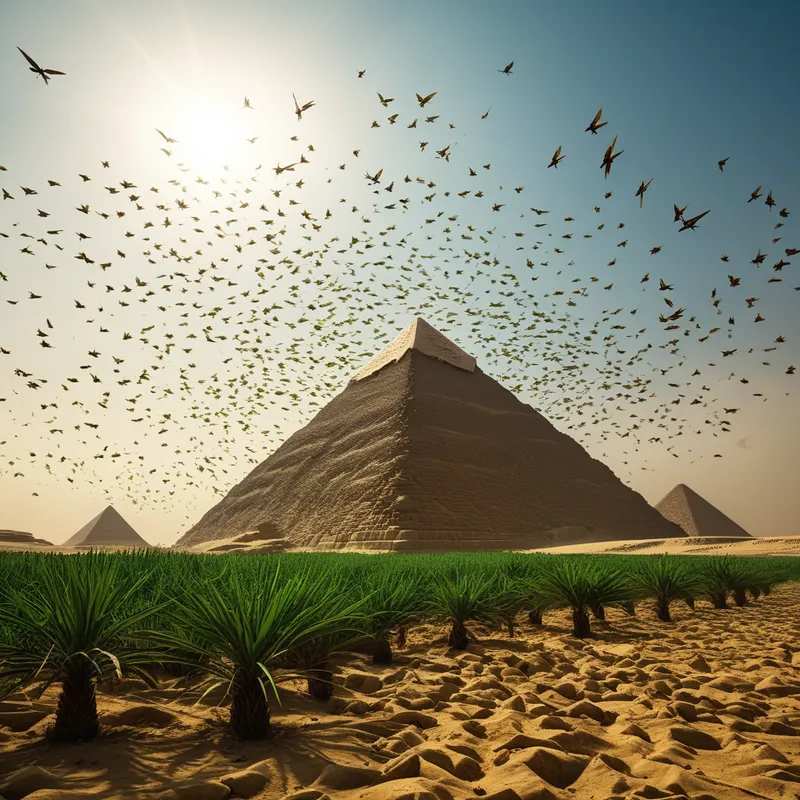
The next morning, the east wind began to blow. It was not a gentle breeze, but a sirocco, hot and relentless. And then, the horizon began to move. It was not a cloud, but a living, humming darkness. The swarm of locusts descended, a billion wings beating a single, deafening dirge. They did not fly; they possessed the sky, turning noon into a twilit nightmare. They settled upon the earth, a crawling, devouring blanket. Every leaf, every shoot, every piece of fruit that had survived the previous plagues—all that the hail had left—was consumed. Not a speck of green remained from the delta to the first cataract. The land, the Kemet, was stripped bare, a skeleton of branches against a blotted-out sun. Inside the houses, the sound was a constant, horrifying rustle-scrape as the creatures filled every space, a tangible curse in every corner.
In the palace, surrounded by stone but unable to shut out the sound or the sight of his kingdom being eaten alive, Pharaoh’s resolve crumbled. He called urgently for Moses and Aaron. “I have sinned against your God, and against you,” he confessed, the words of a broken king, not a living god. “Now therefore, forgive my sin, I pray you, only this once, and plead with your God to remove this death from me.”
Moses went out from the city and stretched his hands to a sky he could not see. And the wind shifted. A mighty west wind, sweeping in from the sea, caught the immense swarm and hurled it into the Yam Suph, where not a single locust remained in all of Egypt. But as the sun shone once more on the stripped and barren land, and the terrible silence replaced the humming, Pharaoh looked upon the devastation. And his heart, once more, grew hard. He did not let the people go.
Cultural Origins & Context
This narrative is embedded in the foundational epic of the Israelites, the Book of Exodus. It functioned as sacred history, a theological and national origin story recited during festivals like Passover to cement communal identity. It was not merely a record of events but a polemic and a proclamation: a demonstration of the supreme power of Yahweh over the gods of Egypt—in this case, a direct challenge to Apis and to Pharaoh himself, the guarantor of Egypt’s agricultural fertility and cosmic order (Ma’at). The locust, a known and feared natural phenomenon in the Ancient Near East, is transformed into a precise instrument of divine will. The story’s structure—the warning, the hardened heart, the devastating plague, the temporary remorse, and the final recalcification—is a rhythmic, liturgical pattern. It served to explain the severity of the struggle for freedom and to justify the totality of the victory, framing the entire conflict as a cosmic courtroom where the gods of empire are judged and found wanting.
Symbolic Architecture
The Eighth Plague operates on multiple symbolic levels. The locusts represent total consumption. They are the embodied consequence of a system—be it psychological, political, or spiritual—that has exhausted its grace, that has consumed all goodwill and left only the bare, inedible structures of pride and control.
The swarm is the shadow of possession itself, devouring not just crops, but the very future, the hope of regeneration.
Pharaoh’s heart is the central symbol. In Egyptian thought, the heart (Ib) was the seat of intelligence and moral character, weighed against the feather of Ma’at in the afterlife. To have a heart “hardened” is to have it become inert, incapable of the discernment and compassion necessary for true rule. It is the ultimate spiritual pathology: the inability to change, even in the face of utter ruin. The plague is not an arbitrary punishment, but the external, ecological mirror of an internal, psychic state. The land is stripped as bare as Pharaoh’s humanity.
The east wind that brings the swarm and the west wind that removes it frame the plague as a force of nature harnessed to divine purpose, emphasizing that the natural world itself participates in this moral drama. The locusts leave nothing, creating a scorched earth within the soul, a necessary void that must precede any true exodus.
The Dreamer’s Resonance
To dream of a locust swarm today is to encounter the psyche’s signal of an all-consuming pattern. It rarely speaks of a single event, but of a process. The dreamer may feel a situation, a relationship, or an internal habit (like anxiety or resentment) is devouring all their psychic “green shoots”—their creativity, their peace, their future plans. The somatic feeling is one of being overwhelmed, of a humming, inescapable dread that fills all space.
This dream pattern suggests the individual is at the “eighth plague” stage of a cycle. The earlier, perhaps subtler, warnings (the “blood” of emotional life fouled, the “frogs” of intrusive thoughts) have been ignored. The swarm is the psyche’s last, most dramatic attempt to break a hardened pattern of behavior or belief. It announces: What you are clinging to is now consuming you. All that remains is the bare structure. You must let go, or be stripped completely. The dream may evoke a profound sense of regret or a desperate plea for relief (Pharaoh’s momentary repentance), followed upon waking by the fear of returning to the old, barren pattern.

Alchemical Translation
The alchemical journey of individuation requires a nigredo—a blackening, a dissolution of the old, rigid personality structure (the Persona and the stubborn, ruling complexes). The Eighth Plague is a mythic map for this brutal but necessary phase.
The swarm performs the psychic function of the massa confusa, the chaotic, devouring mixture that reduces everything to a uniform, base state from which new life can eventually grow.
Pharaoh represents the tyrannical, ruling complex within—the ego that identifies itself as absolute ruler, refusing the demands of the deeper Self (symbolized by Yahweh’s command to “let my people go”). This complex believes it possesses the inner life (the Israelites as slave labor). The plagues are the Self’s escalating interventions. The locusts symbolize the point where the ego’s resources are utterly consumed. Its projects, its defenses, its “fruit” are gone. It faces the absolute void of its own making.
The alchemical work for the modern individual is to recognize the swarm not as an external punishment, but as the logical end of an unyielding stance. The goal is not to replicate Pharaoh’ cycle of temporary remorse and re-hardening, but to allow the consumption to complete its work. One must let the west wind of a changed attitude carry the devouring pattern away. This means surrendering the claim to absolute control, acknowledging the sin against the Self, and finally consenting to the exodus—the journey of the whole psyche, young and old, into the wilderness of transformation. The barren land left behind is not a curse, but the clean slate, the tabula rasa, required for the planting of a new and more authentic life.
Associated Symbols
Explore related symbols from the CaleaDream lexicon: