The Eightfold Path Myth Meaning & Symbolism
A mythic map of awakening, charting the path from ignorance to liberation through eight interdependent principles of wisdom, ethics, and mental discipline.
The Tale of The Eightfold Path
In the deep, velvet dark before [the world](/myths/the-world “Myth from Tarot culture.”/)’s remembering, a prince walked away from a palace of [jasmine](/myths/jasmine “Myth from Persian culture.”/)-scented stone. His name was Siddhartha, and he carried a question like a hidden wound, a splinter of moonlight in the heart of the sun. He had seen the world’s face—the trembling age of the elder, the raw cry of birth, the silent retreat of sickness, the cold, final stillness of death—and the question burned: Is this all there is?
For years, he wandered the dust-choked roads of [the Ganges](/myths/the-ganges “Myth from Hindu culture.”/) plain, a ghost among the living. He sat at the feet of masters who spoke of heavens and hells, of breath drawn so thin it could slip between atoms. He became a skeleton wrapped in skin, practicing austerities so severe the very earth seemed to pity him. Yet the question remained, a dull, persistent ache beneath the ribs. The answers offered were like beautiful cages; they described the prison but would not break the lock.
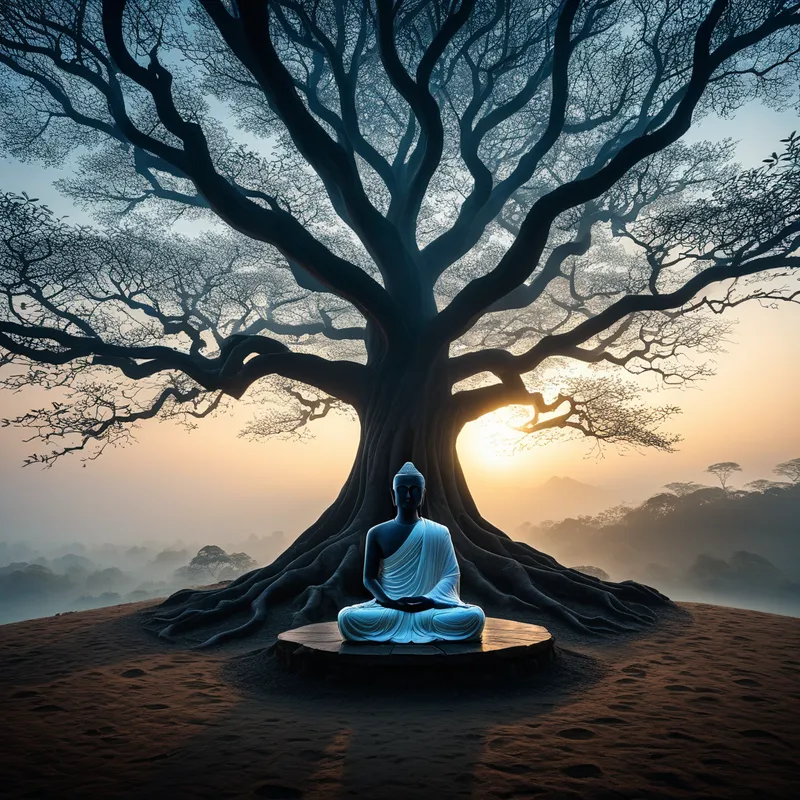
Exhausted, hollowed out, he came to the bank of the Nairañjanā River. His body, a ruin of discipline, collapsed beneath a Bodhi tree whose roots drank from the deep waters of time. Here, he did not seek an answer from outside. He turned the gaze inward, into the storm of his own being. Mara, the great tempter, the embodiment of doubt, fear, and desire, rose before him. He conjured armies of demons whose weapons were whispers of failure. He sent his daughters, whose forms were every longing Siddhartha had ever renounced. “Claim your throne,” Mara hissed. “Your quest is vanity. Your body will fail. What will you have then?”
Siddhartha did not fight. He did not flee. He simply reached down and touched [the earth](/myths/the-earth “Myth from Hindu culture.”/). The ground itself became his witness. “This earth,” his gesture said, “has borne me through countless lives. It knows my striving.” And the earth roared. Mara’s illusions shattered like glass.
In the profound silence that followed, the prince gazed into the ceaseless wheel of becoming. He saw, with unbearable clarity, the chain of cause and effect—[Pratītyasamutpāda](/myths/prattyasamutpda “Myth from Buddhist culture.”/)—that bound all life to suffering. He saw the truth of suffering, its cause, its cessation, and [the way](/myths/the-way “Myth from Taoist culture.”/) leading to that cessation. And in that seeing, the path itself was revealed. It was not a single road, but eight interwoven strands, a living [mandala](/myths/mandala “Myth from Buddhist culture.”/) of understanding, intention, speech, action, livelihood, effort, mindfulness, and concentration. It was a middle way, found not in the palace of indulgence nor the forest of self-torture, but in the very heart of a fully human life, fully awake. As [the morning star](/myths/the-morning-star “Myth from Astrological culture.”/) pierced [the horizon](/myths/the-horizon “Myth from Various culture.”/), Siddhartha was no more. The Buddha had arisen. The path was open.

Cultural Origins & Context
This is not a myth of gods on mountaintops, but a human discovery narrative, rooted in the historical figure of [Siddhartha Gautama](/myths/siddhartha-gautama “Myth from Buddhist culture.”/) in the 5th-6th century BCE in the northeastern Indian subcontinent. The cultural soil was rich with the philosophies of the Vedas and [the ascetic](/myths/the-ascetic “Myth from Christian culture.”/) practices of the Śramaṇa movements, all grappling with the nature of existence, [karma](/myths/karma “Myth from Hindu culture.”/), and liberation ([Moksha](/myths/moksha “Myth from Hindu culture.”/)).
The myth of the path was first articulated in [the Buddha](/myths/the-buddha “Myth from Buddhist culture.”/)’s inaugural sermon, the Dhammacakkappavattana Sutta (“Setting the Wheel of Dhamma in Motion”), delivered to his five former ascetic companions in the Deer Park at Sarnath. It was passed down orally for centuries within the monastic [Sangha](/myths/sangha “Myth from Buddhist culture.”/) before being committed to text in the Sutta Piṭaka. Its societal function was revolutionary: it democratized the pursuit of the ultimate goal. Liberation was not reserved for priests or hermits but was presented as a practical, systematic discipline accessible to anyone—monk, merchant, or king—who was willing to walk it. It provided a coherent ethical and psychological framework for a society in flux, a map out of existential despair.
Symbolic Architecture
The Eightfold [Path](/symbols/path “Symbol: The ‘path’ symbolizes a journey, choices, and the direction one’s life is taking, often representing individual growth and exploration.”/) is a profound [symbol](/symbols/symbol “Symbol: A symbol can represent an idea, concept, or belief, serving as a powerful tool for communication and understanding.”/) of integrated transformation. It is not a [linear](/symbols/linear “Symbol: Represents order, predictability, and a direct, step-by-step progression. It symbolizes a clear path from cause to effect.”/) [staircase](/symbols/staircase “Symbol: A staircase in dreams symbolizes progression, personal growth, and the journey towards achieving one’s goals.”/) but a dynamic, threefold spiral of wisdom (Paññā), ethical conduct (Sīla), and mental discipline (Samādhi). Each fold supports and deepens the others.
The path is not a road one walks upon, but a loom on which one weaves the very fabric of a liberated consciousness.
Psychologically, the “Right View” represents the heroic act of seeing [reality](/symbols/reality “Symbol: Reality signifies the state of existence and perception, often reflecting one’s understanding of truth and life experiences.”/) as it is, without the filters of our personal mythologies and wishful thinking. “Right [Intention](/symbols/intention “Symbol: Intention represents the clarity of purpose and direction in one’s life and can symbolize motivation and commitment within a dream context.”/)” is the alignment of our deepest psychic [energy](/symbols/energy “Symbol: Energy symbolizes vitality, motivation, and the drive that fuels actions and ambitions.”/)—away from craving, ill-will, and harm, and toward renunciation, goodwill, and harmlessness. The ethical [triad](/symbols/triad “Symbol: A grouping of three representing spiritual unity, divine completeness, and cosmic balance across many traditions.”/) of Speech, [Action](/symbols/action “Symbol: Action in dreams represents the drive for agency, motivation, and the ability to take control of situations in waking life.”/), and Livelihood forms the container, the necessary [structure](/symbols/structure “Symbol: Structure in dreams often symbolizes stability, organization, and the framework of one’s life, reflecting how one perceives their environment and personal life.”/) without which the inner work collapses into self-deception. “Right [Effort](/symbols/effort “Symbol: Effort signifies the physical, mental, and emotional energy invested toward achieving goals and personal growth.”/)” is the sustained psychic [energy](/symbols/energy “Symbol: Energy symbolizes vitality, motivation, and the drive that fuels actions and ambitions.”/) required to hold the [tension](/symbols/tension “Symbol: A state of mental or emotional strain, often manifesting physically as tightness, pressure, or unease, signaling unresolved conflict or anticipation.”/) between our unconscious patterns and our conscious aims. “Right Mindfulness” and “Right Concentration” are the twin pillars of deep introspection, the tools for observing the contents of the [psyche](/myths/psyche “Myth from Greek culture.”/) without identification, culminating in the unified, luminous state of Jhāna.
The [hero](/symbols/hero “Symbol: A hero embodies strength, courage, and the ability to overcome significant challenges.”/) of this myth is [consciousness](/symbols/consciousness “Symbol: Consciousness represents the state of awareness and perception, encompassing thoughts, feelings, and experiences.”/) itself, and the adversary is the automated, conditioned mind—Mara. The [triumph](/myths/triumph “Myth from Roman culture.”/) is not over an external foe, but over the internal compulsion to be enslaved by one’s own reactions.
The Dreamer’s Resonance
When this myth stirs in the modern dreamer, it often manifests not as eight clear steps, but as a profound somatic and psychological process of re-orientation. One might dream of being lost in a complex, bureaucratic building (the maze of samsaric existence) and suddenly finding a simple, elegant diagram or key that makes sense of all the corridors. One might dream of trying to tune a radio or musical instrument, struggling with static and discord, until a precise, eight-point adjustment brings everything into perfect, harmonious resonance.
These dreams signal a psyche reaching a point of integrative capacity. The somatic feeling is often one of relief and rightness, a deep sigh of the soul. It indicates the dreamer is psychologically ready to move from a state of fragmented, reactive living—where thoughts, feelings, and actions are at war—toward a state of inner coherence. The conflict in the dream is the friction of the old, disjointed self; the resolution is the emergent pattern of a self that is aligned, intentional, and whole.

Alchemical Translation
For the modern individual navigating the chaos of the inner world, the Eightfold Path is a precise alchemical formula for psychic transmutation, a guide for the individuation process.
The alchemy begins with the [nigredo](/myths/nigredo “Myth from Alchemical culture.”/), the blackening: “Right View.” This is the brutal, necessary work of shadow integration—seeing the full truth of one’s own suffering, one’s complicity in it, and the unconscious drives that fuel it. From this dark soil grows the albedo, the whitening: the ethical triad. This is the creation of the vas, the purified vessel of the personality. One must stop leaking psychic energy through harmful speech, action, and livelihood to have a stable container for the heat of transformation.
The path transmutes the lead of conditioned reaction into the gold of conscious response. Each ‘Right’ is a turn of the alembic, distilling raw experience into wisdom.
The citrinitas, the yellowing, is the application of “Right Effort” and “Mindfulness”—the sustained, mindful heat of observation that separates the essential from the non-essential in the psyche. Finally, the [rubedo](/myths/rubedo “Myth from Alchemical culture.”/), the reddening, is “Right Concentration”: the fusion of all elements into a new, enduring substance—the integrated Self. The “middle way” is the alchemical conjunctio, [the sacred marriage](/myths/the-sacred-marriage “Myth from Various culture.”/) of opposites within the psyche: intellect and intuition, discipline and compassion, humanity and transcendence. One does not escape the world but learns to hold it, and oneself, in a fully awake, compassionate, and liberated embrace. The path’s end is not elsewhere, but here, in a consciousness that has become its own sanctuary.
Associated Symbols
Explore related symbols from the CaleaDream lexicon: