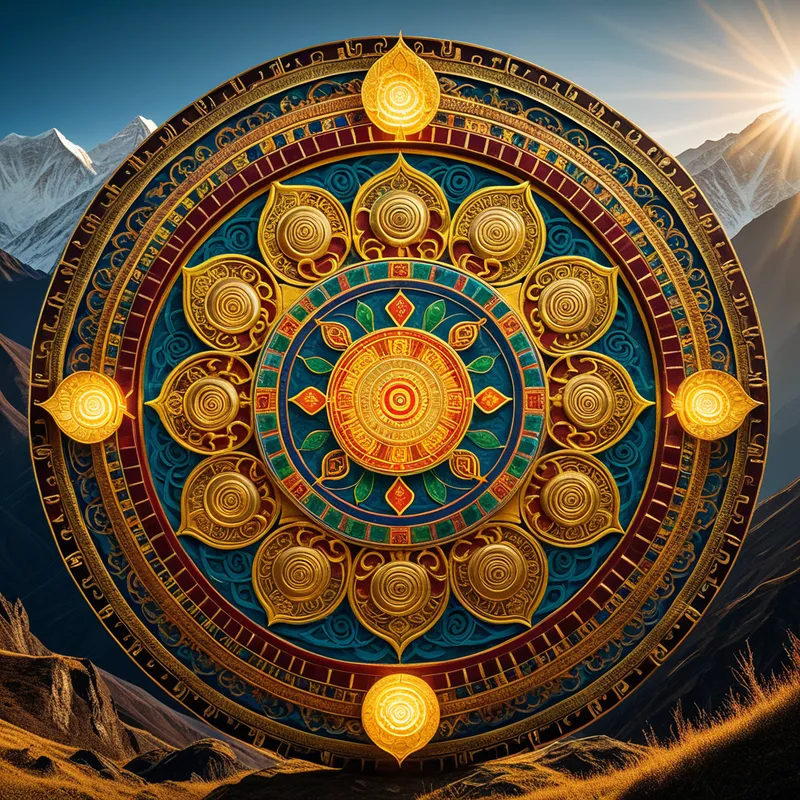
The Eight Auspicious Symbols Myth Meaning & Symbolism
A sacred offering from celestial beings to the Buddha, these eight symbols map the path from worldly suffering to enlightened awakening.
The Tale of The Eight Auspicious Symbols
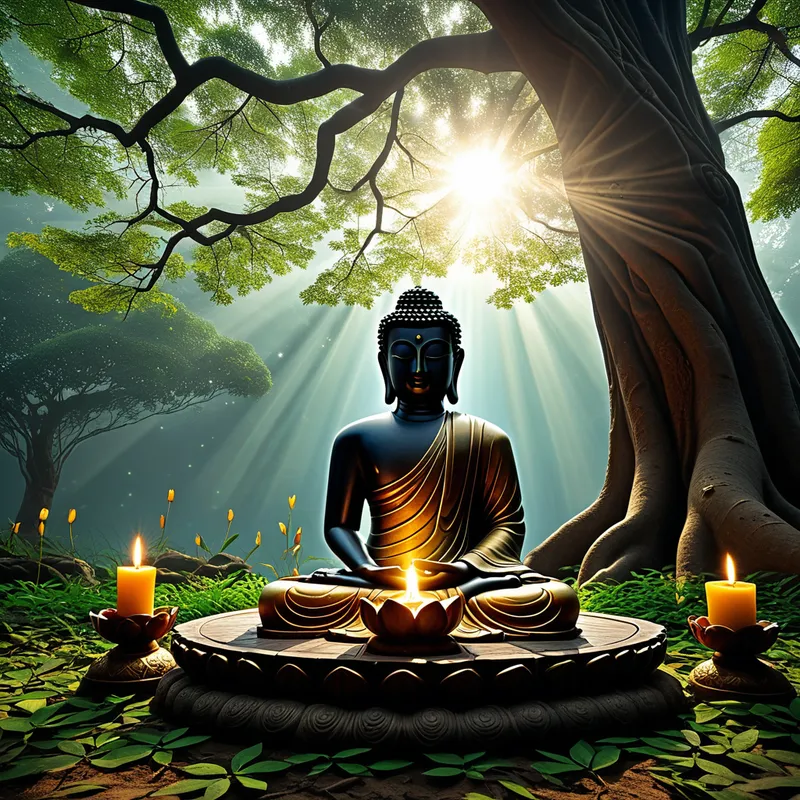
Listen, and let the winds of the high plateau carry you back. Before the great Lamas walked the earth, before the monasteries clung to the cliffs like eagles’ nests, the world trembled on the cusp of a great turning. Under the spreading branches of the Bodhi Tree, a prince sat in unmoving resolve. Shakyamuni had faced the armies of the demon Mara, had withstood storms of desire and fear, and now touched the very fabric of reality.
As the final veils of ignorance parted, a profound silence descended, deeper than any mountain lake. It was a silence so complete it became a song, vibrating through the realms. And the heavens heard it. From the pure lands of the Devas, and from the serpent-kings in their jeweled palaces beneath the earth, great beings stirred. They perceived the immeasurable light of awakening breaking upon the world and were moved to make an offering, not of ordinary things, but of the very principles of auspiciousness.
First came the Kinnara, beings of music, bearing a treasure. It was not gold, but a Endless Knot, a labyrinth of interwoven lines with no beginning and no end, a symbol of the Buddha’s infinite wisdom and the interconnected nature of all phenomena. Then, the great White Elephant of the skies approached, its trunk gently cradling a radiant, multi-petaled Lotus, unsullied by the mud from which it grew.
The Dharmapalas offered a Victory Banner, its silken streamers catching a wind that did not blow, proclaiming the conquest of the mind’s darkest corners. From the hands of a serene Dakini appeared two shimmering Golden Fish, swimming in unison, representing the fearlessness and joy of beings liberated from the ocean of suffering.
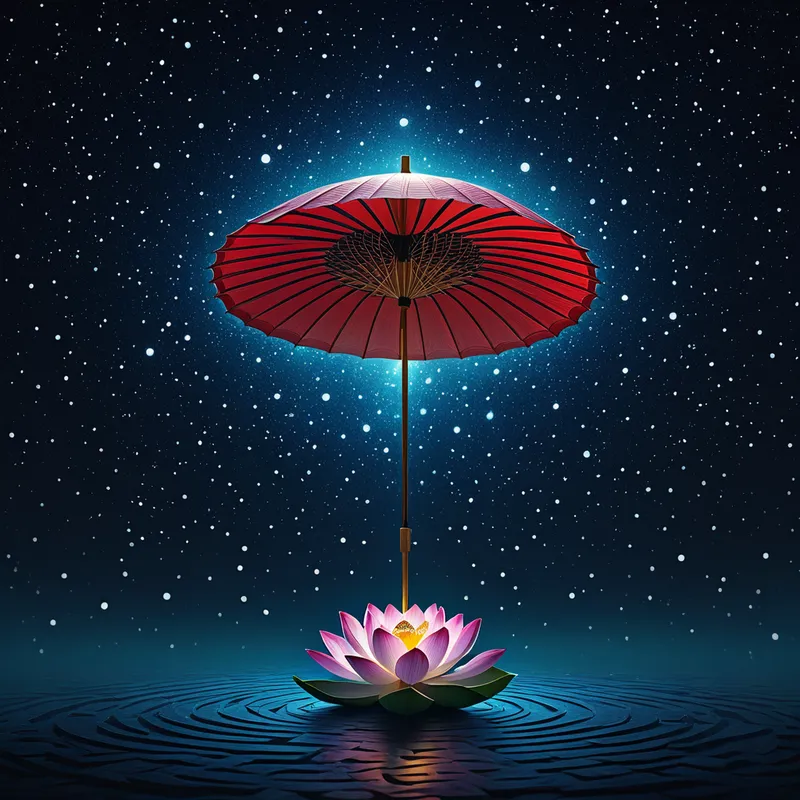
A celestial monarch unfurled a magnificent, jeweled Parasol, its canopy offering shade from the heat of afflictions. A wise Snow Lion roared softly, presenting a pristine, spiraling Conch Shell, whose right-turning spiral echoed the true Dharma. Next, a vessel of exquisite form was placed upon the earth—the Treasure Vase, brimming with the nectar of immortality and endless riches of the spirit.
Finally, as the first light of the new aeon touched the Buddha’s brow, the great Indra himself descended. In his hand was not a weapon, but the Wheel of Dharma, its eight spokes sharp and true, ready to be set in motion to churn the suffering of the world into wisdom. The eight offerings lay before the Awakened One, a silent testament from all realms. He did not need them, for he possessed the reality they pointed to. Yet, for the sake of all beings still wandering in the dark, he accepted them, allowing these symbols to become a map, a promise, and a guide for the long journey home.
Cultural Origins & Context
The myth of the Eight Auspicious Symbols, or Ashtamangala, is woven deeply into the fabric of Himalayan spiritual life. While their iconography appears across Buddhist Asia, their narrative integration as a celestial offering to the Buddha finds particular resonance in Tibetan culture. This was not a myth confined to a single epic but a living symbolic language transmitted through sacred art, ritual, and oral teaching.
Lamas and monastics would explain these symbols during initiations and public teachings, using them as mnemonic devices to encode complex philosophical tenets. They were painted on temple walls, woven into ceremonial thangkas, stamped into prayer flags, and etched onto ritual objects. In a society where literacy was specialized, these eight emblems served as a universal scripture, visible to all. Their societal function was multifaceted: they were invoked for protection and good fortune in daily life, used to consecrate spaces, and, most importantly, they served as a profound pedagogical tool, embedding the entire path to enlightenment in a set of recognizable, auspicious forms.
Symbolic Architecture
The power of the myth lies not in a [linear](/symbols/linear “Symbol: Represents order, predictability, and a direct, step-by-step progression. It symbolizes a clear path from cause to effect.”/) [plot](/symbols/plot “Symbol: A plot symbolizes the unfolding of a story, representing personal narratives and life direction.”/) but in the collective symbolic [weight](/symbols/weight “Symbol: Weight symbolizes burdens, responsibilities, and emotional loads one carries in life.”/) of the offering. Each object is a crystallized teaching, an archetypal form pointing to a facet of enlightened mind and the [path](/symbols/path “Symbol: The ‘path’ symbolizes a journey, choices, and the direction one’s life is taking, often representing individual growth and exploration.”/) to achieve it.
The symbols are not mere objects, but the anatomy of awakening itself—a skeleton key to the palace of wisdom.
The Parasol symbolizes the compassionate protection of the Dharma, offering shade from the heat of neurosis and harm. The Golden Fish, often shown as a pair, represent the fearlessness and happiness of beings swimming freely in the Dharma’s waters, and the unity of method and wisdom. The [Treasure](/symbols/treasure “Symbol: A hidden or valuable object representing spiritual wealth, inner potential, or divine reward.”/) [Vase](/symbols/vase “Symbol: A vase represents containment, beauty, and preservation, often symbolizing the nurturing of emotions or ideas.”/) signifies the inexhaustible spiritual riches and accomplishments of the [Buddha](/symbols/buddha “Symbol: The image of Buddha embodies spiritual enlightenment, peace, and a quest for inner truth.”/), the fulfillment of both mundane and supreme wishes.
The Lotus is the quintessential [symbol](/symbols/symbol “Symbol: A symbol can represent an idea, concept, or belief, serving as a powerful tool for communication and understanding.”/) of pristine awakening emerging unstained from the mud of samsara. The Conch [Shell](/symbols/shell “Symbol: Shells are often seen as symbols of protection, transition, and the journey of personal growth.”/), with its right-turning spiral, proclaims the far-reaching, melodious sound of the Buddha’s teachings, awakening beings from ignorance. The Endless [Knot](/symbols/knot “Symbol: A knot symbolizes connections, commitments, complications, and the binding or untying of relationships and situations.”/) is a visual [metaphor](/symbols/metaphor “Symbol: A figure of speech where one thing represents another, often revealing hidden connections and deeper truths through symbolic comparison.”/) for the infinite wisdom of the Buddha and the interdependent, interwoven [nature](/symbols/nature “Symbol: Nature symbolizes growth, connectivity, and the primal forces of existence.”/) of all [reality](/symbols/reality “Symbol: Reality signifies the state of existence and perception, often reflecting one’s understanding of truth and life experiences.”/).
The Victory Banner celebrates the triumph of the Buddha’s wisdom over all maras, or obstacles, especially the four maras of [death](/symbols/death “Symbol: Symbolizes transformation, endings, and new beginnings; often associated with fear of the unknown.”/), disturbance, pride, and [passion](/symbols/passion “Symbol: Intense emotional or physical desire, often linked to love, creativity, or purpose. Represents life force and deep engagement.”/). Finally, the Wheel of Dharma represents the Buddha’s first teaching on the Four Noble Truths and the Noble Eightfold Path—the very [mechanism](/symbols/mechanism “Symbol: Represents the body’s internal systems, emotional regulation, or psychological processes working together like a machine.”/) for liberation. Psychologically, the set represents the complete toolkit for the mind’s transformation: protection (Parasol), joy and freedom (Fish), inner [wealth](/symbols/wealth “Symbol: Wealth in dreams often represents abundance, security, or inner resources, but can also symbolize burdens, anxieties, or moral/spiritual values.”/) (Vase), purity of essence (Lotus), the call to awakening (Conch), the understanding of interconnectedness (Knot), the confidence of victory over neurosis (Banner), and the structured path forward (Wheel).
The Dreamer’s Resonance
When the Eight Auspicious Symbols appear in a modern dream, they rarely arrive as a complete, labeled set from a museum. Instead, their essence permeates the dreamscape. One might dream of a complex, mesmerizing knot they cannot untie, representing the dreamer’s grappling with the interconnected nature of their life choices and relationships. A radiant, unearthly flower blooming in a polluted urban gutter embodies the Lotus, signaling the dreamer’s own potential for purity and beauty emerging from a difficult or “muddy” psychological situation.
A dream of a spiraling shell emitting a silent, compelling vibration speaks to the Conch Shell—an inner call to heed one’s own deeper wisdom or vocation. Finding a simple, sturdy wheel that turns with perfect ease could mirror the Wheel of Dharma, indicating the dreamer is discovering or needs to discover a coherent, functional philosophy or “path” to navigate their life. These dreams suggest a somatic and psychological process of integration. The psyche is assembling its own “auspicious symbols”—internal resources, protective structures, and guiding principles—as it moves toward greater wholeness and conscious order amidst chaos.
Alchemical Translation
The myth models the alchemical process of psychic transmutation, or Jungian individuation, with elegant precision. The initial state is the “mud” of the unconscious, the undifferentiated and often troubled psyche (the world before the Buddha’s awakening). The catalyst is the moment of profound insight or self-confrontation (the Buddha’s victory under the Bodhi tree).
The offering of the symbols is the psyche’s own response to a moment of clarity—it generates the internal archetypal forms necessary to sustain and structure the new consciousness.
The Parasol becomes the necessary psychological boundary and self-care that protects the nascent, vulnerable self-awareness. The Golden Fish represent the rediscovery of joy and fluidity in the psychic waters. The Treasure Vase is the inner sense of value and soul-wealth that replaces material or external validation. The Lotus is the emergence of the true Self, the central archetype of wholeness, from the personal unconscious.
The Conch Shell is the inner voice of the Self, the call to remain true to one’s unique path. The Endless Knot symbolizes the integration of the conscious and unconscious, the realization of the complex, interconnected web of one’s own psyche. The Victory Banner is the triumph over inner demons—the persistent complexes, fears, and outdated identities. Finally, the Wheel of Dharma is the establishment of a new, conscious ordering principle for the personality—a self-created ethic and worldview that brings lasting movement and purpose. The individual does not receive these from external gods but, like the Buddha, recognizes them as the innate, auspicious architecture of their own completed psyche.
Associated Symbols
Explore related symbols from the CaleaDream lexicon:
- Lotus — The central symbol of purity and spiritual emergence, directly corresponding to the Lotus of the Eight Auspicious Symbols, representing the soul’s birth into clarity from murky depths.
- Wheel — The core symbol of cosmic order and cyclical motion, mirroring the Dharma Wheel, which sets the structured path of teachings and ethical living into motion.
- Knot — A symbol of intricate connection and binding fate, reflecting the Endless Knot’s representation of the infinite interweaving of all causes, conditions, and wisdom.
- Fish — A symbol of intuition, depth, and the unconscious, paralleling the Golden Fish’s representation of fearlessness and joy in navigating the waters of existence.
- Vase — A symbol of containment, potential, and the sacred vessel, echoing the Treasure Vase’s promise of inexhaustible spiritual and psychological abundance.
- Conch — A symbol of call, announcement, and sacred sound, representing the far-reaching proclamation of truth and the call to awakening embodied by the White Conch Shell.
- Banner — A symbol of declaration, identity, and triumph, corresponding to the Victory Banner’s celebration of the conquest of inner ignorance and obstacles.
- Parasol — A symbol of shelter, authority, and sacred space, reflecting the protective and dignifying function of the jeweled Parasol over the spiritual journey.
- Mountain — A symbol of unwavering stability, aspiration, and spiritual abode, representing the grounded, enduring context of the Himalayan culture from which this symbolic set emanates.
- Light — The ultimate symbol of wisdom, consciousness, and revelation, which is the essential quality that the Eight Auspicious Symbols collectively reflect and guide one toward.
- Journey — The core narrative of spiritual seeking and transformation, for which the Eight Symbols serve as both map and provisions on the path from suffering to awakening.
- Temple — A symbol of sacred architecture and inner sanctum, reflecting how the Eight Symbols are used to consecrate space and structure the inner landscape of the mind.