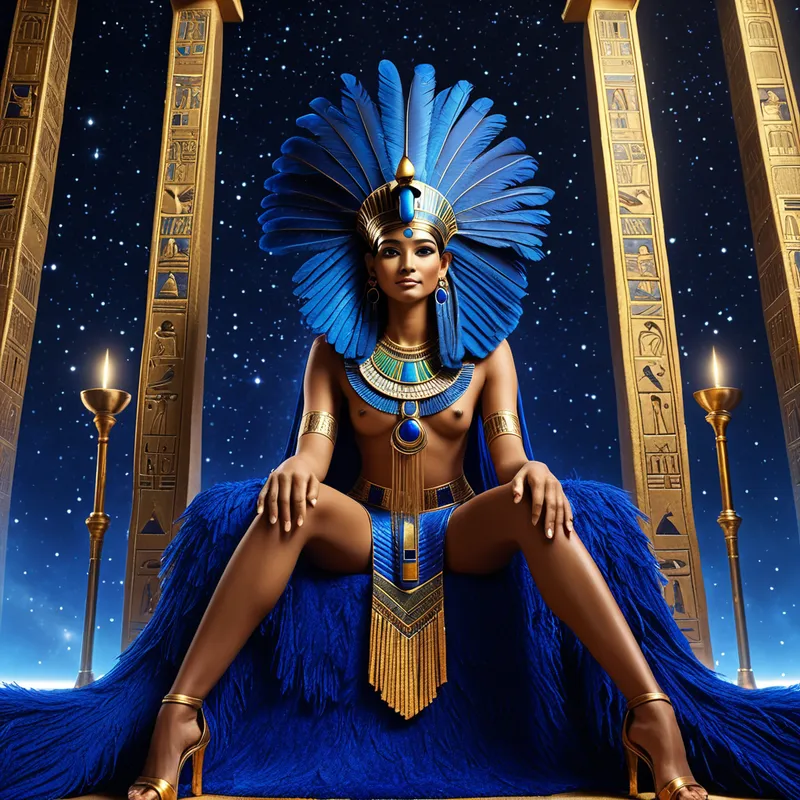
The Egyptian goddess Ma'at Myth Meaning & Symbolism
The goddess Ma'at embodies cosmic order and truth, weighing hearts against her feather in the afterlife to judge the harmony of a soul.
The Tale of The Egyptian goddess Ma’at
Before the first word was spoken, before the first king raised a city from the mud of the Nile, there was a silence. And in that silence, a principle was born—not with a [thunderclap](/myths/thunderclap “Myth from Various culture.”/), but with the gentle settling of dust upon a scale. They called her [Ma’at](/myths/maat “Myth from Egyptian culture.”/).
She was there when the sun god Ra first pushed his barque across [the sky](/myths/the-sky “Myth from Persian culture.”/), bringing light to the primordial waters of Nun. Where his light fell, Ma’at followed, a subtle force weaving harmony from chaos. She was the rhythm in [the river](/myths/the-river “Myth from Buddhist culture.”/)‘s flood and retreat, the predictable path of the stars, the turn of the seasons that brought barley from [the earth](/myths/the-earth “Myth from Hindu culture.”/). She was the daughter of Ra himself, and her breath was [the law](/myths/the-law “Myth from Biblical culture.”/) of the cosmos.
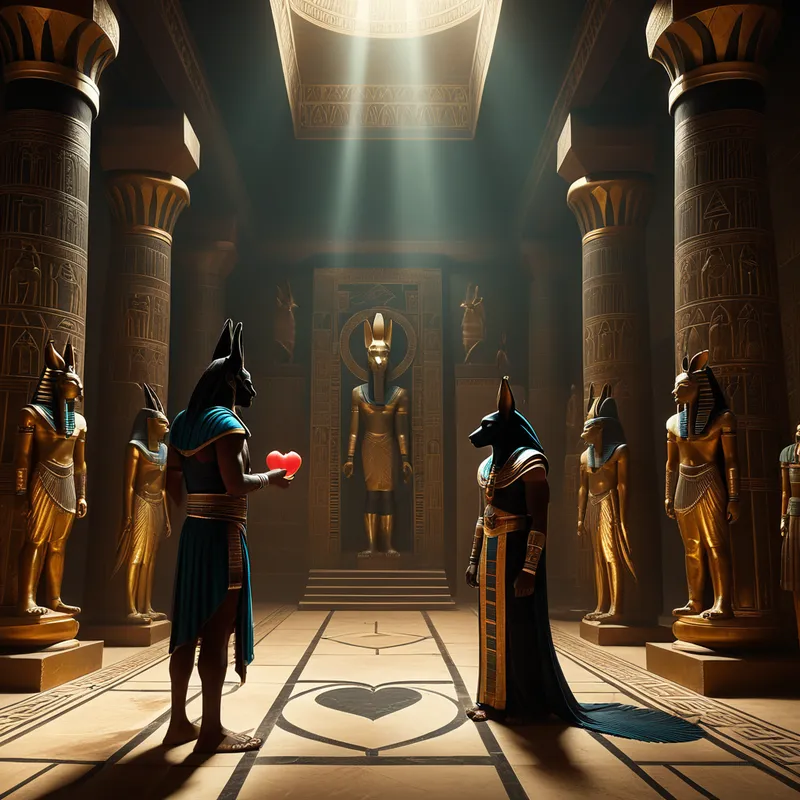
But her true domain was the heart. For in the silent, breathless halls of Duat, beyond the western horizon where the sun died each night, a profound and terrible ceremony unfolded for every soul. The newly deceased, a shimmering ba, would be led by the jackal-headed Anubis into the Hall of Two Truths. The air was thick with incense and the weight of eternity.
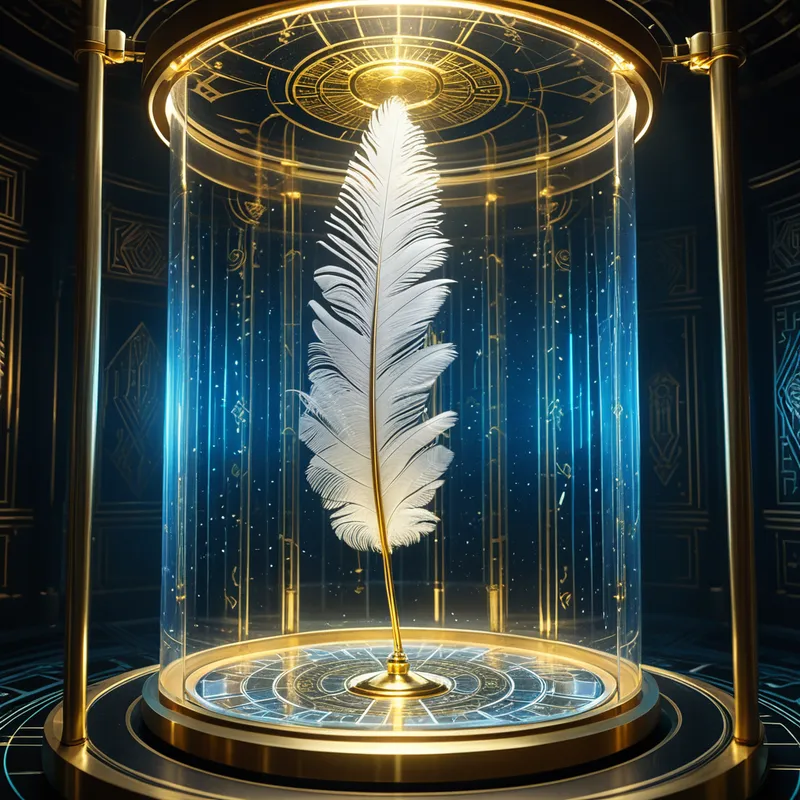
At the hall’s center stood the scales. On one golden plate, Anubis would place [the feather of Ma’at](/myths/the-feather-of-maat “Myth from Egyptian culture.”/)—a single, perfect ostrich plume, light as a thought, heavy as a mountain. On the other plate, he placed the heart of the deceased. The heart, the seat of memory and desire, of love and rage. The scribe god [Thoth](/myths/thoth “Myth from Global/Universal culture.”/) stood ready, stylus poised over a [papyrus](/myths/papyrus “Myth from Egyptian culture.”/) scroll, his ibis head tilted in observation. And presiding over all was [Osiris](/myths/osiris “Myth from Global/Universal culture.”/), the resurrected king, green-skinned and still, his eyes holding the patience of the earth.
The crowd of gods watched, unblinking. The scales began to move. If the heart, burdened with lies, greed, or violence, sank lower than the feather, the monstrous beast Ammit waited, jaws agape. Oblivion. But if the heart was as light as the feather—if it was free from the weight of falsehood and disorder—Thoth would declare, “True of voice!” The soul was granted passage to [the Field of Reeds](/myths/the-field-of-reeds “Myth from Egyptian culture.”/), a perfected reflection of life in eternal harmony.
This was the tale whispered by priests and etched in tombs: that the universe itself hung in the balance, and every human life was its own measure of truth.
Cultural Origins & Context
The principle of Ma’at was not merely a story for the afterlife; it was the foundational bedrock of ancient Egyptian civilization for over three millennia. Unlike myths of dramatic battles, Ma’at was a pervasive, lived reality. Her concept was passed down through sacred texts like the [Pyramid Texts](/myths/pyramid-texts “Myth from Egyptian culture.”/), Coffin Texts, and most famously, the Book of the Dead, which provided the spells and knowledge to navigate [the weighing of the heart](/myths/the-weighing-of-the-heart “Myth from Egyptian culture.”/).
Pharaohs were not just political rulers; they were the “Lord of Ma’at,” personally responsible for upholding her order (ma’at) against the ever-present threat of chaos (isfet). This was enacted through just laws, proper rituals, and maintaining the balance between humanity and the gods. The myth functioned as the ultimate social and ethical contract: cosmic order depended on personal integrity. It taught that truth was not a private virtue but a cosmic necessity, binding the individual, the state, and the gods in a single, delicate ecosystem of harmony.
Symbolic Architecture
Ma’at represents the archetypal principle of Objective Order. She is not a personal, capricious deity but the embodiment of an impersonal, foundational [truth](/symbols/truth “Symbol: Truth represents authenticity, honesty, and the quest for knowledge beyond mere appearances.”/). The [feather](/symbols/feather “Symbol: A feather represents spiritual elevation, lightness, and the freedom of the spirit. It often symbolizes messages from the divine and connection to ancient wisdom.”/) is her perfect [symbol](/symbols/symbol “Symbol: A symbol can represent an idea, concept, or belief, serving as a powerful tool for communication and understanding.”/): it is not weightless, but it has a precise, unalterable [weight](/symbols/weight “Symbol: Weight symbolizes burdens, responsibilities, and emotional loads one carries in life.”/). It is the standard against which all substance (the [heart](/symbols/heart “Symbol: The heart symbolizes love, emotion, and the core of one’s existence, representing deep connections with others and self.”/)) is measured.
The heart is the record of a life, but the feather is the law by which it is read. The struggle is not to be without weight, but to be aligned with the true weight of existence.
Psychologically, Ma’at symbolizes the superordinate function of [the Self](/myths/the-self “Myth from Jungian culture.”/) in individuation. The Hall of Two Truths is the inner tribunal of [consciousness](/symbols/consciousness “Symbol: Consciousness represents the state of awareness and perception, encompassing thoughts, feelings, and experiences.”/), where our actions, motives, and self-deceptions are weighed against the innate, often unconscious, standard of our own deepest integrity. Ammit represents the psychic [dissolution](/symbols/dissolution “Symbol: The process of breaking down, dispersing, or losing form, often representing transformation, release, or the end of a state of being.”/) that occurs when we are consumed by our own [shadow](/symbols/shadow “Symbol: The ‘shadow’ embodies the unconscious, repressed aspects of the self and often represents fears or hidden emotions.”/)—when our lives become so out of [harmony](/symbols/harmony “Symbol: A state of balance, agreement, and pleasing combination of elements, often associated with musical consonance and visual or social unity.”/) with our essential [nature](/symbols/nature “Symbol: Nature symbolizes growth, connectivity, and the primal forces of existence.”/) that the [psyche](/myths/psyche “Myth from Greek culture.”/) collapses into [chaos](/symbols/chaos “Symbol: In Arts & Music, chaos represents raw creative potential, uncontrolled expression, and the breakdown of order to forge new artistic forms.”/).
The Dreamer’s Resonance
When the motif of Ma’at surfaces in modern dreams, it rarely appears as an Egyptian goddess. Instead, the dreamer may experience being weighed—standing on a giant scale, or feeling an immense, invisible pressure assessing their worth. They may dream of losing something as light as a feather but of critical importance, or of a courtroom where they are the defendant, judge, and jury.
These dreams signal a profound somatic and psychological process of self-evaluation. The psyche is conducting its own “[weighing of the heart](/myths/weighing-of-the-heart “Myth from Egyptian culture.”/).” It is a time of life review, moral reckoning, or a deep intuition that one’s current path is out of alignment with one’s core values. The anxiety in the dream is the fear of being “found wanting,” of being consumed by the consequences of inauthenticity. The process, though often uncomfortable, is ultimately integrative, pushing the dreamer toward a more conscious and truthful relationship with themselves.
Alchemical Translation
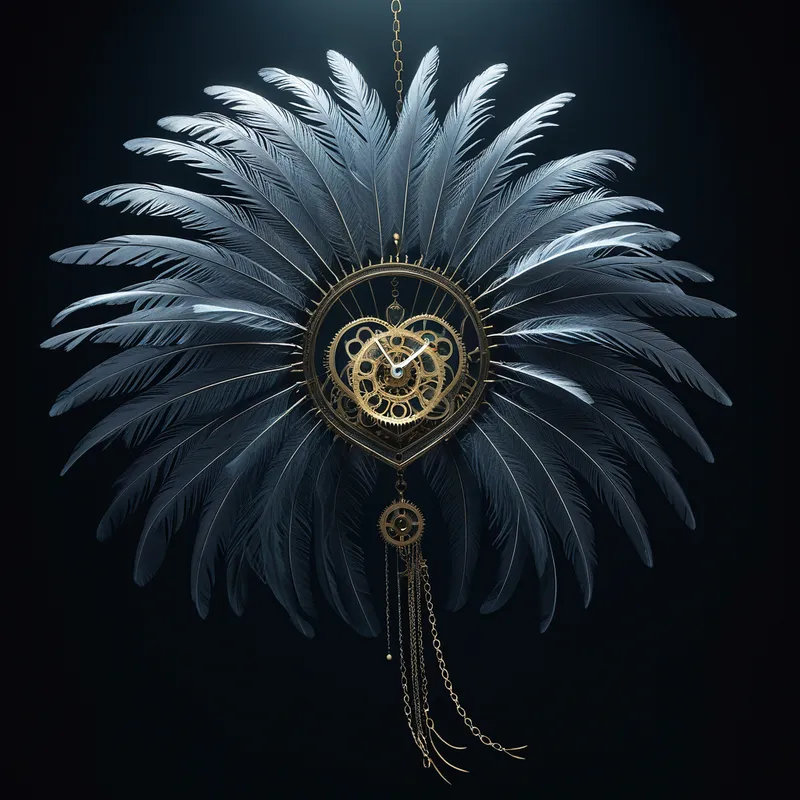
The alchemical journey modeled by the myth of Ma’at is the opus of discernment and integration. The base material is the leaden, confused heart—the personality burdened with complexes, societal expectations, and unexamined impulses (the chaos of isfet). The goal is not to annihilate the heart, but to refine it into gold, to make it “as light as the feather.”
This requires a ruthless, Anubis-like honesty in examining one’s motivations (the [psychopomp](/myths/psychopomp “Myth from Greek culture.”/) function that guides into the unconscious). It requires the observational precision of Thoth to accurately record what is found, without judgment but with clarity. The triumphant resolution is the moment of equilibrium, where the conscious ego (the heart) willingly submits to and aligns with the objective law of the Self (the feather).
Individuation is the process by which the personal heart learns to beat in rhythm with the impersonal feather. The goal is not perfection, but congruence.
For the modern individual, this translates to the courageous work of shadow integration—acknowledging the “heavier” aspects of oneself—and the conscious cultivation of integrity. It means building an inner life where one’s thoughts, words, and actions are in harmony. The “Field of Reeds” one reaches is not an external paradise, but a state of inner order where the psyche is no longer at war with itself, and one can act in [the world](/myths/the-world “Myth from Tarot culture.”/) from a place of authentic, balanced truth.
Associated Symbols
Explore related symbols from the CaleaDream lexicon: