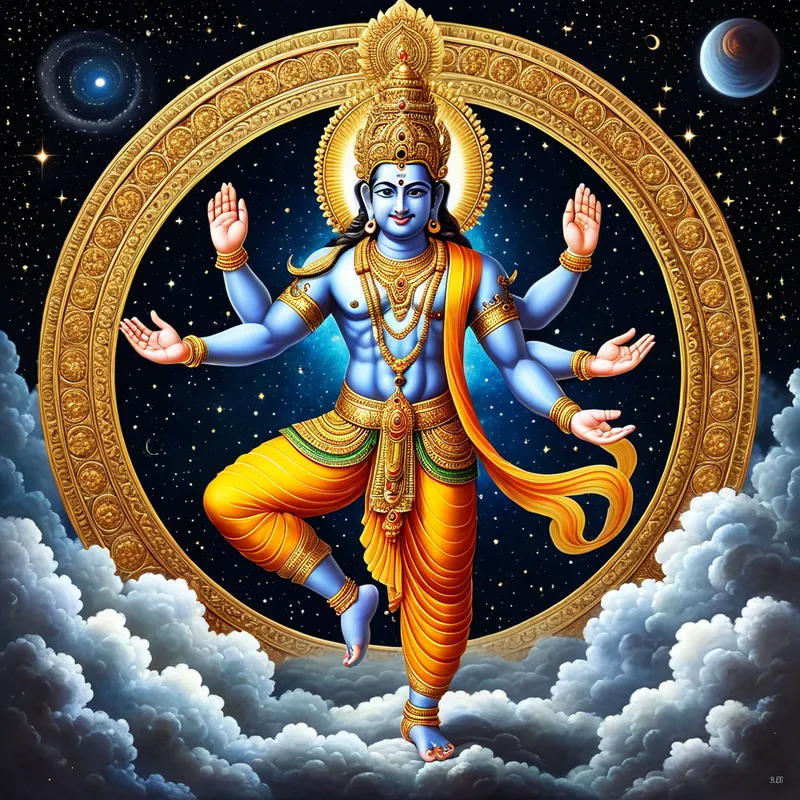
The Doorway of Vishnu Myth Meaning & Symbolism
A myth where the god Vishnu, as a dwarf, tricks a king to reclaim the cosmos, revealing the doorway between the manifest and the infinite.
The Tale of The Doorway of Vishnu
Listen, and let the ages turn back. The cosmos was young, yet already it groaned under a new order. Not the reign of the devas, but the dominion of the asuras. Their king was Bali, a ruler of such profound virtue and might that he had performed a hundred great sacrifices. Through his austerity and valor, he had wrested the three worlds from Indra himself. Heaven, earth, and the nether realms bowed to his righteous scepter. The devas, displaced and despairing, fled to the milky abyss of the primordial ocean, to the feet of the Preserver.
There, upon the coils of the great serpent Shesha, reclined Vishnu. His eyes were closed in yogic sleep, yet the universe pulsed within his heart. Hearing the lament of the gods, a smile touched his lips—not of mirth, but of profound purpose. “The balance has tipped,” his voice resonated, not as sound, but as the fundamental law of reality. “A king of such perfect generosity must be met not with a thunderbolt, but with a request. The cure for a power gained through sacrifice is a sacrifice itself.”
Thus, Vishnu took form. But not the form of the four-armed cosmic sovereign. He condensed his infinite essence into the guise of Vamana, a young, radiant brahmin student, small of stature, clad in simple deerskin, carrying a wooden umbrella. He walked from the nebulae of creation onto the earthly plane, to the grand sacrificial arena where King Bali was distributing gifts to all who asked.
The air was thick with the smoke of holy fires and the scent of clarified butter. Bali, magnificent and generous, sat upon his throne. “Ask of me anything,” he proclaimed to the humble dwarf who approached. Vamana’s voice was soft, yet it silenced the crowd. “O king of kings, I ask only for land. Just three paces of land, measured by my own stride.”
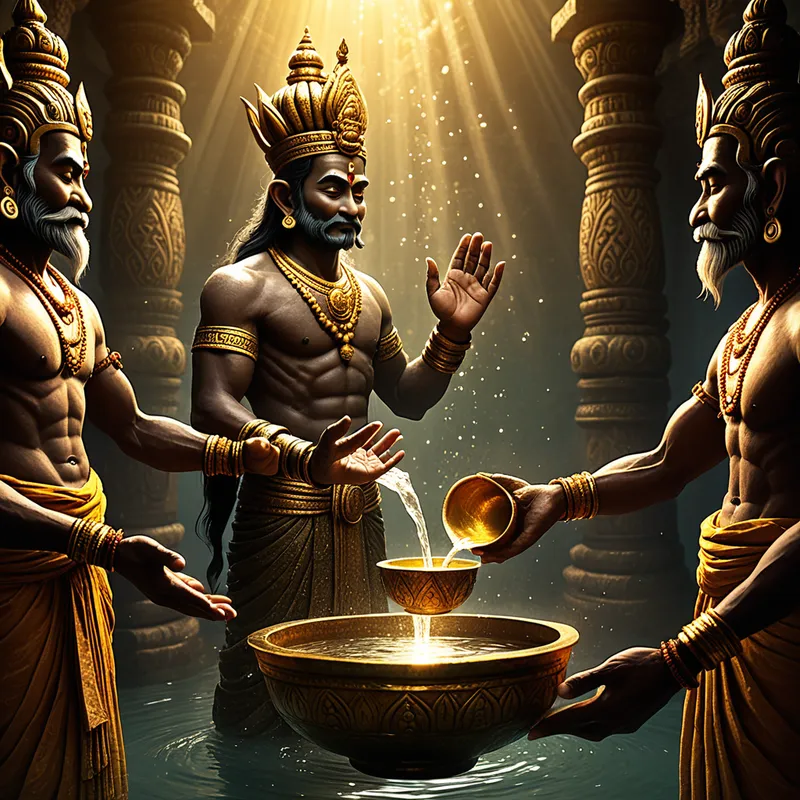
A murmur rippled through the court. The king’s guru, the sage Shukracharya, perceived the divine illusion. “Stop!” he cried, “This is no mere mendicant! This is Vishnu himself!” But Bali’s dharma was his bond. “My word is given,” he declared, his honor a fortress stronger than any warning. “Let the water be poured.”
As the ceremonial water trickled from Bali’s vessel onto Vamana’s outstretched palm, the transformation began. The dwarf started to grow. He expanded upwards, outwards, beyond the pillars of the pavilion, beyond the clouds, beyond the very dome of the sky. He became a cosmic colossus, Purusha incarnate. With his first step, he measured all of the earth. With his second, he claimed the entirety of the heavens. The universe lay encompassed by two strides.
Then Vishnu looked down, his face a galaxy of calm intent. “Great king, you promised three paces. I have covered all of creation. Where shall I place my third step?”
In that moment, King Bali understood the true nature of the doorway he had opened with his promise. He had not been tricked, but taught. All his conquests, his virtue, his very identity, were but a small parcel within the infinite estate of the divine. With profound humility and unbroken honor, he bowed his head. “Place your foot upon my head, Lord. Let my own self be the ground for your final step.”
And so, Vishnu’s third step descended, not as a crushing blow, but as a gentle pressure of grace, pressing Bali into the netherworld, Patala. But for his flawless devotion and integrity in the face of this cosmic lesson, Vishnu granted him a boon: Bali would rule Patala as an immortal sovereign, and would once a year be remembered and honored in the world above. The doorway had been traversed; the cosmos was restored, not through destruction, but through a gift that revealed the infinite.
Cultural Origins & Context
This myth, known as the Vamana Avatara, is a cornerstone of Puranic literature, most prominently detailed in the Bhagavata Purana and the Matsya Purana. It functions as the fifth of the ten classical Dashavataras. Historically, it emerges from a period where Vedic ritual sacrifice (yajna) was the paramount path to power, both earthly and celestial. The story served as a sophisticated theological narrative, transmitted by storytellers (kathakas) and priests, that established the supremacy of Vishnu’s devotional path (bhakti) and cosmic sovereignty over mere ritualistic attainment.
Its societal function was multifaceted. For rulers, it was a lesson in the limits of temporal power and the supreme value of keeping one’s word (satya) even at personal cost. For the common person, it illustrated that true devotion and humility before the divine were the ultimate virtues, greater than any material or martial achievement. The annual festival of Onam in Kerala is a direct cultural enactment of this myth, celebrating Bali’s righteous rule and his annual return, thus embedding the story in cyclical ritual and communal memory.
Symbolic Architecture
The Doorway of Vishnu is not made of wood or stone, but of a promise. It represents the critical threshold between the finite, egoic self and the infinite, cosmic Self.
The ego builds its kingdom through measured sacrifice and controlled expansion, but the Self asks for the one thing the ego cannot give without ceasing to be: everything.
Vamana symbolizes the seemingly small, humble, or overlooked aspect of consciousness—an intuition, a quiet truth, a simple request from the depths of the psyche. This modest form is the perfect key to unlock the fortress of a rigidly constructed identity (Bali’s righteous empire). The three strides map the totality of experience: the first (earth) is the conquest of the physical and material realm; the second (heaven) is the attainment of spiritual or mental heights; the third, for which there is “no space,” is the confrontation with the transcendent, the boundless ground of being itself that cannot be possessed, only surrendered to.
King Bali is the archetype of the noble ego—virtuous, powerful, and structured by its own codes of honor. His downfall is his greatest triumph: the willing sacrifice of his limited kingship to become the foundation for the divine footstep. He does not lose himself; he finds his true, eternal place within a grander order.

The Dreamer’s Resonance
When this myth stirs in the modern unconscious, it often manifests in dreams of profound thresholds. One might dream of being asked for a seemingly simple favor that spirals into a life-altering commitment, or of a small, overlooked door in a familiar house that opens onto a staggering cosmic vista. The somatic sensation is often one of vertigo—a feeling of the ground of one’s identity dissolving, coupled with a strange, awe-filled peace.
Psychologically, this signals a process where a long-held, perhaps even admirable, self-concept (the “kingdom” of one’s career, persona, or beliefs) is being called to account by a deeper, intrinsic law of the psyche. The dreamer is at the point of their “Bali moment”: the conscious ego is faced with a choice to either double down on control (heeding the “Shukracharya” voice of cynical self-preservation) or to honor a deeper promise to truth, even if it means the apparent dissolution of their current world. The anxiety and awe in such dreams are the birth pangs of a consciousness preparing to step through its own doorway.

Alchemical Translation
The alchemical process modeled here is the solve et coagula—dissolve and coagulate—of the psyche. Bali’s empire represents the coagulated self: well-defined, successful, and morally ordered. Vamana’s request initiates the solve, the dissolution. The three strides are the stages of this dissolution: confronting one’s material attachments, then one’s spiritual pretensions, until one arrives at the naked threshold of the unknown.
Individuation is not about building a better, shinier kingdom of the self. It is about discovering that you are, and always have been, both the humble petitioner and the infinite stride.
The modern individual engages in this alchemy when they face a situation where their core identity is challenged not by failure, but by a demand born of their own deepest integrity. It may be leaving a prestigious career to answer a calling, ending a “good” relationship that lacks soul, or surrendering a long-cherished belief. The “trick” is that the request (the new path, the difficult truth) appears small—“just three paces”—but its acceptance inevitably leads to a catastrophic and glorious reordering of one’s entire universe. The triumph is in the surrender. One does not win back one’s old kingdom; one becomes, like Bali, the eternal ruler of the underworld—the sovereign of the integrated shadow and the foundation upon which the transcendent can now rest. The doorway, once passed, reveals that the true home was not the territory owned, but the act of giving it away.
Associated Symbols
Explore related symbols from the CaleaDream lexicon: