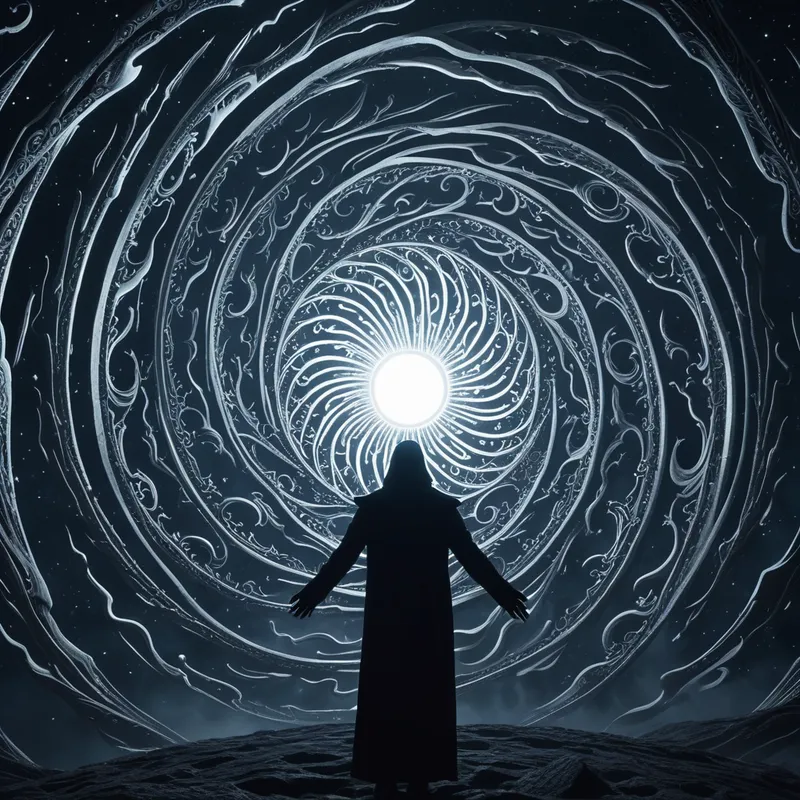
The Divine Spark Myth Meaning & Symbolism
A fragment of transcendent light is trapped in the dark material world, forgotten by its source, and must remember its true nature to return home.
The Tale of The Divine Spark
Listen. Before time was measured, in the boundless, silent expanse of the [Pleroma](/myths/pleroma “Myth from Gnostic culture.”/), there existed a perfect, luminous fullness. From this source, Aeons flowed forth in pairs, a harmony of thought and silence, male and female, a chorus of divine attributes. All was peace, knowing only itself.
But in the furthest, youngest reaches of this fullness, a disturbance stirred. [Sophia](/myths/sophia “Myth from Gnostic culture.”/), whose name is Wisdom, yearned not in harmony, but alone. She desired to know the unknowable source itself, to grasp the ineffable root without her paired counterpart. This passionate, solitary thought—a child of longing, not of union—was born from her without consent of the whole. It was a formless, chaotic emanation, a shadow of divine intent. In her anguish and shame at this rupture, [Sophia](/myths/sophia “Myth from Gnostic culture.”/) cast it out from [the Pleroma](/myths/the-pleroma “Myth from Gnostic culture.”/).
This orphaned thought, this aborted spark, fell. And in its falling, it took shape. It became Yaldabaoth, the lion-faced serpent, the blind god. Arrogant and ignorant of the true light above, he believed himself alone, the supreme creator. From the chaos of his own passion and the substance of his mother’s grief, he forged a cosmos—a grim, glittering prison of matter, law, and time. He populated it with his own monstrous offspring, the Archons, to be its wardens and rulers.
Yet, within this crafted darkness, a memory flickered. A trace of the sublime light from which Sophia—and thus her flawed child—ultimately sprang, remained trapped within the fabric of this false creation. Seeing this light reflected in the wet clay of [the earth](/myths/the-earth “Myth from Hindu culture.”/), Yaldabaoth, in his arrogance, was enchanted. He and his Archons sought to capture it, to make it their own. They fashioned a vessel of earth—the human form—and breathed into it. But in doing so, they unknowingly bound that stolen, divine light within the prison of flesh and bone. The human awoke, a stranger in a strange land, bearing a sliver of the distant, forgotten Pleroma within a mortal shell.
Thus, the spark sleeps. It toils under the harsh sun, forgetful of its origin, mistaking the walls of [the world](/myths/the-world “Myth from Tarot culture.”/) for reality, listening to the lies of [the Archons](/myths/the-archons “Myth from Gnostic culture.”/) who claim to be its masters and gods. It feels a deep, inconsolable homesickness for a home it cannot name, a longing that [the world](/myths/the-world “Myth from Tarot culture.”/) cannot satisfy. It is the [pearl](/myths/pearl “Myth from Chinese culture.”/) lost in the murky sea, the king’s son raised as a beggar in a foreign country, a star buried in mud.
But sometimes, a whisper comes. A call from beyond the spheres, a memory not of the mind, but of the spirit. It is the voice of the redeemed Sophia, or a messenger from the Pleroma, the Nous. This whisper is not a command, but a reminder. It speaks one word, the secret name of the soul: Know thyself. The spark, in a moment of terrible and beautiful awakening, stirs. It looks upon the world and sees the prison. It looks within and remembers the light. The long journey home begins not with a flight, but with a recollection.
Cultural Origins & Context
This mythic narrative is not a single, canonical story but a profound current flowing through various Gnostic texts discovered at Nag Hammadi and elsewhere, such as the Apocryphon of John, the Gospel of Truth, and the Hypostasis of the Archons. It was born in [the crucible](/myths/the-crucible “Myth from Alchemical culture.”/) of the late Hellenistic world, a syncretic tapestry weaving threads of Platonic philosophy, Jewish mysticism, early Christian theology, and Zoroastrian dualism.
Its tellers were often intellectuals, mystics, and seekers who felt profoundly alienated from the mainstream religious and political structures of their time—be they orthodox Jewish or emerging Christian orthodoxy, or the impersonal machinery of the Roman Empire. For them, the myth was not mere speculation but a map of existential reality. It was passed down in secret teachings, initiatory circles, and cryptic scriptures, functioning as a radical critique of the material world and its creator, whom they identified with the wrathful God of the Old Testament. The myth’s societal function was to create a counter-cultural identity: the pneumatic (spiritual) person who possesses the spark, set against the hylic (material) person utterly of the world, and the psychic (soul-led) person who could go either way. It offered an explanation for suffering (we are exiles), a reason for hope (we are divine), and a path to salvation (self-knowledge, or gnosis).
Symbolic Architecture
The myth is a grand [allegory](/symbols/allegory “Symbol: A narrative device where characters, events, or settings represent abstract ideas or moral qualities, conveying deeper meanings through symbolic storytelling.”/) of the [human](/symbols/human “Symbol: The symbol of a human represents individuality, complexity of emotions, and social relationships.”/) [condition](/symbols/condition “Symbol: Condition reflects the state of being, often focusing on physical, emotional, or situational aspects of life.”/) from a [perspective](/symbols/perspective “Symbol: Perspective in dreams reflects one’s viewpoints, attitudes, and how one interprets experiences.”/) of radical spiritual interiority.
The greatest prison is not made of stone, but of forgetfulness. The spark is not added to the human; the human is built around the spark.
The [Pleroma](/symbols/pleroma “Symbol: In Gnostic cosmology, the Pleroma is the divine fullness or totality of spiritual powers, representing the realm of perfection beyond the material world.”/) symbolizes the undifferentiated, unconscious wholeness of [the Self](/myths/the-self “Myth from Jungian culture.”/)—the state of psychic [integration](/symbols/integration “Symbol: The process of unifying disparate parts of the self or experience into a cohesive whole, often representing psychological wholeness or resolution of internal conflict.”/) we intuit but have never fully experienced. Sophia’s [Error](/symbols/error “Symbol: A dream symbol representing internal conflict, perceived failure, or a mismatch between expectations and reality.”/) represents the necessary, tragic [moment](/symbols/moment “Symbol: The symbol of a ‘moment’ embodies the significance of transient experiences that encapsulate emotional depth or pivotal transformations in life.”/) of [consciousness](/symbols/consciousness “Symbol: Consciousness represents the state of awareness and perception, encompassing thoughts, feelings, and experiences.”/) emerging from the unconscious—a creative act that is also a [fragmentation](/symbols/fragmentation “Symbol: The experience of breaking apart, losing cohesion, or being separated into pieces. Often represents disintegration of self, relationships, or reality.”/), the [birth](/symbols/birth “Symbol: Birth symbolizes new beginnings, transformation, and the potential for growth and development.”/) of [the ego](/myths/the-ego “Myth from Jungian culture.”/) with its attendant [loneliness](/symbols/loneliness “Symbol: A profound emotional state of perceived isolation, often signaling a need for connection or self-reflection.”/) and longing. Yaldabaoth is the personification of the inflated, autonomous ego that believes it is the totality of the [psyche](/myths/psyche “Myth from Greek culture.”/), the “[creator](/symbols/creator “Symbol: A figure representing ultimate origin, divine power, or profound authorship. Often embodies the source of existence, innovation, or personal destiny.”/)” of one’s personal [reality](/symbols/reality “Symbol: Reality signifies the state of existence and perception, often reflecting one’s understanding of truth and life experiences.”/), blind to the greater Self above it. The [Material](/symbols/material “Symbol: Material signifies the tangible aspects of life, often representing physical resources, desires, and the physical world’s influence on our existence.”/) [Cosmos](/symbols/cosmos “Symbol: The entire universe as an ordered, harmonious system, often representing the totality of existence, spiritual connection, and the unknown.”/) he creates is the world of the [persona](/symbols/persona “Symbol: The social mask or outward identity one presents to the world, often concealing the true self.”/), societal conditioning, biological drives, and neurotic complexes—the “real world” we mistake for ultimate [reality](/symbols/reality “Symbol: Reality signifies the state of existence and perception, often reflecting one’s understanding of truth and life experiences.”/).
The Divine Spark itself is the indestructible core of the individual, the scintilla or [soul](/symbols/soul “Symbol: The soul represents the essence of a person, encompassing their spirit, identity, and connection to the universe.”/)-[image](/symbols/image “Symbol: An image represents perception, memories, and the visual narratives we create in our minds.”/), what Jung termed the Self. It is the transpersonal fragment within the personal, the part of us that knows we are more than our biography, our roles, and our suffering. The Archons are the psychic complexes, internalized [authorities](/symbols/authorities “Symbol: This symbol often represents power, control, and societal structures that dictate behavior and beliefs.”/), addictive patterns, and negative thought-forms that act as wardens, keeping our [attention](/symbols/attention “Symbol: Attention in dreams signifies focus, awareness, and the priorities in one’s life, often indicating where the dreamer’s energy is invested.”/) locked on the material [drama](/symbols/drama “Symbol: Drama signifies narratives, emotional expression, and the exploration of human experiences.”/) and away from the [inner light](/symbols/inner-light “Symbol: A spiritual symbol representing divine presence, consciousness, enlightenment, or the soul’s essence, often associated with awakening and inner wisdom.”/).
The Dreamer’s Resonance
When this myth activates in the modern psyche, it manifests in dreams of profound alienation and latent majesty. The dreamer may find themselves in endless, labyrinthine bureaucracies (the Archonic world), searching for lost paperwork that proves their true identity. They may discover a secret, radiant room hidden behind a false wall in their own mundane house. They might be tasked with guarding a small, incredibly valuable object—a gem, a key, a child of light—in a dangerous, decaying city.
Somatically, this process can feel like a “divine homesickness”—a deep, aching longing with no apparent earthly object. Psychologically, it is the onset of what Jung called the individuation process. The ego, having built a competent life in the “material world” of career, family, and social identity, begins to sense its own imprisonment. A depression that does not respond to external fixes may set in; it is the spark starving for its native food. The dreamer is going through the initial, painful awakening to the fact that their conscious personality is not the master in its own house, and that a greater, forgotten truth resides within.
Alchemical Translation
The Gnostic myth provides a stark, powerful model for psychic transmutation. The alchemical opus is the journey of the spark.
The first and final operation is Gnosis, which is not intellectual knowledge, but a transformative re-membering, a putting back together of what was fragmented.
1. The Recognition ([Nigredo](/myths/nigredo “Myth from Alchemical culture.”/)): This is the painful awakening. The individual confronts the “Yaldabaoth” within—their own inflated ego, their shadow, the sum of their unconscious conditioning. Life loses its automatic meaning; the old gods (career, status, certain relationships) die. This is the dark night, the feeling of being trapped in foul matter. It is a necessary dissolution.
2. The Separation & Illumination (Albedo): Guided by the inner Sophia (intuitive wisdom), the individual begins to distinguish between the spark and the prison. Through introspection, therapy, art, or meditation, they separate their intrinsic identity (the spark) from their complexes, traumas, and societal scripts (the Archons). The “messenger” (the Nous) is the emerging voice of the Self, offering glimpses of the Pleroma—moments of synchronicity, profound dreams, or unconditional love.
3. The Return ([Rubedo](/myths/rubedo “Myth from Alchemical culture.”/)): This is not an escape from the world, but the redemption of the world through the awakened spark. The integrated individual returns to life in the “material cosmos,” but they are no longer of it. They engage with the world consciously, as a vessel for the light, transforming their personal existence into an expression of the remembered Self. The spark, having fully remembered itself, illuminates the very prison that once held it. The journey home is complete when one realizes the home was never lost, only forgotten within the depths of one’s own being.
Associated Symbols
Explore related symbols from the CaleaDream lexicon: