The Digestive Furnace Myth Meaning & Symbolism
A myth of a cosmic forge where the soul's raw matter is consumed, purified, and reborn through a sacred, agonizing, and transformative inner fire.
The Tale of The Digestive Furnace
Listen, and hear the tale of the fire that does not burn, but births.
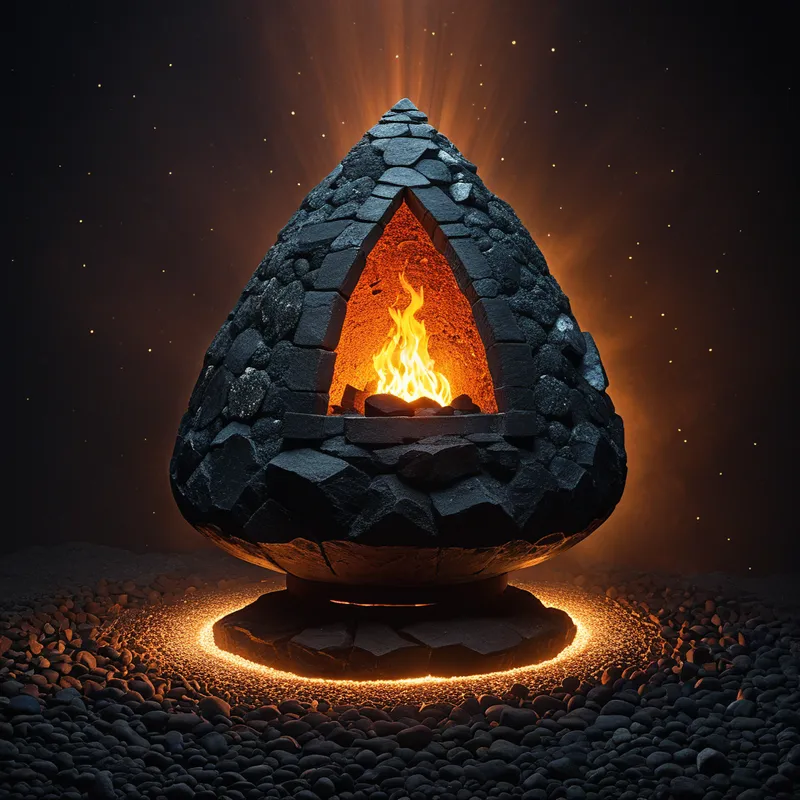
In the time before time was measured, when the substance of [the world](/myths/the-world “Myth from Tarot culture.”/) was still heavy with potential, there stood in the silent heart of the cosmos a solitary structure: the Digestive Furnace. It was not built by hand, but had always been, a mountain of somber, pitted bronze and basalt that breathed. From its single, cavernous aperture came no smoke, but a light that was also a song—a deep, resonant hum that vibrated in the marrow of stars.
Its keeper was the Opus, a figure of indeterminate form, robed in the ashes of spent worlds and the shimmer of nascent ones. [The Opus](/myths/the-opus “Myth from Alchemical culture.”/) did not speak, for their work was beyond language. Their sole purpose was to tend the Furnace’s impossible hunger.
For the Furnace was forever empty, and forever starving. It consumed, but not to destroy. It hungered for the unrefined, the base, the forgotten dross of creation. Pilgrims—not of flesh, but of essence—would journey across the desolate plains of potential to its base. They came bearing their burdens: lumps of heavy Lead that wept with sorrow, jagged shards of Quicksilver that fought the hand that carried them, and dull, earthy Iron.
One by one, they would approach the roaring maw. The heat was not of flame alone, but of a profound attention that saw into the very core of what was offered. To offer your Lead was to stand in that gaze, feeling its weight, its cold despair, its resistance. The offering was an agony of release. [The pilgrim](/myths/the-pilgrim “Myth from Christian culture.”/) would thrust their burden into the brilliance, and the Furnace would accept.
The sound was not a crunch, but a sigh—a deep, resonating assimilation. The base metal would not vanish. Instead, it would hang suspended in the Furnace’s heart, bathed in the spectrum of its inner fire. It would writhe. It would melt. It would scream in a silent language of transmutation, shedding layers of impurity that fell away as black, weightless ash. The process was eternal and instantaneous. From the molten core of the digested metal, a new substance would coalesce—a single, perfect drop of Gold, not yellow, but a living, white-gold light.
This drop, singing a pure, clear note, would then descend from the Furnace, not to the hand of the pilgrim, but into the very ground from which they came, seeding a new order into reality. The pilgrim would depart, not lighter, but different—hollowed by the sacrifice, yet imprinted with the memory of the Gold’s song. The Furnace would rumble, its hunger momentarily assuaged, yet already turning its attention to the next shadow approaching with its burden. The Opus watched, eternally tending the fire that was also a mouth, that was also a womb.
Cultural Origins & Context
The myth of the Digestive Furnace is not a folktale of a people, but the foundational narrative of the Alchemical worldview. It emerged from the silent observations of early metallurgists and healers—those who worked with earth, fire, and substance. They witnessed lead melting in a crucible, its dullness giving way to a shimmering liquid, and saw not just a physical process, but a cosmic parable.
It was passed down not in public squares, but in the secrecy of workshops and scriptoria, encoded in cryptic texts and illustrated in emblematic woodcuts. The tellers were masters to their apprentices, not merely teaching a recipe, but initiating them into a mystery. The myth’s societal function was profound: it provided a sacred model for all forms of change. It framed suffering, disease, decay, and even death not as meaningless afflictions, but as the necessary “feeding” of a cosmic process of refinement. It taught that value (Gold) is not found, but forged from the most despised materials (Lead) through a voluntary, terrifying submission to an inner fire.
Symbolic Architecture
At its core, the Digestive [Furnace](/symbols/furnace “Symbol: A furnace represents transformation through intense heat, purification, and the containment of powerful energy. It symbolizes both creative potential and destructive force.”/) is the archetypal [symbol](/symbols/symbol “Symbol: A symbol can represent an idea, concept, or belief, serving as a powerful tool for communication and understanding.”/) of the transformative vas, the sacred [vessel](/symbols/vessel “Symbol: A container or structure that holds, transports, or protects something essential, representing the self, emotions, or life journey.”/) where opposites are held in [tension](/symbols/tension “Symbol: A state of mental or emotional strain, often manifesting physically as tightness, pressure, or unease, signaling unresolved conflict or anticipation.”/) until a third, transcendent [thing](/myths/thing “Myth from Norse culture.”/) is born. It is the alchemical [retort](/symbols/retort “Symbol: A vessel for alchemical transformation, representing spiritual purification, the union of opposites, and the distillation of wisdom through intense process.”/), the [human](/symbols/human “Symbol: The symbol of a human represents individuality, complexity of emotions, and social relationships.”/) [heart](/symbols/heart “Symbol: The heart symbolizes love, emotion, and the core of one’s existence, representing deep connections with others and self.”/), and the [crucible](/symbols/crucible “Symbol: A vessel for intense transformation through heat and pressure, symbolizing spiritual purification, testing, and alchemical change.”/) of [consciousness](/symbols/consciousness “Symbol: Consciousness represents the state of awareness and perception, encompassing thoughts, feelings, and experiences.”/) itself.
The Furnace does not destroy the offering; it digests it. To digest is to break down through a contained, internal process, extracting nourishment and essence while expelling waste. This is the model of true psychological work.
The Lead represents the psychic burdens we carry: our depressions, our [shame](/symbols/shame “Symbol: A painful emotion arising from perceived failure or violation of social norms, often involving exposure of vulnerability or wrongdoing.”/), our rigid identifications, our “base” instincts not as evil, but as unintegrated potential. The [Opus](/symbols/opus “Symbol: A spiritual or alchemical term for a great work of creation, often representing the culmination of a life’s purpose or a transformative process.”/) is the observing, non-judgmental Self, the part of us that can witness our own suffering without fleeing or identifying with it. The fire is the affect, the emotional and somatic heat generated when we consciously hold our pain in [awareness](/symbols/awareness “Symbol: Conscious perception of self, surroundings, or internal states. Often signifies awakening, insight, or heightened sensitivity.”/) instead of projecting it or repressing it.
The myth’s genius is in its depiction of a self-regulating [cosmos](/symbols/cosmos “Symbol: The entire universe as an ordered, harmonious system, often representing the totality of existence, spiritual connection, and the unknown.”/). The [hunger](/symbols/hunger “Symbol: A primal bodily sensation symbolizing unmet needs, desires, or emotional voids. It represents craving for fulfillment beyond physical nourishment.”/) of the Furnace is the [psyche](/myths/psyche “Myth from Greek culture.”/)’s own drive toward wholeness. We are compelled to offer our Lead because a deeper part of us knows it is the only [food](/symbols/food “Symbol: Food in dreams often symbolizes nourishment, both physical and emotional, representing the fulfillment of basic needs as well as deeper desires for connection or growth.”/) for our transformation. The resulting Gold is not a [trophy](/symbols/trophy “Symbol: The trophy symbolizes achievement, recognition, and the reward for perseverance in competitive endeavors.”/) for [the ego](/myths/the-ego “Myth from Jungian culture.”/), but a seed for the world—symbolizing that individual [integration](/symbols/integration “Symbol: The process of unifying disparate parts of the self or experience into a cohesive whole, often representing psychological wholeness or resolution of internal conflict.”/) contributes to the healing of the collective.

The Dreamer’s Resonance
When this myth stirs in the modern dreamer, it often manifests as dreams of intense, contained heat or pressure. One might dream of a basement boiler room that must be tended, of a powerful engine overheating, or of swallowing something hot that then glows inside the belly. These are somatic metaphors for a psychological process that has become urgent.
To dream of feeding something into a fire or a machine represents the unconscious recognition that a part of one’s life—a relationship, a career, a long-held belief—must be “digested.” It is no longer serving as it is and must be broken down to its essential components. The anxiety in the dream mirrors the resistance of the ego, which rightly fears its own dissolution. The figure of the silent Opus may appear as a calm stranger, an animal, or even the dreamer themselves in a detached, focused state, representing the emergent Self-capacity to hold this process.
These dreams often cluster around life transitions: midlife, grief, recovery, or spiritual crisis. They signal that the dreamer is in the [nigredo](/myths/nigredo “Myth from Alchemical culture.”/) phase—the blackening, the putrefaction—where old forms are breaking down inside the psychic Furnace. The dream is the body-mind’s way of narrating this inherently wordless, fiery ordeal.

Alchemical Translation
For the modern individual seeking individuation, the myth of the Digestive Furnace provides a non-linear map. The journey is not outward to slay dragons, but inward to feed them to the fire of conscious attention.
The first step is Recognizing the Lead. This is shadow-work: identifying the heavy, rejected, or painful aspects of oneself—the jealousy, the laziness, the childhood wound—and acknowledging it as valid “matter” for transformation, not as something to be exterminated.
The second is Approaching the Furnace. This is the act of bringing that material into [the vessel](/myths/the-vessel “Myth from Alchemical culture.”/) of therapy, meditation, journaling, or authentic relationship. It is the creation of a sacred, bounded space (the therapeutic alliance, the meditation cushion) where the heat of focused awareness can be applied.
The fire is not aggression; it is the unwavering light of consciousness. It is the heat of feeling your fear fully without running, of speaking your shame aloud without collapsing.
The third is The Digestion. This is the painful, patient middle phase where the old pattern melts. It feels like chaos, grief, or confusion—the metal screaming as it changes state. Here, one must trust the process and the silent Opus Self, learning to tolerate the uncertainty.
The final stage is Receiving the Gold. This is not an egotistical “enlightenment,” but the quiet emergence of a new capacity: compassion where there was judgment, creativity where there was blockage, resilience where there was fragility. This “Gold” then naturally integrates into one’s life, benefiting not just the individual but their world—seeding a more authentic presence into their relationships and work.
The myth assures us that the Furnace is already within. Its hunger is our own deepest calling toward wholeness. Our task is not to build the fire, but to become brave enough to feed it, and wise enough to tend it, until our heaviest lead becomes the light that seeds a new dawn within.
Associated Symbols
Explore related symbols from the CaleaDream lexicon: