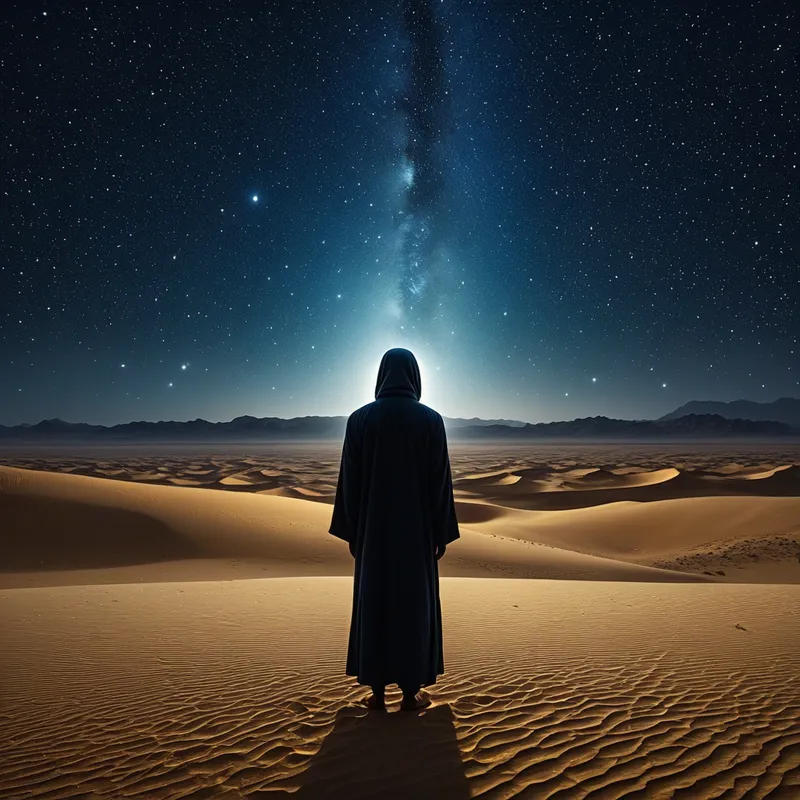
The Desert of Annihilation Myth Meaning & Symbolism
A seeker journeys into a desert that dissolves all identity, confronting the terrifying void to discover the true, undying Self beyond the ego.
The Tale of The Desert of Annihilation
Listen, and let the silence between the words speak. There is a tale told in the whispers of the caravan winds, a story not of conquest, but of un-becoming.
In a time before time was counted, there lived a seeker whose heart was a furnace of questions. He had mastered the scriptures, performed the rites, and worn the robes of piety, yet a restless emptiness echoed in his soul’s chambers. He sought the Beloved, but found only the reflection of his own seeking. In despair, he went to a Murshid whose eyes held the calm of deep, still waters. “You seek the Ocean,” said the master, “but you carry a cup. You must lose the cup.”
The master pointed westward, beyond the last oasis, beyond the maps. “There lies the Fana Desert. It is not a place of dunes and sun, but of essence and absence. It is the Desert of Annihilation. Its sands do not burn the foot; they consume the footprint. Its wind does not howl; it erases the name from the tongue of the one who speaks it. To enter is to consent to be unmade.”
With a heart trembling between terror and longing, the seeker set out. For days, the known world fell away. Then, the landscape shifted. The air grew thick with a luminous silence. The ground beneath him became not sand, but something like solidified light that yielded like ash. He took a step, and the memory of his childhood village softened at the edges, bleeding into the haze. Another step, and the pride of his scholarly achievements dissolved like salt in water. The desert did not attack; it simply refused to hold the shape of his stories.
Panic rose—a final, fierce clinging to the “he” that was walking. He cried out his own name, but the wind took the syllables and scattered them into meaningless sound. He fell to his knees, watching as the very concept of “knees,” of “his” body, began to blur. The terror was absolute. This was not death, but something more profound: the unraveling of the one who could die. The ego, the Nafs, screamed its final protest into a void that absorbed all sound.
Then, in the core of that screaming silence, a shift. As the last ghost of his individual self dissolved—his fears, his history, his very sense of separation—something else remained. Not a thing, but a presence. A vast, serene awareness that had been watching the entire drama, the way the sky watches a storm. It was not his awareness. It was Awareness itself. In the absolute vacuum of his annihilation, the Beloved was not found, but recognized as the only thing that had ever been. The desert had not destroyed him; it had burned away the veil.
He stood, though there was no “he” to stand. The desert was now a mirror of boundless, loving clarity. The journey back was not a return, for the one who had left was gone. He walked into the world, but now the world walked within him.

Cultural Origins & Context
The Desert of Annihilation is not a single, codified myth from a specific text, but a pervasive and potent teaching story within the oral and poetic tradition of Sufism. It finds its roots in the central Sufi concept of Fana, leading to Baqa. This narrative pattern is woven through the mathnawis of Rumi, the ghazals of Hafez, and the allegories of Ibn Arabi and Mansur al-Hallaj.
It was transmitted in the Khanqah or Zawiya, not as a historical account but as a map of the interior journey. The Murshid would offer such tales to a disciple when intellectual understanding had reached its limit, and only an existential metaphor could point the way. Its societal function was subversive and unifying: it democratized the ultimate spiritual goal, presenting it as an inward journey accessible to any sincere heart, beyond ritual and dogma, while also explaining the often-ecstatic, seemingly paradoxical behavior of God-intoxicated saints.
Symbolic Architecture
The myth is a masterful symbolic blueprint for the death of the psychological ego and the birth of the transpersonal Self.
The Seeker represents the conscious personality that has exhausted the resources of the personal unconscious—the realm of complexes and personal history—and stands at the threshold of the collective unconscious. The Murshid symbolizes the guiding principle of the Self, the inner archetype of wholeness that knows the necessary path, even when the ego fears it.
The Desert is the archetypal realm of the Self itself—not a benevolent guide, but the terrifying, purifying fire of reality that tolerates no illusion.
Its sands, which dissolve memory and identity, symbolize the deconstructive power of absolute truth. The Wind that erases the name is the animating spirit (Ruh) that strips away all false attributions. The pivotal moment of terror is the ego’s final resistance, its confrontation with the shadow and its own ultimate insignificance. The ensuing Awareness that remains is the irreducible core of consciousness, what Jung termed the Self, indistinguishable from the Sufi experience of the Divine Reality (Al-Haqq).

The Dreamer’s Resonance
When this myth stirs in the modern psyche, it often manifests in dreams of profound disorientation and loss. One may dream of being in a vast, empty landscape where familiar landmarks melt or are shrouded in fog. They may be searching for a home that no longer exists or trying to recall a name or face that slips from memory. The somatic feeling is one of groundlessness, anxiety, and a chilling existential loneliness.
This is not a nightmare of external threat, but a reflection of an internal, necessary process: the psyche’s initiation into a deeper level of being. The ego-structure is being called to loosen its grip. The dreamer is encountering the psychic equivalent of the Desert. This process often precedes or accompanies major life transitions—the end of a defining career, the dissolution of a long-held identity (e.g., “the caregiver,” “the achiever”), or a spiritual crisis. The dream is the psyche’s way of rehearsing the death of an outworn self, making space for a more authentic configuration of consciousness to emerge.

Alchemical Translation
The alchemical journey of Nigredo—the blackening, the dissolution—is perfectly modeled by the seeker’s trek into the annihilating desert. The ego, with all its attachments and self-narratives (the prima materia), must be broken down into its essential, psychic atoms. This is a voluntary descent into the massa confusa, a state of utter hopelessness and disintegration from the ego’s perspective.
The triumph of the myth is not in avoiding the void, but in discovering that consciousness itself is the substance of the void, brilliantly alive.
The moment of “Awareness” recognizing itself is the Albedo—the dawn that follows the darkest night. What emerges is not the old ego repaired, but a consciousness that has integrated the experience of its own dissolution. This is the Rubedo, the creation of the philosophical gold: the individuated Self. For the modern individual, this translates to the courage to endure periods of profound meaninglessness, identity crisis, and depression not as pathologies to be hastily medicated away, but as potential crucibles for transformation. It is the process of shifting one’s center of gravity from the personal ego to the wider, more durable ground of being. One learns to identify not with the content of consciousness (thoughts, feelings, roles), but with the context—the aware space in which all content arises and passes away, like shapes in the desert wind.
Associated Symbols
Explore related symbols from the CaleaDream lexicon: