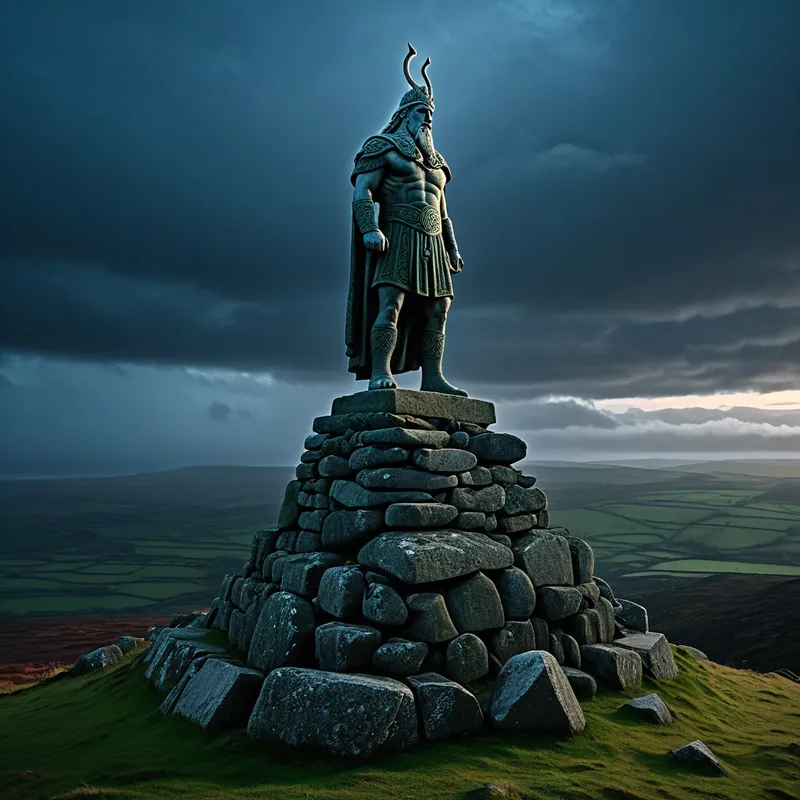
The Daghda's Cairn Myth Meaning & Symbolism
The Daghda, the Good God, builds a cairn for his son, embedding his power in the land, a pact of sacrifice that defines true sovereignty.
The Tale of The Daghda’s Cairn
Listen, and hear the stones speak. In the time before time, when the world was raw and the Tuatha Dé Danann walked openly upon the green earth, there lived The Daghda. He was the All-Father, his belly a cauldron of plenty, his club so vast it could kill with one end and restore life with the other. Yet, for all his strength, a shadow fell upon his heart. His son, Aedh, lay slain, a bright flame extinguished by treachery and battle.
The Daghda’s grief was not a silent weeping. It was a tectonic force. He wandered the wild places of Ireland, his footsteps hollow thuds upon the turf, until he came to a high, wind-scoured place overlooking the realm. Here, he stopped. The air tasted of salt and coming rain. Without a word, he bent his great back to the earth. He did not call upon magic or command his people. This labor was his alone, a father’s final rite.
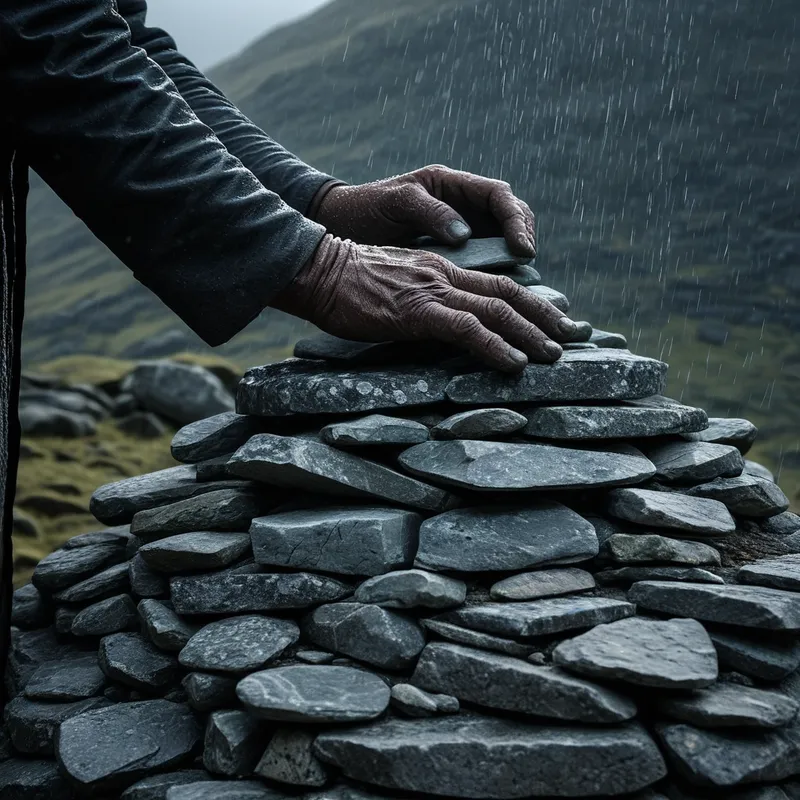
Stone by stone, he built. He hauled basalt pillars from the sleeping bones of the land, rolled granite boulders that had slumbered since the world’s first dawn. His hands, which had wielded the club of life and death, now grew raw and bloody, the skin wearing away to merge with the grit of the rock. The sun burned him; the rain chilled him. He built by day and by the cold light of the moon, his silhouette a moving mountain against the sky. He was not building a tomb, but a testament—a cairn.
The cairn grew, a conical mountain of grey stone, a permanent scar and crown upon the hill. With each stone laid, a piece of The Daghda’s own boundless vitality, his fírinne, seeped into the mineral flesh of Ireland. He was not burying his son; he was planting him. He was transmuting personal, searing loss into an eternal, silent anchor. When the last stone was set, the capstone that sealed the structure, The Daghda stood back. The wind howled through the stones, a new voice on the hill. He placed his hand upon the cold rock, and in that touch was a surrender. His son was gone. But his son was the land now. The Daghda, the Good God, had become the steward of a sorrow that would forever define the sovereignty of the place. The cairn stood, and the hill was forever changed.
Cultural Origins & Context
This myth, like much of the Celtic mythological cycle, survives in medieval Irish manuscripts, such as the Lebor na hUidre and later compilations. These texts are Christian transcriptions of a far older, oral tradition preserved by the fili. The story of The Daghda’s Cairn is not a mere folktale; it is a dindshenchas, a “lore of place.” Its primary function was to explain the origin and sacred significance of a specific, physical landmark—a cairn on a hill that would have been a known feature in the landscape.
By anchoring the divine grief of the chief god to a tangible location, the myth sacralized the land itself. It taught that sovereignty—the right and responsibility to rule—was not abstract. It was a pact sealed with sacrifice and labor, literally embedded in the earth. The king’s legitimacy was mirrored in the land’s fertility and stability; a king out of harmony with this pact would bring blight. The myth was a societal instruction, told and retold, binding the people to their terrain through a story of divine, parental investment.
Symbolic Architecture
At its core, the myth is an alchemical map of transforming raw, personal power into structured, enduring legacy. The Daghda begins as the embodiment of undifferentiated, potent force—the club, the cauldron, the appetite. His son’s death represents the ultimate limitation, the shock that forces potency to confront its own mortality.
The cairn is the psyche’s answer to chaos: not a denial of loss, but its architectural integration.
The building process is the critical symbol. The Daghda does not rage against the dying of the light; he builds with the darkness. Each stone is a memory, a piece of unprocessed grief, given form and order. His bloody hands signify the necessary cost—the “good” of the Good God is not nicety, but the willingness to be worn down by one’s own sacred duty. The cairn itself is a perfect symbol of the conscious ego-structure: a deliberate, layered construction that channels and contains the immense, subterranean forces of the unconscious (the land) and personal history (the slain son). It turns a point of loss into a point of orientation, a landmark visible for miles.
The Dreamer’s Resonance
When this myth stirs in the modern unconscious, it often manifests in dreams of profound, solitary labor. You may dream of building a wall, a tower, or a puzzling structure with heavy, earthen materials. There is a deep somatic sense of weight, effort, and often exhaustion, but also a driven, non-negotiable purpose. The dream landscape is typically stark, elevated, and windswept.
Psychologically, this signals a process of psychic containment. The dreamer is undergoing a loss, a failure, or a confrontation with a limit that has shattered a previous sense of personal power or identity (The Daghda’s potency). The dreaming psyche is not seeking to escape this feeling but to metabolize it through symbolic action. The laborious building is the psyche’s instinct to take the rubble of that shattered self and reorganize it into a new, more resilient structure. It is the work of turning a wound into a witness post, creating an inner landmark from which to survey one’s life with hard-won perspective. The exhaustion felt in the dream is real; it is the cost of this profound inner restructuring.
Alchemical Translation
The individuation process modeled here is the transformation of the Psychic Libido into the Individuated Self. We all possess an inner Daghda—a reservoir of raw potential, desire, and life force. Life, however, inevitably presents us with our “slain son”: a cherished project that fails, a relationship that ends, an ideal that dies, the simple confrontation with aging and mortality.
The immature psyche might try to wield the club harder, to deny the loss with more force. The alchemical path, as shown by the myth, is the opposite: to cease projecting power outward and to turn it inward toward a work of soul-making.
Sovereignty over the self is claimed not through conquest, but through consecrated labor on the bedrock of one’s own experience.
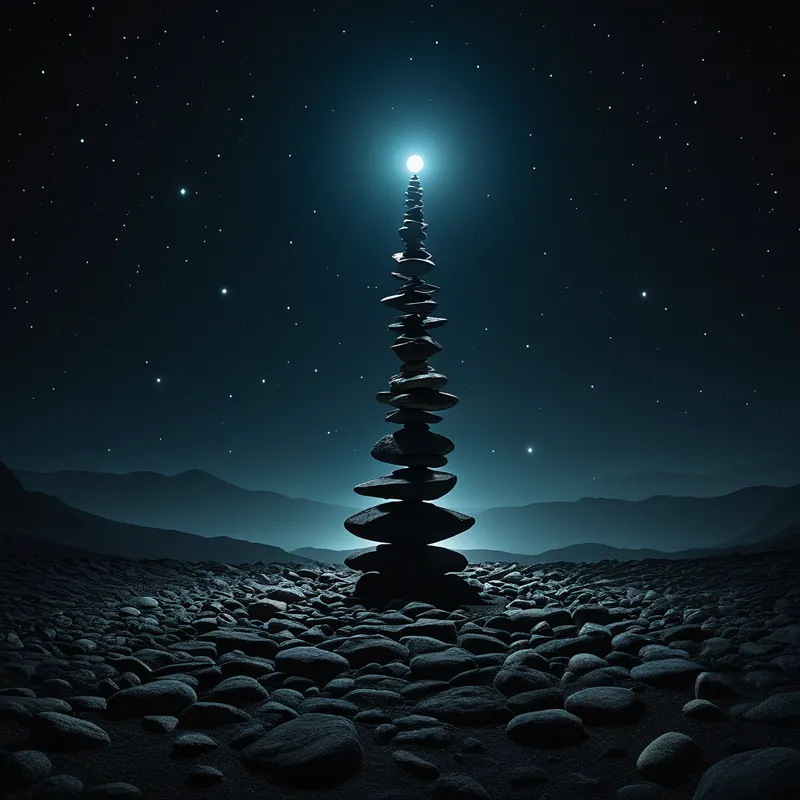
Your “cairn” is the enduring identity you construct from the stones of your experiences, especially the heavy, dark ones of grief and limitation. The act of consciously, patiently placing each stone—integrating a memory, accepting a flaw, honoring a loss—is what transmutes chaotic suffering into structured meaning. The capstone, the moment of completion, is not happiness, but a solemn, durable peace. You become the steward of your own history. The power is no longer something you have; it is something you are, and have embedded in the very ground of your being. You look out from your cairn, and you see your territory—your life—not as a possession, but as a sacred trust forged in sacrifice. This is the true meaning of becoming the ruler of your own inner realm.
Associated Symbols
Explore related symbols from the CaleaDream lexicon: