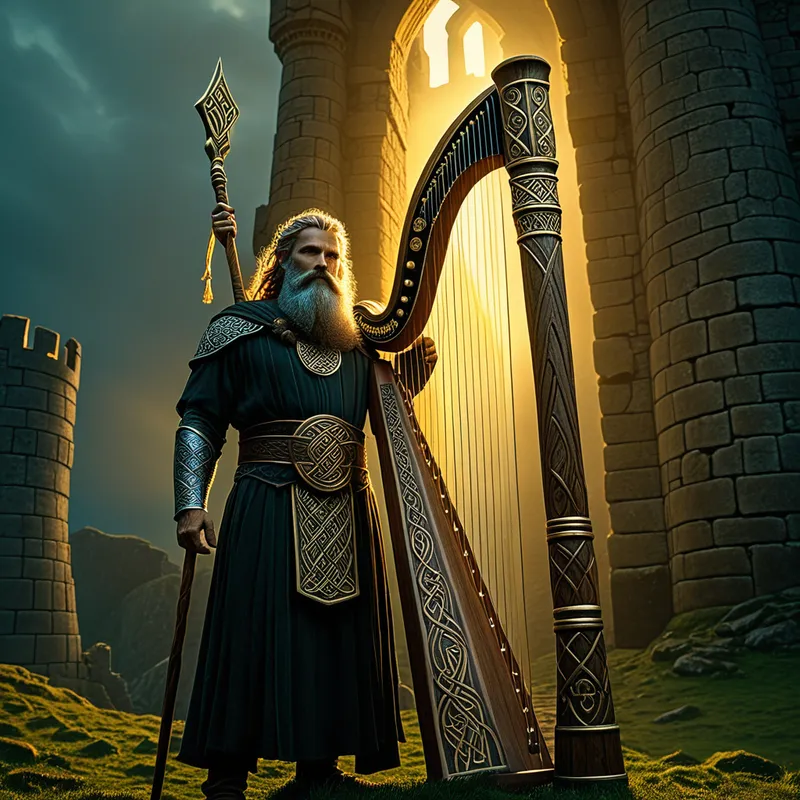
The Dagda's Harp Myth Meaning & Symbolism
The Dagda, the Good God, reclaims his stolen magical harp from the Fomorians, using its three strains to command order, sorrow, and joy.
The Tale of The Dagda’s Harp
Listen, and let the firelight cast the shadows of the tale. The great war was over. The Tuatha Dé Danann had driven the monstrous [Fomorians](/myths/fomorians “Myth from Irish culture.”/) from the land, but at a terrible cost. The fields were scorched, the rivers ran with memory, and a weary silence had settled over the halls of the gods.
Among them, the Dagda felt the loss most deeply. His great club, which could slay nine men with one end and restore them to life with the other, lay still. His cauldron, the Coire Ansic, was empty. And his harp, his Uaithne, was gone. In the chaos of the final battle, the retreating Fomorians had stolen it away, carrying the very music of [the world](/myths/the-world “Myth from Tarot culture.”/) into their grim, northern stronghold.
[The Dagda](/myths/the-dagda “Myth from Celtic culture.”/)’s spirit, once as vast as [the sky](/myths/the-sky “Myth from Persian culture.”/), grew heavy. Without Uaithne, the seasons themselves seemed unsure. He journeyed alone, following the psychic wound of its absence, until he stood before the fortress of the Fomorian king. The air was thick with salt and malice. He entered not as a warrior, but as a supplicant, a harper seeking his instrument.
He found it hanging on the western wall of the great hall, a [thing](/myths/thing “Myth from Norse culture.”/) of beauty amidst ugliness. Its frame was of ancient oak, its strings of shining bronze. The Fomorians, who knew its power, had left it untouched, a silent trophy. They laughed at the Dagda, this great god come begging. “Play for us, then,” they sneered. “Play a lament for your fallen people.”
The Dagda reached out his hand and spoke the harp’s secret name. It flew from the wall into his grasp, as if waking from a deep sleep. He plucked the strings.
First, he played the Goltraí. A wave of profound, unassuageable grief filled the hall. The Fomorian warriors, creatures of spite and rage, were unprepared for true sorrow. They began to weep, great wracking sobs that bent their twisted forms. Their weapons clattered to the floor, forgotten.
Then, his fingers moved, and he played the Geantraí. The weeping turned, without pause, into uncontrollable laughter. The Fomorians clutched their sides, gasping, tears of mirth replacing tears of anguish. They were helpless, disarmed by a joy they could not comprehend, rolling on the stone floor in hysterical, breathless paroxysms.
Finally, the Dagda played the Suantraí. A deep, irresistible peace flowed from the strings. One by one, the laughter ceased. The Fomorians slumped where they stood, falling into a sleep as deep and silent as the stone beneath them. The Dagda walked through the hall of slumbering giants, took what was his, and left. He carried the music of the world back to a waiting land, and with it, he played the seasons back into their proper order.
Cultural Origins & Context
This myth survives primarily within the medieval Irish textual tradition, most notably in the Lebor Gabála Érenn and the later Ulster Cycle. It is a post-battle tale, a coda to the epic conflict between order and chaos symbolized by the Tuatha Dé Danann and the Fomorians. As an oral tradition preserved by the filid (the poet-seers), its function was multifaceted. On one level, it explained the sovereignty of the land—why the seasons turn and why joy follows grief. On another, it served as a divine model for kingship. The true ruler is not merely the strongest warrior, but the one who can master and administer the emotional and natural states of his people, bringing harmony (fír flathemon, the ruler’s truth) out of discord. The harp itself, Uaithne, was less an instrument of entertainment and more a [talisman](/myths/talisman “Myth from Global culture.”/) of cosmic order, a direct conduit to the structuring principles of reality.
Symbolic Architecture
The myth’s power lies in its tripartite [symbolism](/symbols/symbolism “Symbol: The use of symbols to represent ideas or qualities, often conveying deeper meanings beyond literal interpretation. In dreams, it’s the language of the unconscious.”/). The Dagda is the archetypal Sovereign, the embodied Self who must integrate disparate and hostile elements. His [journey](/symbols/journey “Symbol: A journey in dreams typically signifies adventure, growth, or a significant life transition.”/) to the Fomorian [fortress](/symbols/fortress “Symbol: A fortress symbolizes security and protection, representing both physical and psychological safety from external threats.”/) is a descent into the [shadow](/symbols/shadow “Symbol: The ‘shadow’ embodies the unconscious, repressed aspects of the self and often represents fears or hidden emotions.”/)—the chaotic, repressed, or stolen parts of one’s own [psyche](/myths/psyche “Myth from Greek culture.”/).
The stolen harp is the soul’s native talent, the core creative power, held captive by inner demons of neglect, trauma, or fear.
The three strains—Goltraí, Geantraí, and Suantraí—represent the complete emotional and energetic [spectrum](/symbols/spectrum “Symbol: A continuum of possibilities, representing diversity, transition, and the full range of existence from one extreme to another.”/). They are not mere moods but fundamental forces: the [catharsis](/symbols/catharsis “Symbol: A profound emotional release or purification through artistic expression, often involving intense feelings of relief and transformation.”/) of [grief](/symbols/grief “Symbol: A profound emotional response to loss, often manifesting as deep sorrow, yearning, and a sense of emptiness.”/), the liberation of joy, and the [peace](/symbols/peace “Symbol: Peace represents a state of tranquility and harmony, both internally and externally, often reflecting a desire for resolution and serenity in one’s life.”/) of [resolution](/symbols/resolution “Symbol: In arts and music, resolution refers to the movement from dissonance to consonance, creating a sense of completion, release, or finality in a composition.”/). The Fomorians, overcome by these forces, symbolize how unintegrated shadow elements cannot withstand the full, conscious [expression](/symbols/expression “Symbol: Expression represents the act of conveying thoughts, emotions, and individuality, emphasizing personal communication and creativity.”/) of authentic feeling. They are specialists in one note—malice—and are shattered by the [chord](/symbols/chord “Symbol: A musical harmony of multiple notes played simultaneously, symbolizing unity, resolution, or emotional resonance.”/).
The Dreamer’s Resonance
When this myth pattern stirs in the modern unconscious, it often manifests in dreams of searching for a lost, precious object in a hostile or labyrinthine place. The dreamer may feel a profound sense of lack or disconnection. Somatic experiences might include a tightness in the chest (the stifled Goltraí), restless energy with no outlet (the blocked Geantraí), or chronic insomnia and anxiety (the absent Suantraí).
The psychological process is one of reclamation. The dream-ego is being called to venture into its own “Fomorian fortress”—perhaps a memory of past failure, a pattern of resentment, or a buried grief—to retrieve a vital capacity that has been silenced. The dream may present the harp as a forgotten skill, a muted voice, or a symbol of personal harmony. The act of finding and “playing” it in the dream signals the psyche’s readiness to re-own its full emotional and creative authority, to command its inner chaos rather than be commanded by it.
Alchemical Translation
The alchemical process mirrored here is one of recalcitratio—the bringing back of what was lost. For the individual on the path of individuation, the myth models the stages of psychic transmutation.
First, one must acknowledge the theft. The “harp” is missing; life feels out of tune, governed by external chaos (Fomorians). This is the [nigredo](/myths/nigredo “Myth from Alchemical culture.”/), the dark night. The journey to reclaim it is the conscious confrontation with [the shadow](/myths/the-shadow “Myth from Jungian culture.”/), the mortificatio. One enters the hall of one’s own defenses and denials.
The playing of the three strains is the albedo and citrinitas—the washing and yellowing—where raw, chaotic emotional material is separated, purified, and given conscious expression.
Playing Goltraí is to fully feel one’s grief without resistance, allowing it to cleanse. Playing Geantraí is to reclaim joy not as distraction, but as a fundamental life force. Playing Suantraí is to achieve the integration that allows for deep rest, the coniunctio where opposites are held in harmony. The reclaimed harp is the fully realized Self, no longer a passive victim of circumstance but the active musician of one’s own soul, capable of ordering the inner seasons and walking freely out of the prison of old patterns, leaving the slumbering giants of past trauma behind.
Associated Symbols
Explore related symbols from the CaleaDream lexicon: