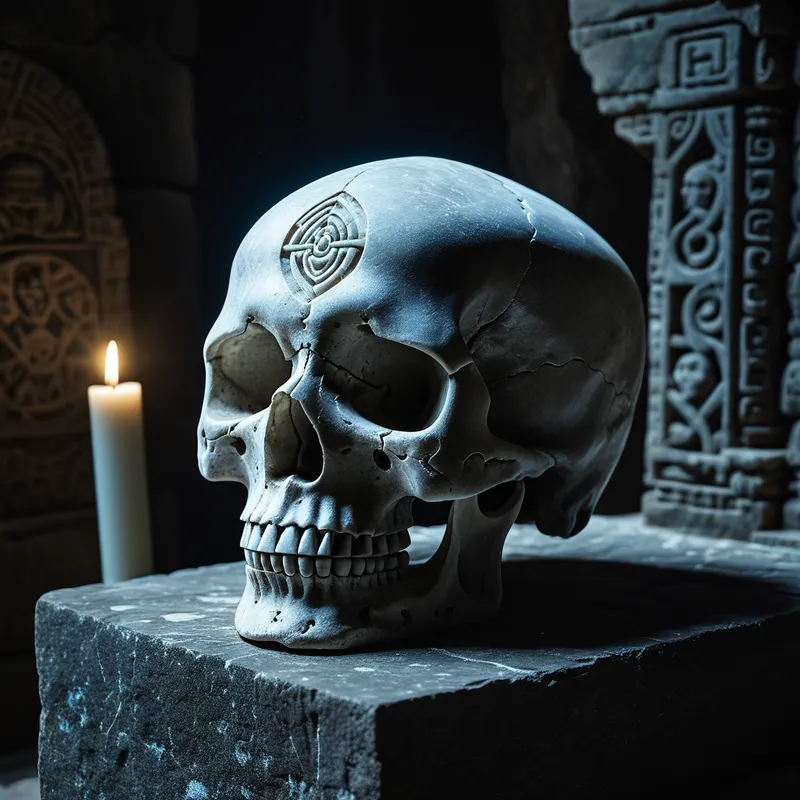
The Crystal Skulls Myth Meaning & Symbolism
A tale of thirteen crystal skulls, repositories of ancestral memory and cosmic knowledge, scattered to be reunited when humanity is ready to remember.
The Tale of The Crystal Skulls
Listen. Before the first city, before the first king, when the world was young and the sky spoke directly to the earth, there was a knowing. This knowing was not held in books or in the mouths of priests, but in silence. It was a memory of the stars, a song of the earth’s bones, a map of time itself. To hold such a thing in a mortal mind was to shatter it. So, the Old Ones did not try to hold it. They sang it into form.
From the heart of the living earth, from the clearest veins of quartz and amethyst, they called forth thirteen skulls. Not as symbols of death, but as vessels of the mind that endures. With breath that was not breath and tools that were not tools, they shaped the unshapable. Each curve of the brow held a law of harmony. Each hollow of the eye socket was a lens to see the weave of fate. The jaw, set in eternal stillness, held the unspoken word of creation.
These were the Skulls of Living Light. Together, placed in a circle under the vault of the night, they would hum. Their song was the history of rains and the genealogy of jaguars. It was the path of the planets and the quiet thoughts of stones. For a time, the people lived in the resonance of this song. They knew when to plant, when to journey, when to speak, and when to be still. There was no separation between the dream of the shaman and the task of the builder.
But the world turns, and cycles end. A shadow grew, not of evil, but of forgetting. A hunger for a simpler, louder truth—the truth of possession, of boundary, of a single voice shouting down the chorus. The song of the skulls became a whisper, then a memory of a whisper. The people began to fear the silent knowledge in the temple.
Knowing the age was turning, the last keepers of the song made a solemn choice. They would not guard the skulls unto destruction. Instead, they would scatter them. With great sorrow and greater hope, they entrusted each skull to a guardian. Some were carried on long journeys over vast seas, hidden in caves at the world’s edge, or buried beneath the roots of great, sleeping trees. Others were given to the keeping of the stars, the deep forests, and the hidden rivers.
As the last skull was taken from the circle, the humming ceased. A profound silence fell. The keepers spoke the prophecy into that silence: “They are apart, so that they may be together again. When the children of the future have walked to the edge of their own knowing, when their hearts yearn for the song they have never heard, the skulls will begin to call to one another. Through many hands, across forgotten paths, they will journey home. And when the thirteen are once more joined in circle, the living light will return. Not to rule, but to remember. And in that remembering, a new world will be dreamed.”
Cultural Origins & Context
The myth of the crystal skulls does not belong to a single, codified tradition. It is a modern mythologem, a powerful story that has woven itself from many threads. Its deepest roots tap into the reverence for skulls as vessels of consciousness and ancestral presence found in Mesoamerican cultures, particularly the Aztec and Maya. For these civilizations, carved stone and crystal skulls were likely ritual objects associated with deities of death and rebirth, like the Aztec Mictlantecuhtli, or used in divinatory practices.
The specific narrative of thirteen skulls of immense antiquity and power, however, emerged primarily in the 20th century, championed by figures like explorer F.A. Mitchell-Hedges and woven into the fabric of New Age and alternative archaeological lore. It functions as a “cosmogonic myth” for a global, syncretic spirituality. It is passed down not around ancient fires, but in books, documentaries, workshops, and online forums. Its tellers are modern seekers, channelers, and storytellers who find in it an echo of a universal longing.
Societally, this myth serves a critical function for a fragmented, information-saturated age. It provides a narrative of hidden wholeness. It suggests that our perceived chaos and disconnection are part of a larger, intentional scattering, and that a process of sacred reunion is not only possible but prophesied. It transforms the anxiety of lost wisdom into the active quest for re-membering.
Symbolic Architecture
The crystal skull is a supreme symbol of the paradox of consciousness: a container of infinite space. The skull represents the mortal, individual mind—the specific vessel of our awareness, bound by time and form. The crystal represents transparency, permanence, and the capacity to hold and transmit light—qualities of the transcendent, impersonal awareness or cosmic mind.
The skull is the chalice of the particular; the crystal is the wine of the universal.
The number thirteen is profoundly alchemical. It is twelve (the number of cosmic order: months, zodiac signs, disciples) plus one—the central, unifying principle. The scattered skulls symbolize the fragmentation of the original, unified field of consciousness into specialized aspects: intellect, intuition, emotion, memory, vision, etc. The prophecy of their reunion is the promise of individuation—not as a solo endeavor, but as a planetary awakening where every reclaimed piece of wisdom contributes to a restored whole.
The myth also elegantly addresses the danger of sacred knowledge. The skulls were scattered to prevent their destruction by a world not ready for their integrated song. This reflects the psychological truth that insight received before the ego is prepared to integrate it can lead to inflation or psychosis. Wisdom must be sought, not merely given.
The Dreamer’s Resonance
When the motif of the crystal skull appears in a modern dream, it often signals a profound encounter with the collective unconscious. It is not a dream of personal memory, but of ancestral or species memory.
To dream of finding a crystal skull suggests the dreamer is on the cusp of retrieving a lost piece of innate, transpersonal knowledge. There is often a somatic quality—a feeling of crystalline clarity, a humming vibration, or a cool, smooth solidity. The dreamer may feel they are being “downloaded” with information they cannot yet rationally articulate.
To dream of a skull that is fractured or cloudy indicates a blockage in this process. The psyche knows a truth, but fear, intellectual over-analysis, or cultural conditioning is preventing its clear reception. The dream is highlighting the need for inner purification—the clearing of the “crystal” of one’s own perception.
Dreaming of the reunion of multiple skulls is a powerful symbol of psychic integration. It suggests disparate parts of the self—perhaps a logical mind, a buried intuition, a creative spirit, and a wounded heart—are finally coming into communication, preparing to form a new, more complete and resonant whole.
Alchemical Translation
The myth of the crystal skulls is a perfect map for the alchemical Magnum Opus applied to the modern soul. The process begins with Nigredo—the blackening, the scattering. This is our contemporary condition: feeling spiritually orphaned, intellectually fragmented, and cut off from ancestral roots. We are the scattered skulls.
The call to reunite them is the Albedo—the whitening. This is the arduous work of seeking. It is the study, the meditation, the therapy, the travel, the humble piecing together of wisdom from diverse sources (science, art, indigenous tradition, personal shadow-work). Each “skull” we recover is a reclaimed complex: healing our relationship with the body (one skull), reconciling with our inner child (another), mastering a skill, or understanding a deep archetypal pattern.
The quest for the skulls is not about acquiring external artifacts, but about recognizing the latent artifacts of wholeness within the architecture of the self.
Finally, the reunion ceremony is the Rubedo—the reddening, the culmination. This is not a one-time event, but a state of being achieved when the seeker realizes they are the temple. The integrated knowledge—the reunited song—does not manifest as omniscience, but as a quality of presence. Decisions arise from a deeper harmony. Creativity flows from a syncretic well. One becomes a living node in the network of awakening, a clear vessel (a crystal skull) through which the “living light” of conscious, compassionate awareness can shine into the world. The prophecy fulfills itself not in a grand spectacle, but in the quiet, daily act of remembering who, and what, we truly are.
Associated Symbols
Explore related symbols from the CaleaDream lexicon: